Govt spends Rs 4.18 to make one Rs 2,000 note, Rs 2.57 for one Rs 500 note: RTI
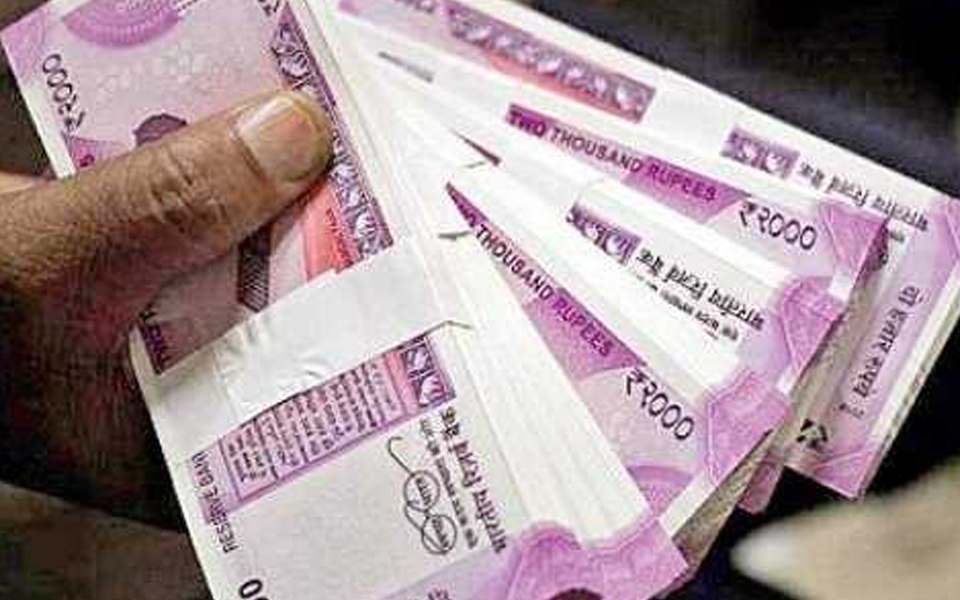
New Delhi : When it comes to spending our money, we tend to weigh in the value against the want and utility of the product. It is a widely adopted manoeuvre. However, when it comes to money itself, we are mostly in the dark about its cost. For instance, do you know how costly it is to produce one Rs 10 note? Does it cost more or less than its value?
India Today tried to find out the answer. It filed a RTI and asked Bhartiya Reserve Bank Note Mudran (P) Limited the cost of printing different denomination notes. India Today asked how much money does the government spend on printing different notes.
Turns out that the Government of India spends Rs 4.18 on each Rs 2,000 note. It spends Rs 2.57 on every Rs 500 note, Rs 1.51 for every Rs 100 note and Rs 1.01 for every Rs 10 note. The Rs 20 note is, in fact, cheaper by a paisa than the Rs 10 note.
As per calculations, the government spends Rs 1,010 for a thousand Rs 10 and Rs 50 notes, Rs 1,000 for a thousand Rs 20 notes, Rs 1,510 per thousand Rs 100 notes, Rs 2,570 for a thousand Rs 500 notes and Rs 4,180 per thousand Rs 2,000 notes.
India Today also found the cost of printing the old Rs 500 and Rs 1,000 notes that were demonetised on November 8, 2016.
The cost of printing the old Rs 500 note was Rs 3.09 which works out to be more expensive by 52 paisa than its current counterpart. The cost of printing the old Rs 1,000 note was Rs 3.54 which means that it was cheaper by 64 paisa than the current Rs 2,000 note.
Printing a thousand Rs 500 notes of the demonetised currency cost the government Rs 3,090, while they spent Rs 3,540 per thousand Rs 1,000 notes.
courtesy : businesstoday.in
Let the Truth be known. If you read VB and like VB, please be a VB Supporter and Help us deliver the Truth to one and all.
26 killed, 61 injured in blast at fireworks factory in China
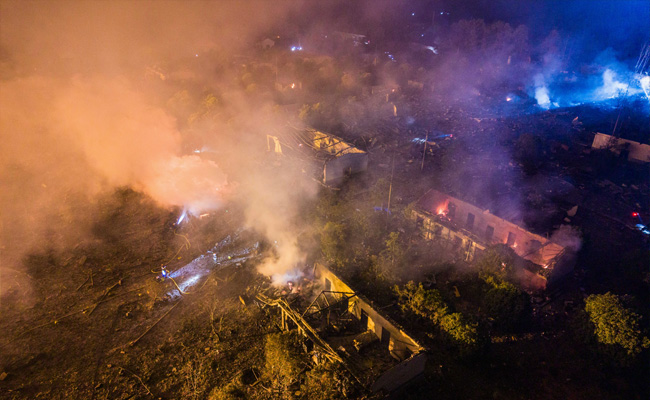
Beijing (PTI): At least 26 people were killed and 61 others injured in a massive explosion at a fireworks factory in China's Hunan province, officials said on Tuesday.
The explosion occurred on Monday afternoon at the plant operated by the Huasheng fireworks manufacturing and display company in Liuyang, a county-level city under Changsha, the provincial capital.
Videos circulating on Chinese social media showed massive destruction of property spanning several kilometres.
ALSO READ: Will of people supreme, says Mahua Moitra after BJP's landslide victory in Bengal
More than 480 rescuers, organised into five teams, have been deployed for relief operations, with three rescue robots pressed into service.
Officials said 26 people were killed and 61 others were injured. The injured have been rushed to hospitals for treatment, while a second round of search operations is underway.
China is a leading manufacturer and exporter of fireworks.
As the explosion site is located near two black powder warehouses, the rescuers have evacuated nearby residents and set up a buffer zone to prevent a secondary accident, the state-run Xinhua news agency reported.
The Ministry of Emergency Management has dispatched experts to the scene to guide rescue efforts.
The person in charge of the company has been detained by police and the cause of the accident is being investigated, the report said.