Govt to facilitate return of Indians from abroad from May 7
New Delhi: The Union government will facilitate the return of Indians stranded abroad and the process will begin from May 7 in a phased manner.
In a statement, the Home Ministry said only asymptomatic people would be allowed to travel and it would be arranged by aircraft and naval ships, and the facility will be available on a payment basis.
After their arrival in India, medical examination will be conducted on everyone and they will be subsequently put under quarantine for 14 days, either in a hospital or in an institutional facility, the ministry said.
"The government of India will be facilitating the return of Indian nationals stranded abroad on compelling grounds in a phased manner. The travel would begin from May 7," it said.
The government has prepared the standard operating protocol (SOP), and the Indian embassies and high commissions are preparing a list of distressed citizens, according to the ministry.
"This facility would be made available on payment-basis. Non-scheduled commercial flights would be arranged for air travel," it said.
Medical screening of passengers will be done before taking the flight and only asymptomatic passengers will be allowed to travel. During the journey, they will have to follow the protocols, such as the health protocols issued by the Health Ministry and the Civil Aviation Ministry, it said.
"On reaching the destination, everyone would have to register on the Arogya Setu app," the Home Ministry said.
"Everyone would be medically screened. After scrutiny, they would be quarantined for 14 days, either in a hospital or in an institutional quarantine on payment-basis, by the concerned state government," it said.
COVID-19 tests will be done after 14 days and further action would be taken according to health protocols, the statement said.
The Ministries of External Affairs and Civil Aviation will soon share detailed information about it through their websites, it said.
"The state governments are being advised to make arrangements, including for testing, quarantine and onward movement of the returning Indians in their respective states," the ministry said.
India banned arrival of international flights beginning March 23. The 21-day lockdown was first announced by Prime Minister Narendra Modi on March 24 in a bid to combat the the novel coronavirus pandemic. It was first extended till May 3 and then again till May 17.
Let the Truth be known. If you read VB and like VB, please be a VB Supporter and Help us deliver the Truth to one and all.
Massive turnout in assembly polls across states, women voters outnumber men: EC data
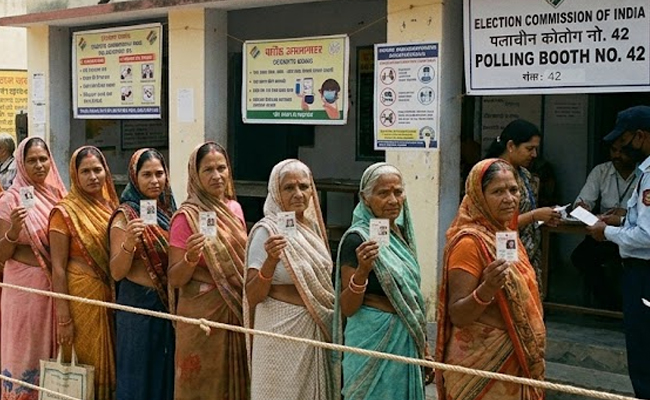
New Delhi (PTI): The recently-concluded assembly elections witnessed exceptionally high voter participation across states, with women voters outnumbering men in turnout percentages, according to Election Commission data.
West Bengal recorded the highest voter turnout among states, with 93.71 per cent polling in 293 constituencies where counting has been completed. The state saw over 6.38 crore votes cast, including postal ballots, against a total of more than 6.81 crore electors.
Women voters recorded a turnout of 93.8 per cent in the West Bengal Assembly polls, slightly higher than the 92.06 per cent participation among men.
The data for West Bengal does not include the figures for the Falta assembly constituency, which is scheduled for repolling.
Tamil Nadu registered an 85.01 per cent turnout, with nearly 4.8 crore votes polled from an electorate of 5.74 crore. Women voters recorded a turnout of 86.2 per cent, higher than the 83.77 per cent among men.
Assam also witnessed robust participation, with the final turnout touching 85.74 per cent. More than 2.15 crore votes were cast in the state, while female turnout at 86.53 per cent marginally exceeded the 84.95 per cent recorded among male voters.
Kerala registered a turnout of 78.11 per cent, with over 2.12 crore votes polled. Female voter participation stood at 81.17 per cent against 74.9 per cent among men.
Puducherry recorded a turnout of 89.82 per cent, with women voters again leading participation at 91.39 per cent. More than 8.5 lakh votes were polled in the Union territory.
Yet, women's representation among elected candidates remained modest.
Tamil Nadu elected 23 women MLAs (9.83 per cent) out of 234 members, West Bengal elected 37 women legislators (12.62 per cent) out of 293, while Kerala returned only 11 women MLAs (7.85 per cent) in the 140-member House.
Only two third-gender candidates contested the elections - one each from Tamil Nadu and Kerala, and both lost, forfeiting their deposits.
The elections also reflected extensive electoral mobilisation infrastructure. West Bengal had the highest number of polling stations at 85,092, followed by Tamil Nadu with 75,064 and Assam with 31,490.
In terms of candidates, Tamil Nadu saw the largest contest with 4,023 candidates in the fray across 234 constituencies, averaging 17 candidates per seat and peaking at 79 contestants in one constituency.
West Bengal pitted 2,920 candidates for 293 constituencies, while Kerala had the fewest contestants among the major states, with 883 candidates for 140 seats.
The data also showed relatively low NOTA votes across states. Tamil Nadu recorded the lowest NOTA share at 0.4 per cent of total votes polled, while Assam recorded the highest at 1.23 per cent. In West Bengal, 0.78 per cent of the total votes polled were NOTA, while it 0.77 per cent and 0.57 per cent of the electorate opted for None of the Above (NOTA) in Puducherry and Kerala, respectively.