Govt to play enabler not handler, India never had more decisive government: PM Modi
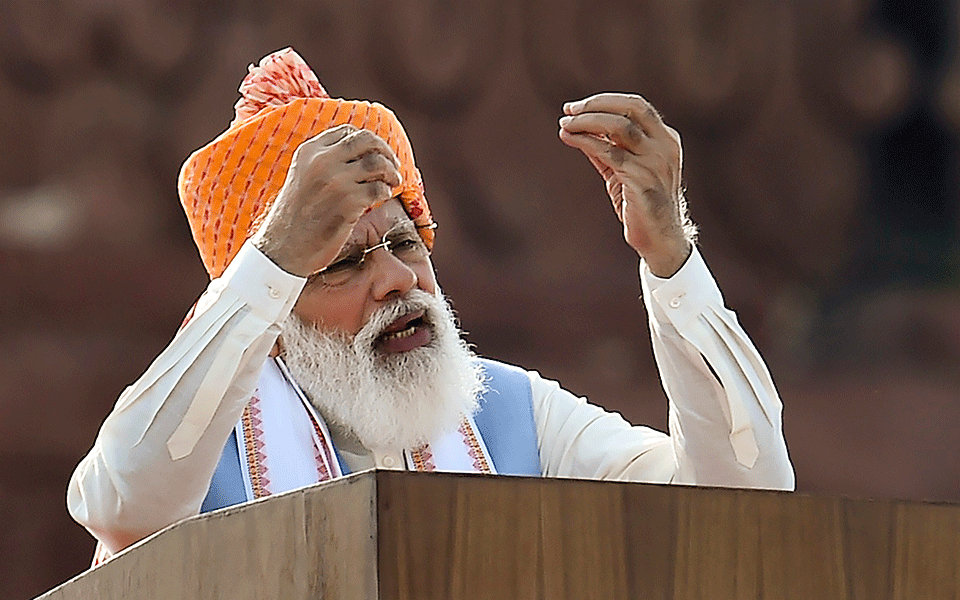
New Delhi(PTI): Prime Minister Narendra Modi on Monday cited his dispensation's push for wide-ranging reforms, including the privatisation of Air India, to assert that the country never had a more decisive government .
Launching the Indian Space Association (ISpA), an industry body aspiring to be the voice of the country's space sector, Modi noted that fields like mining, coal, defence and space have been opened to private players, and said his government's clear policy about public sector enterprises is to open those to private industry where its presence is not required.
While opening a host of sectors, the government has built a regulatory environment in which priority has been given to national interest as well as the interests of different stakeholders, he said.
The prime minister referred to the successful bid to privatise loss-making government-run airline Air India, and said this shows his dispensation's commitment and seriousness.
An unshakable faith in India's capabilities and the belief that it is not an iota less than any other country in the world are driving its approach and reforms in the 21st century, Modi told the audience after members of the space sector shared their views.
It is the government's responsibility to remove any obstacle in that direction, and the government is leaving no stone unturned for this. India never had a more decisive government, he said, adding that the reforms related to the space sector and technology are a part of these efforts.
Space sector, he noted, was once synonymous with the government sector but his government has worked to change this mindset.
He said this is not a time for linear innovations for the country but for exponential innovation and this, Modi added, will be made possible when the government plays the role of an enabler and not handler.
That is why it has been sharing expertise in sectors ranging from defence to space, he noted.
He said India is seeing reforms on such a wide scale because its vision is clear, which is about having an 'Aatmanirbhar Bharat'.
This is not merely a vision but a well-though, planned and integrated economic strategy too, he said, adding that it is aimed at making India a powerhouse of global manufacturing.
Modi said his government's approach to reforms in the space sector is based on four pillars; allowing the private sector freedom of innovation, government playing the enabler's role, preparing youngsters for the future and envisioning the sector as a resource to help the common man's development.
He said India is among the few countries which has end-to-end technology in the space sector and called upon the industry to work to make the country a part of supply chain for the end-to-end space system.
As a partner, the government has been helping industry, young innovators, start-ups and will continue doing so, he added.
The prime minister observed that a tendency of trying to rule the space and the space sector divided the world in the 20th century, and said India will have to ensure in the 21st century that the field plays an important role in uniting and connecting the world.
The space sector is a major medium for the progress of 130 crore countrymen, Modi said, adding the field for India means better mapping, imaging, and connectivity facilities to help people.
The space sector also means better speed from shipment to delivery for entrepreneurs, this also means better security and income for fishermen and better forecast of natural calamities, he added.
During the last seven years, space technology has been converted into a tool of last-mile delivery and providing leakage-free and transparent governance, he said.
The prime minister emphasised the importance of making technology accessible to everyone.
Giving an example of the use of digital technology, he said India is among the top digital economies today because it could make the power of data accessible to the poorest of the poor.
He also expressed confidence that through the suggestions of all stakeholders a better Spacecom policy and Remote Sensing Policy, which is in the final stages, will soon emerge.
Noting that it is also the International Girl Child Day on Monday, Modi expressed hope that women will play a bigger role in the space field in the coming days, and said the sector will have an important contribution in shaping India's journey when it celebrates its 100th independence day in 2047.
The ISpA will undertake policy advocacy and engage with all stakeholders in the Indian space domain, including the government and its agencies, the government has said.
Echoing the prime minister's vision of 'Aatmanirbhar Bharat', the ISpA will help in making India self-reliant, technologically advanced and a leading player in the space arena, it added.
The ISpA is represented by leading home grown and global corporations with advanced capabilities in space and satellite technologies. Its founding members include Larsen & Toubro, Nelco (Tata Group), OneWeb, Bharti Airtel, Mapmyindia, Walchandnagar Industries and Ananth Technology Ltd.
Other core members include Godrej, Hughes India, Azista-BST Aerospace Private Ltd, BEL, Centum Electronics and Maxar India.
Let the Truth be known. If you read VB and like VB, please be a VB Supporter and Help us deliver the Truth to one and all.
BJP has history of ‘contradictory alliances’, says BK Hariprasad
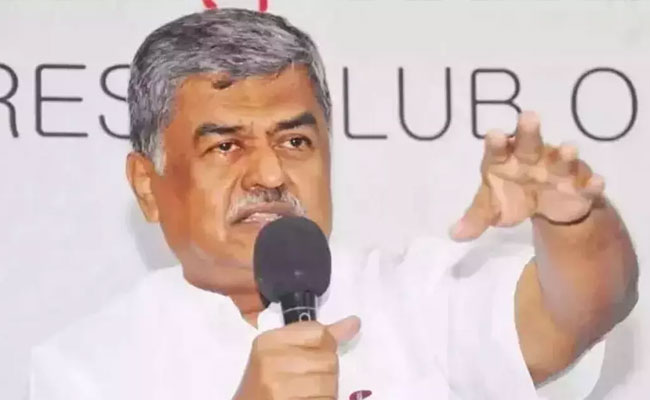
Bengaluru: Congress MLC B. K. Hariprasad has launched a sharp attack on the BJP, accusing the party of hypocrisy over its criticism of alliance politics in Tamil Nadu.
In a post on X on Friday, Hariprasad said BJP leader B. L. Santhosh criticising the Congress party’s alliance politics in Tamil Nadu was “not just laughable, but the height of political contradiction.”
He said the Congress has always joined hands with like-minded parties to protect secular and democratic values in the country.
Hariprasad questioned the BJP over several of its past and present alliances across the country. Referring to Jammu and Kashmir, Punjab, Tripura, Bihar and Maharashtra, he accused the BJP of sharing power with parties it had earlier criticised.
He alleged that the BJP had aligned with separatist and corruption-linked political forces in different states for political gains.
“The BJP, which speaks against alliances today, should first look at its own political history,” he said, adding that the party’s record was full of “contradictions and changing stands.”
Hariprasad also accused the BJP of using central agencies such as the Enforcement Directorate, Income Tax Department and CBI as political tools to target opposition leaders, topple governments and influence electoral mandates.
He further claimed that the people of Tamil Nadu had strongly rejected the BJP and its ideology in the recent election.
“Congress forms alliances to protect the Constitution, secularism and national unity, while the BJP enters into alliances only for power,” he said.