Govt to set up daycare cancer centres in all district hospitals over next 3 years: Sitharaman

New Delhi (PTI): The government will facilitate setting up of daycare cancer centres in all district hospitals over the next three years and 200 of these will be established in 2025-26, Union Finance Minister Nirmala Sitharaman announced on Saturday.
Presenting the 2025-26 Union Budget, her record eighth, Sitharaman said 10,000 additional seats will be added in medical colleges and hospitals next year towards the goal of adding 75,000 seats in the next five years.
She further announced that gig workers will be provided healthcare facilities under PM Jan Aarogya Yojana (PM-JAY) and this measure is likely to assist nearly 1 crore workers.
The government will facilitate setting up of daycare cancer centres in all district hospitals in the next three years, Sitharaman said.
She said, "200 centres will be established in 2025-26 itself."
To provide relief to patients, particularly those suffering from cancer, rare diseases and other severe chronic diseases, 36 lifesaving drugs and medicines are proposed to be added to the list of medicines fully exempted from basic customs duty (BCD).
"I also propose to add six lifesaving medicines to the list attracting concessional customs duty of 5 per cent. Full exemption and concessional duty will also respectively apply on the bulk drugs for manufacture of the above," the minister said.
Specified drugs and medicines under Patient Assistance Programmes run by pharmaceutical companies are fully exempt from BCD, provided the medicines are supplied free of cost to patients, she said.
"I propose to add 37 more medicines along with 13 new patient assistance programmes," she said.
On adding seats in medical colleges and hospitals, Sitharaman said, "Our government has added almost 1.1 lakh undergraduate and postgraduate medical education seats in 10 years, an increase of 130 per cent."
"In the next year, 10,000 additional seats will be added in medical colleges and hospitals towards the goal of adding 75,000 seats in the next five years," she said.
She said medical tourism and 'Heal in India' will be promoted in partnership with the private sector along with capacity building and easier visa norms.
Also, broadband connectivity will be provided to all government secondary schools and primary healthcare centres, the minister said.
Let the Truth be known. If you read VB and like VB, please be a VB Supporter and Help us deliver the Truth to one and all.
Trump says EU has until July 4 to approve last year's trade deal or it will face higher tariffs
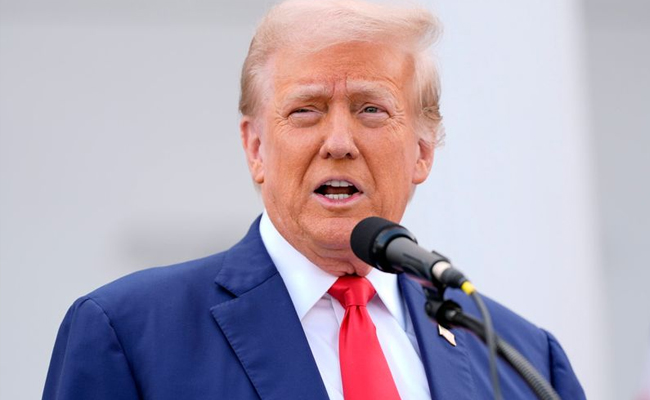
Washington (AP): President Donald Trump has said in a social media post that goods from the European Union would face higher tariff rates if the 27-member bloc fails to approve last year's trade framework by July 4.
The announcement on Thursday appeared to be a deadline extension after the president said last Friday that EU autos would face a higher 25 per cent tariff starting this week. Trump made the updated announcement after what he described as a "great call" with European Commission President Ursula von der Leyen.
Still, the US president was displeased that the European Parliament had yet to finalize the trade arrangement reached last year, which was further complicated in February by the US Supreme Court ruling that Trump lacked the legal authority to declare an economic emergency to impose the initial tariffs used to pressure the EU into talks.
"A promise was made that the EU would deliver their side of the Deal and, as per Agreement, cut their Tariffs to ZERO!" Trump posted. "I agreed to give her until our Country's 250th Birthday or, unfortunately, their Tariffs would immediately jump to much higher levels."
It was unclear from the post whether Trump was implying that the tariff rates would jump on all EU goods or the increase would only apply to autos.
His latest statement indicates he might be backing away from his earlier threat on EU autos by giving the European Parliament several more weeks to approve the agreement.
Under the original terms of the framework, the US would charge a 15 per cent tax on most goods imported from the EU.
But since the Supreme Court ruling, the administration has levied a 10 per cent tariff while investigating trade imbalances and national security issues, aiming to put in new tariffs to make up for lost revenues.