
Govt wanted Kashmir like rest of India, ended up making India like Kashmir: Yashwant Sinha
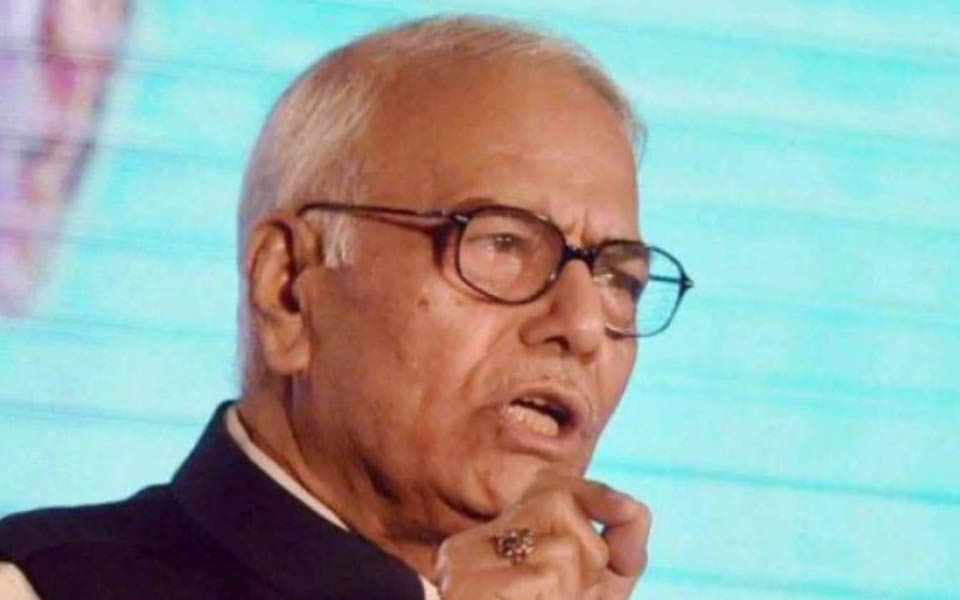
New Delhi, Jan 6: The government had claimed of making Kashmir like the rest of India but has ended up doing otherwise, former Union Minister Yashwant Sinha said on Monday, as he slammed the Centre over what he called was its policy of "suppression".
Sinha, who had quit the BJP after being sidelined in the party he served for more than two decades, made the remarks while addressing the anti-citizenship law protestors outside Jamia Millia Islamia here.
He also said the attack on JNU students and teachers on Sunday had left no difference in "government goons and government police", accusing police of "helping" the anti-social elements and not the innocent.
Sinha said he was part of a five-member group which had visited Kashmir amid restrictions and shutdowns there around four years ago and after talking to locals and stakeholders drafted a report for the central government with a proposal for dialogue to resolve the situation.
"Here a top level official told me that I was suggesting talks which is not the government's policy. We have a doctrine of state -- a method and ideology of running the government -- which was that anybody opposing us would be suppressed. That is the policy being followed and will be followed in Kashmir," the 82-year-old leader said.
He said he was disappointed by the government's approach then and last year also tried to go to Kashmir but was once "sent back" and on another occasion "confined to a hotel room".
"Recently when they abrogated Articles 370 and 35A to remove special status of Jammu and Kashmir and divided it into two union territories it was that same doctrine of state at work -- suppression of dissent," he claimed.
Sinha said, "Those in the government had claimed that we will make Kashmir like the rest of India. Today, after five months, Kashmir has not become like any other part of India but the rest of India has become like Kashmir."
He said if one were to visit Shopian, Baramulla or Pulwama in Kashmir, he would witness the heavy presence of security forces and the situation was now similar in Delhi where police personnel are deployed in large numbers near colleges.
"Wherever you look around, it's a cycle of suppression. Earlier they would use police to suppress voices but now they are also using goons to this effect. Whatever happened in JNU yesterday, shows this very tie-up ... (Sarkari police aur sarkari gundon ka jo farq tha wo sab khatam ho gaya) The difference between government police and government goons is no longer there," Sinha said.
"And the police here helps the goons and not the innocent people. It's a strange situation across the country," he added.
Thousands of people, including women and children, are on a protest outside Jamia Millia Islamia and nearby Shaheen Bagh for over 20 days to oppose the Citizenship Amendment Act (CAA) and the National Register of Citizen (NRC).
Besides Delhi, protests have been witnessed across the country over the contentious law and have at several places led to clashes including Uttar Pradesh, where more than 20 people have died.
According to the amended law, members of Hindu, Sikh, Buddhist, Jain, Parsi and Christian communities, who have come from Pakistan, Bangladesh and Afghanistan till December 31, 2014 and facing religious persecution there, will not be treated as illegal immigrants but given Indian citizenship. The law excludes Muslims.
Let the Truth be known. If you read VB and like VB, please be a VB Supporter and Help us deliver the Truth to one and all.
Attack on Constitution defeated, says Rahul Gandhi as bill to amend women’s quota law fails LS test
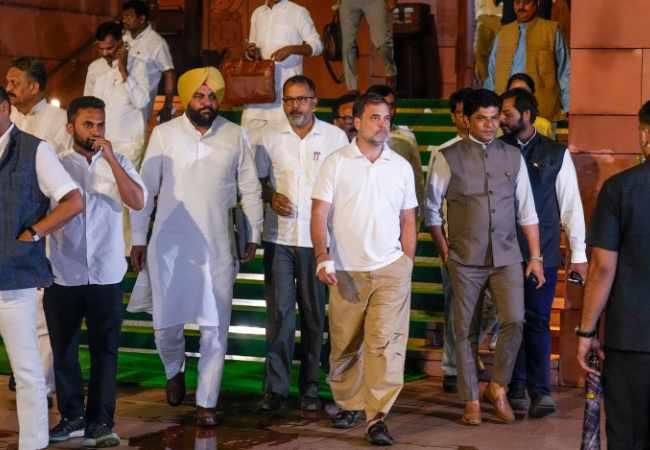
New Delhi (PTI): Congress leader Rahul Gandhi on Friday said the Constitution amendment bill brought by the government to tweak the women’s quota law was an attack on the Constitution, which the opposition has defeated.
The bill was not aimed at providing women reservation, but an attempt to change India's electoral structure, the leader of opposition in Lok Sabha said.
Talking to reporters after the Constitution amendment bill failed to secure two-third majority in the Lok Sabha, Gandhi also said that if the prime minister is serious in providing women reservation in Parliament, he should bring the 2023 law and the opposition would extend its support outrightly.
"As I have said, it was an attack on the Constitution and we defeated that,” he said outside Parliament.
"We clearly said that this was not a women's bill, but an attempt to change India's electoral structure which we have stopped," he added.
In a direct message to Prime Minister Narendra Modi, Gandhi said if he wants the women's bill to be implemented, he should bring the 2023 law and implement it from today.
"The entire opposition will support you and ensure women's reservation from today itself," he said.
Later, in a post on X in Hindi, Gandhi said, "The amendment bill has fallen. They used an unconstitutional trick in the name of women to break the Constitution."
"India has seen it. INDIA has stopped it. Hail the Constitution," the Congress leader said.
Congress general secretary Priyanka Gandhi Vadra said the manner in which the government sought to link the bill to delimitation can never be accepted.
"The way the Modi government presented women's reservation made its passage impossible. The BJP government linked women's reservation to delimitation and the old census, in which the OBC category was not included.
"We can never agree to this. What happened today is a huge victory for the country's democracy and its integrity," she told reporters.
Asked about the BJP leaders accusing the Congress of being anti-women, Priyanka said, "Those who did nothing in Hathras, those who did nothing in Unnao, those who did nothing in Manipur and those who did nothing for women wrestlers are now talking about anti-woman mindset?"
The Constitution amendment bill to implement 33 per cent reservation for women in legislatures in 2029 and increase the number of Lok Sabha seats was defeated in the Lower House on Friday.
While 298 members voted in support of the bill, 230 MPs voted against it. Out of 528 members who voted, the bill required 352 votes for a two-third majority.
The bill proposed to increase the number of Lok Sabha seats to a maximum of 850 from the current 543 to "operationalise" the women's reservation law before the 2029 parliamentary polls, following a delimitation exercise based on the 2011 Census.
Seats were also to be increased in states and UT assemblies to accommodate 33 per cent reservation for women.
_vb_33.jpeg)
_vb_18.jpeg)