TV, refrigerator, washing machines to get cheaper, GST rate cut on 50 items
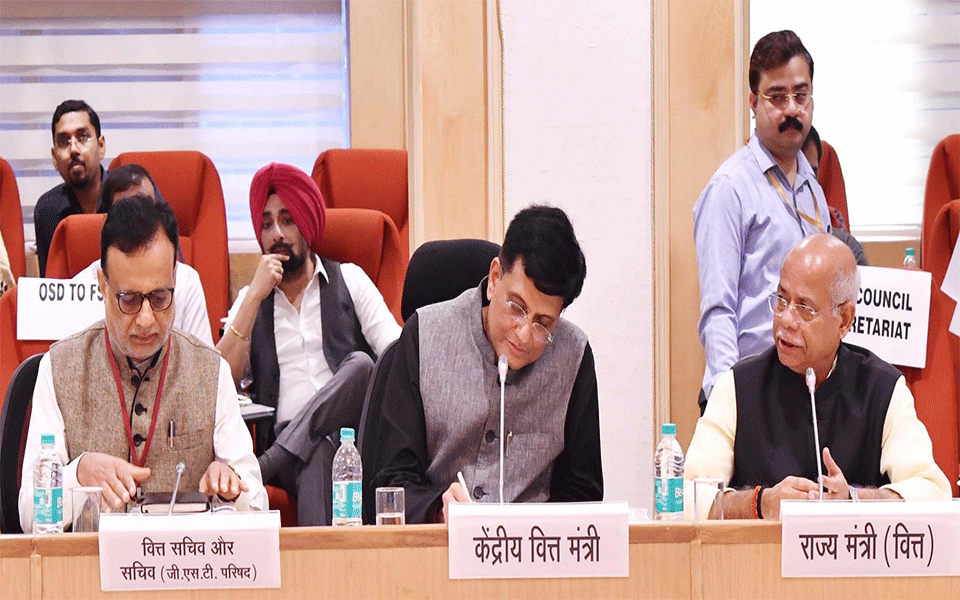
New Delhi, July 21 : In a relief for common man, the GST Council on Saturday reduced tax rates on over 50 items including refrigerators, washing macines and small televisions, which would now be taxed at 18 per cent, down from the current 28 per cent.
Apart of bringing down rates, the Goods and Services Tax (GST) Council also exempted GST on sanitary napkins, rakhis, fortified milk and idols of deities made of stone, marble and wood.
The changes would come into effect across the country from July 27 onward, Finance Minister Piyush Goyal told media after the 28th meeting of the GST Council.
"Refrigerators, small televisions, of upto 25 inches, lithium ion batteries, vacuum cleaners, domestic electrical appliances, such as food grinders, mixers....storage water heaters, immersion heaters, hair dryers, hand driers, electric smoothing irons," among others have been brought to the 18 per cent slab," Goyal said.
The council also gave a major relief to the hotel industry by providing that tax rate shall be based on transaction value instead of declared tariff.
Earlier, there was a lack of clarity on the issue causing a lot of trouble for consumers booking hotels with 'declared tariffs' of Rs 7,500 and above which incurred 28 per cent GST.
While hotels with tariff below Rs 1,000 are exempted from GST, those with tariff between Rs 1,000-2,500 are taxed at 12 per cent, those between Rs 2,500-7,500 at 18 per cent, and above Rs 7,500 at 28 per cent.
However, it often happened that hotels offered discounts and hence the actual transaction cost would be much lower than the declared cost, but tax would still be charged at the declared cost.
Another significant decision the council made was regarding easing of return filing procedure by approving two new simplified forms called 'Sugam' and 'Sahaj', the minister said.
Also, enterprises with annual turnover of upto Rs 5 crore would have to file quarterly returns instead of the current monthly filing, although they would continue to pay tax on a monthly basis.
However, the implementation of the revamped return filing process would take some time as corresponding changes would have to be made into the GST network, the minister clarified.
The council also deferred the implementation of reverse charge mechanism by another year and now it will come into force from October next year.
The minister further informed that the council would have a special meeting on August 4 to address concern of small and medium enterprises.
Among other tax-reduction decisions, Goyal said, tax rate on handicraft items such as handbags, pouches and purses, jewellery box, wooden frames of paintings and photographs among others have been brought under the 12 per cent slab, from 18 per cent.
GST on handmade carpets and handmade textile floor coverings has been reduced from 12 per cent to 5 per cent.
The tax rate on ethanol, which is used in the blending of petrol and diesel also has been brought down to 5 per cent from 18 per cent.
During the meeting, the council also made certain amendments to the GST Act including raising the upper limit of turnover for opting for composition scheme from Rs 1 crore to Rs 1.5 crore.
It also approved an amendment which will enable taxpayers to opt for multiple registrations within a state in respect of multiple places of business located within the same state.
Let the Truth be known. If you read VB and like VB, please be a VB Supporter and Help us deliver the Truth to one and all.
Karnataka govt directs municipal corps to regulate, prohibit pigeon feeding

Bengaluru (PTI): The Karnataka government has issued directions to municipal corporations across the state to regulate and prohibit feeding pigeons in public places, citing serious public health concerns.
Deputy Secretary to Government V Lakshmikanth has written to the Urban Development Department requesting it to issue directions to the Greater Bengaluru Authority (GBA) and all municipal corporations to take immediate steps to implement the measures.
In an official note dated December 16 issued by the Health and Family Welfare Department and released to the media on Wednesday, the department said uncontrolled feeding of pigeons in public places has resulted in large congregations of birds, excessive droppings and serious health concerns, particularly respiratory illnesses linked to prolonged exposure to pigeon droppings and feathers such as hypersensitivity pneumonitis and other lung diseases.
ALSO READ: Chinese GPS tracker found on seagull near Karwar Coast
"The commissioner, the Greater Bengaluru Authority and the Commissioners and chief officers of other municipal corporations shall take necessary action to mitigate the causes of dangerous disease spread by pigeon and enforce specified guidelines in their respective jurisdiction," the note said.
According to the department, these include a prohibition on feeding pigeons or causing pigeons to be fed in areas where it may cause nuisance or pose a health hazard to the public. Pigeon feeding shall be permitted only in designated areas in a controlled manner, subject to certain conditions.
"The designated areas may be selected in consultation with stakeholders. The responsibility for upkeep of the designated areas and compliance to the directions shall be taken up by some charitable organisation or an NGO. The feeding in designated areas shall be permitted only for some limited hours in the day," it said.
The note further stated that authorised officers of local authorities shall issue on-the-spot warnings and may impose fines for violation of the order, or lodge complaints to prosecute offenders under Sections 271 (Negligent act likely to spread infection of disease dangerous to life) and 272 (Malignant act likely to spread infection of disease dangerous to life) of the Bharatiya Nyaya Sanhita.
It also directed local authorities to conduct public awareness campaigns, including the display of signboards, banners and digital messages, explaining the health hazards associated with pigeon droppings and feathers, the content of the regulatory directions and penalties for violations, and alternative humane methods of bird conservation that do not endanger public health.