Gujarat Assembly passes resolution against BBC for documentary on 2002 riots
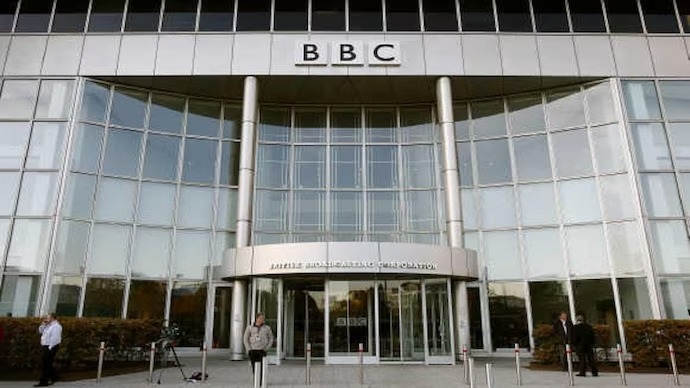
Gandhinagar, Mar 10: The Gujarat Assembly on Friday passed a resolution requesting the Centre to take strict action against BBC for tarnishing the image and popularity of Prime Minister Narendra Modi with its documentary on the 2002 riots in the state.
The controversial two-part series by the British Broadcasting Corporation titled 'India: The Modi Question' misrepresents the events of 2002 in a malicious and low-level attempt to tarnish India's image globally, Bharatiya Janata Party MLA Vipul Patel said in the House while moving the resolution.
The documentary claims to have probed certain aspects of the riots, which took place after the Godhra train burning incident, when Modi was Gujarat chief minister.
The documentary was banned in India soon after its release.
Patel's resolution was supported by BJP MLAs Manisha Vakil, Amit Thaker, Dhavalsinh Zala and minister Harsh Sanghavi.
It was passed by voice vote in the absence of Congress MLAs who were expelled from the House earlier in the day.
After passing the resolution unanimously, Speaker Shanker Chaudhary said the attempt by BBC is "reprehensible" and is "condemned vehemently," adding the House passed the resolution to send its message to the Centre.
"India is a democratic country and freedom of expression is at the core of its Constitution, but that does not mean a news media can act by abusing such freedom," said Patel while moving the private-member resolution in the second sitting of the House.
"If someone behaves or acts like this (BBC), then it cannot be taken lightly. BBC is losing its credibility and seems to be working with some hidden agenda against India and the Indian government. Hence, this House requests the Central government to take strict action against the mind-boggling findings shown in the BBC documentary," Patel said in the Assembly.
Through the documentary, there is a deliberate attempt to "tarnish the image and popularity of Prime Minister Narendra Modi" with an agenda to affect the country's intention to find top place globally, Patel said.
He claimed opposition parties in other countries support the government during such times, but this is not the case in India, which allowed international organisations like the BBC to get the strength to carry out activities against the country.
The Nanavati-Shah Commission concluded after thorough investigation the burning of coaches S6 and 7 of Sabarmati Express at Godhra on February 27, 2002 was a premeditated conspiracy, and that the state-wide riots that followed were spontaneous, Patel said.
The Nanavati-Shah Commission found no evidence the state government, religious organization, or political party played any role in the riots, and attempts to make the then chief minister (Modi) and officials responsible have also failed in the courts, Patel asserted.
Supporting the resolution, BJP MLA Vakil said the intention of the documentary was to tarnish India's global image, adding Modi's life has been a journey of courage and compassion.
As the chief minister and prime minister, he has become the most popular world leader, she said.
On the 2002 riots, she said certain NGOs and activists conspired to defame the Gujarat government and wanted to damage Modi's reputation, adding there was a larger political conspiracy of destabilising the state government by hook or crook.
Vakil referred to the Supreme Court verdict on the Zakia Jafri case giving clean chit to Modi and claimed the BBC documentary was "mere international propaganda which is totally biased and showcases the colonial mindset".
Supporting the resolution, Thaker said Modi is not a question but a solution for various issues plaguing the world today, such as climate change and COVID-19 pandemic, etc.
The BBC is in the habit of making controversial documentaries on subjects in India, Thaker alleged.
He also questioned the timing of the documentary by connecting it with the conclusion of Congress 'Bharat Jodo Yatra' led by Rahul Gandhi.
Gujarat Home Minister Harsh Sanghavi said the documentary was not just against Modi but against 135 crore citizens of the country.
"The resolution brought by Vipul Patel for strict action is historic. ..Is it Modi's fault to realise the dream of making Gujarat a riot-free state? Many forces worked to ensure Gujarat does not get a stable government," Sangahvi said in his speech in the House.
He said "so-called intellectuals" started hurling one allegation after another on Modi after he took over as the prime minister.
"As 2024 (Lok Sabha polls) approaches, they (opponents) have no other issue against Modi. They used BBC to make a documentary," Sanghavi said.
He also criticised social activist Teesta Setalvad and said "truths regarding her have not been shown in any documentary".
Sanghavi also quoted "important people" who have commented and criticised the BBC documentary such as the Indian foreign ministry spokesperson, British parliamentarian Bob Blackman, and former BBC head Mark Tully.
The Gujarat minister compared the BBC documentary to the "toolkit" conspiring against India, adding certain sections of the media suffered from "Modi phobia".
Let the Truth be known. If you read VB and like VB, please be a VB Supporter and Help us deliver the Truth to one and all.
Choose faith or future: BJP alleges 'second-class treatment' of Hindus in K'natka CET row
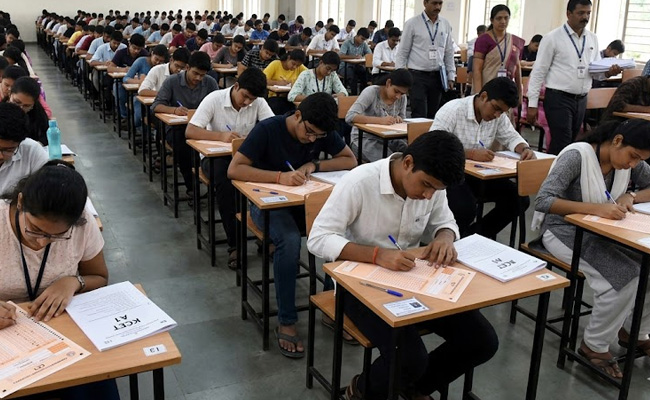
New Delhi (PTI): The BJP on Saturday accused the Karnataka Congress government of being "anti-Hindu" and following double standards after students appearing for the Common Entrance Test (CET) were allegedly asked to remove their 'janeu'.
A political row erupted after five Brahmin students were allegedly forced to remove the thread, considered sacred and worn across the torsos, at a city college in during the CET on Friday.
Students alleged that the invigilators at Madivala asked them to remove their janeu/yajnopaveetha if they wanted to write the exam.
In a video post on X, BJP national spokesperson Shehzad Poonawalla lambasted the act.
"Is it a crime to be a Hindu in Karnataka? In Karnataka, students were stopped from entering the examination hall for wearing a janeu and were given a brutal option -- choose your faith or your future. This happened last year as well," Poonawalla alleged.
ALSO READ: ECI to release exact voter turnout in TN
He accused the Karnataka government of practising double standards and engaging in appeasement politics.
"In Karnataka, we have seen the politics of appeasement. Muslim reservation, a Muslim-only budget, and quotas and contractual work for Muslims. But Hindus have to remove their sacred thread if they want to take an exam, which even the courts have, by the way, allowed," he alleged.
He accused the Congress government of adopting a similar approach in other states where it is in power, while allowing hijab and burka in classrooms.
"It has happened in various Congress-ruled states. We have seen that the Congress party advocates the right to hijab and burkha within the classroom. They say this should be allowed. Even the courts have overruled it.
"But in the case of janeu, they want it to be removed. This is not the first time this has happened. In Telangana and other states, the tilak and mangalsutra were removed. But hijab is fine. This is the kind of second-class treatment being given to Hindus," he added.
Poonawalla said the Congress should rename itself from INC to "MMC -- Muslim League Maowadi Congress" or the "Islamic National Caliphate Party".
As the controversy took a political turn, the college suspended the invigilator pending inquiry. The government also ordered a probe.
The police registered a case and detained three staff members of Krupanidhi College who were in charge of examination checking for questioning, officials said.
A similar incident took place last year in Karnataka, following which the government directed that the candidates would not be asked to remove the janeu while appearing for the CET.