Gujarat riots: Zakia Jafri seeks hearing after polls on plea against clean chit to Modi, SC agrees
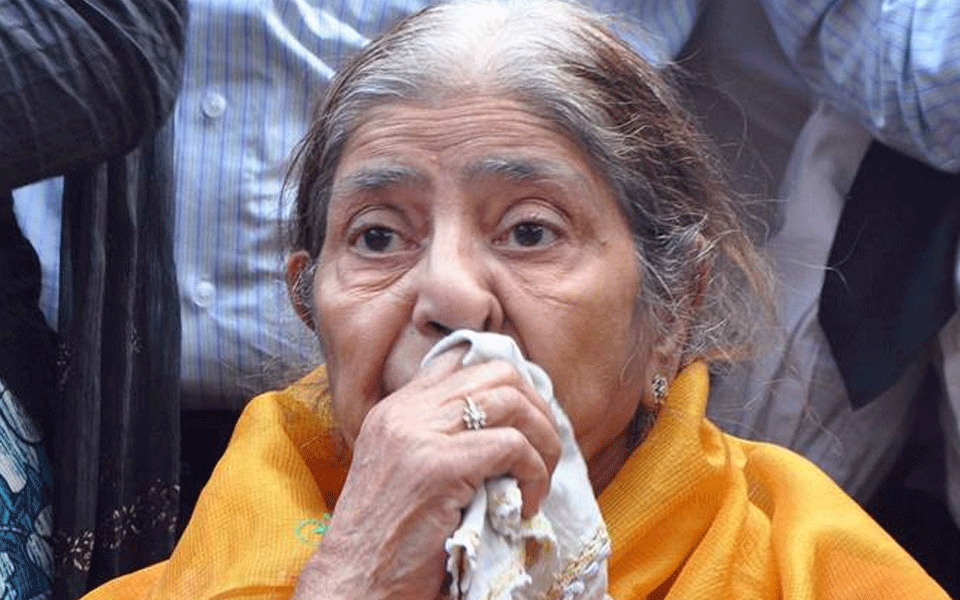
New Delhi : Zakia Jafri, wife of slain MP Ehsan Jafri, told the Supreme Court Monday that her plea challenging SIT's clean chit to Narendra Modi, the then Chief Minister of Gujarat, in the 2002 post-Godhra riots be heard after the Lok Sabha polls.
There is "no urgency in the matter" and it can be heard in July after the general election, she told the top court.
A bench of Justices A M Khanwilkar and Ajay Rastogi considered the submission for deferment by senior advocate Kapil Sibal, appearing for Jafri and listed the matter for hearing in July.
"At the request of senior advocate Kapil Sibal, for the petitioners, hearing is deferred. List on a non-miscellaneous day in July, 2019, as requested," the bench said.
At the outset, senior advocate Sibal said, "There is no urgency in the matter. It can be heard any time. Let it be heard after the elections".
The bench said it is up to the petitioner.
Jafri who filed the petition in 2018, challenging the Gujarat High Court's October 5, 2017 order rejecting her plea against the SIT decision, had never made any such submission for deferring the hearing on the plea.
Ehsan Jafri, an ex-MP, was among the 68 people killed at Gulberg Society on February 28, 2002, a day after the S-6 Coach of the Sabarmati Express was burnt at Godhra killing 59 people and triggering riots in Gujarat.
The court had previously said it will also look into the application by social activist Teesta Setalvad on becoming a co-petitioner in Zakia's plea ahead of hearing the main case.
Jafri's counsel had told the apex court that a notice needs to be issued in the plea as it pertains to alleged "larger conspiracy" during February 27, 2002 and May 2002.
The plea had also maintained that after the SIT gave a clean chit in its closure report before a trial judge, the petitioner filed a protest which was dismissed by the magistrate without considering "substantiated merits".
The plea, filed through advocate Aparna Bhat, has said the high court "failed to appreciate" the petitioner's complaint which was independent of the Gulberg case registered at Meghaninagar Police Station.
On February 8, 2012, the Special Investigation Team filed a closure report giving a clean chit to Modi and 63 others, including senior government officials, saying there was "no prosecutable evidence" against them.
The high court in its October 5, 2017, order said the SIT probe was monitored by the Supreme Court. However, it partly allowed Zakia's petition as far as its demand of a further investigation was concerned.
It said the petitioner can approach an appropriate forum, including the magistrate's court, a division bench of the high court or the Supreme Court seeking further investigation.
Let the Truth be known. If you read VB and like VB, please be a VB Supporter and Help us deliver the Truth to one and all.
Man arrested with Rs 2.54-crore heroin in Mumbai

Mumbai (PTI): Police have arrested a man and seized over 500 grams of heroin worth Rs 2.54 crore in the illicit market from him in Mumbai, officials said on Friday.
The police's Anti-Narcotics Cell (ANC) made the drug seizure in Santacruz in the western suburbs. The operation was conducted by the Kandivali unit of the ANC on Thursday as part of a special crackdown against drug trafficking in the area, they said.
Acting on specific inputs, an ANC team conducted a raid in Santacruz (East) and intercepted a man. During a search, the team recovered 508 grams of high-grade heroin from his possession, an official said.
The seized contraband, a highly addictive, opioid drug derived from morphine, is estimated to be worth Rs 2.54 crore in the international market, he informed.
Following the seizure, a case was registered against the man under relevant sections of the Narcotic Drugs and Psychotropic Substances (NDPS) Act, 1985, and he was formally placed under arrest in the early hours of Friday.
The police are currently investigating the source of the drug and trying to identify the intended recipients of the consignment, he said.