Gyanesh Kumar appointed as chief election commissioner
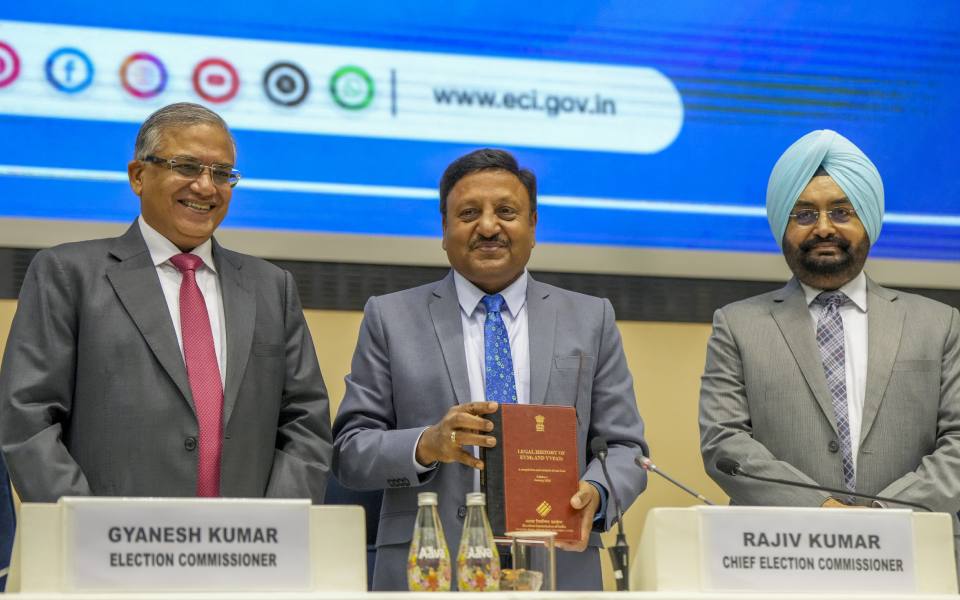
New Delhi, Feb 17 (PTI): Election Commissioner Gyanesh Kumar was appointed as the next chief election commissioner on Monday, the law ministry said.
Kumar is the first CEC to be appointed under the new law on the appointment of the members of the Election Commission (EC).
His term will run till January 26, 2029, days before the EC is expected to announce the schedule of the next Lok Sabha election.
Vivek Joshi, a 1989-batch Haryana-cadre Indian Administrative Service (IAS) officer, has been appointed as an election commissioner.
During his tenure as the 26th CEC, Kumar will oversee the Bihar Assembly polls later this year, and the Kerala and Puducherry Assembly polls in 2026.
Similarly, he will oversee the Assembly polls in Tamil Nadu and West Bengal, which are also due in 2026.
Kumar, who played a key role in implementing decisions following the abrogation of Article 370 of the Constitution in Jammu and Kashmir during his stint in the Union home ministry, took charge as an election commissioner on March 15, 2024.
His appointment came hours after the Congress asked the government to defer its decision on the new CEC till the Supreme Court concludes its hearing on a petition challenging the composition of the selection panel.
The Congress's demand was put forth by Leader of Opposition in the Lok Sabha Rahul Gandhi during a meeting of the selection panel chaired by Prime Minister Narendra Modi, sources said.
The meeting took place in the South Block office of the prime minister. Besides Modi and Gandhi, Home Minister Amit Shah is the third member of the selection panel.
Kumar is a 1988-batch Kerala Cadre IAS officer.
After completing his B.Tech in Civil Engineering from the Indian Institute of Technology (IIT), Kanpur, he studied Business Finance in ICFAI, India and Environmental Economics in HIID, Harvard University, US.
He has worked in the government of Kerala as the assistant collector of Ernakulam, sub-collector of Adoor, managing director of the Kerala State Development Corporation for SC/ST, municipal commissioner of the Corporation of Cochin, besides holding other posts.
As a secretary to the government of Kerala, Kumar handled diverse departments, such as finance resources, fast-track projects and the public works department.
In the government of India, he has rich experience of working as the joint secretary in the Ministry of Defence, joint secretary and additional secretary in the Ministry of Home Affairs, secretary in the Ministry of Parliamentary Affairs and secretary in the Ministry of Cooperation. He superannuated on January 31, 2024.
Let the Truth be known. If you read VB and like VB, please be a VB Supporter and Help us deliver the Truth to one and all.
Marxism will remain relevant despite Left electoral's losses, says general secretary M A Baby
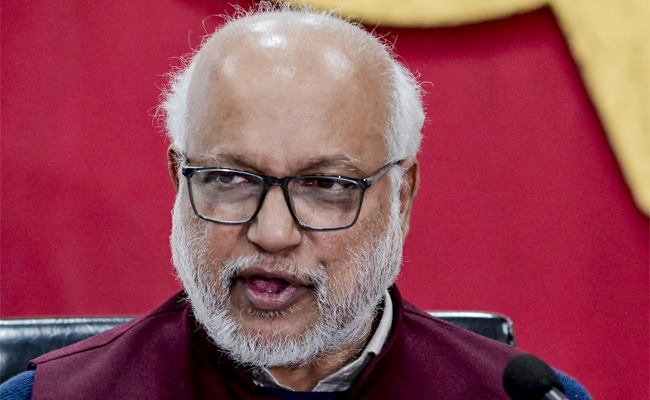
New Delhi (PTI): CPI(M) General Secretary M A Baby on Thursday asserted that the Left movement would remain relevant despite not being in power in any state, saying the ideology would continue to endure as long as social and economic inequalities persist.
Hitting back at BJP leader Rajeev Chandrasekhar over his reported remarks that Marxism had become irrelevant, Baby, in an interview with PTI Videos, said, "So long as there is division in society, so long as there is exploitation of the majority of workers, peasants and ordinary masses by a handful of billionaires, Marxism will remain relevant."
"That perhaps Mr Rajeev Chandrasekhar may not be able to understand, but this is the fact of the matter," he said.
Baby acknowledged that the CPI(M)-led Left was currently without an elected government in any state, but maintained that electoral setbacks would not diminish the movement's role.
"We may not have an elected government in any state. There were occasions when we didn't have a government. But the red flag and the commitment to organise and struggle for the rights of the dispossessed, marginalised and exploited will always be upheld by CPI(M) and the Left movement," he said.
He said the Left continued to enjoy support among workers, peasants, agricultural labourers, youth, students and women, and argued that the movement remained necessary because "oppression and assault" continued in society.
"So long as such problems exist in society, the red flag and the working class movement will continue to work among the masses," the Left leader said.
Exuding confidence on the Left's revival, Baby said the party would reflect on the reasons behind its electoral loss.
"We may be rejected in one election, but we will stage our comeback by understanding what went wrong with us," he said, adding, "We will listen to people and we will come back with higher strength."
Baby also criticised the Congress over reported factional tensions in Kerala after the Congress-led United Democratic Front's victory in the state.
"The way they are behaving is being watched by the people of Kerala," he said, referring to infighting within the Congress.
"Those who have given a massive majority to Congress and UDF would be watching all this," he added, while urging party leaders to "settle the problem in an amicable, democratic manner".
Referring to West Bengal, Baby alleged that violence had escalated following the BJP's victory in the state assembly polls.
"It is quite unfortunate that the moment BJP snatched a massive victory in West Bengal, violence has also started on a big scale," he said.
He also accused the Trinamool Congress of being "notorious for violent activities" and alleged that the "RSS-controlled BJP" had "unleashed violence in many places" after the election results.
"This is not good for Bengal, not good for the country. We wish and hope that normalcy would be restored as soon as possible," he said.
Baby said the CPI(M) and the Left in West Bengal would continue efforts to "pacify people" and avoid violence and confrontation.
Asked about former Kerala chief minister Pinarayi Vijayan not reacting publicly to the election results, Baby said Vijayan would respond "at an appropriate time".