Haryana governor invites BJP-led coalition to form govt; swearing-in on Sunday
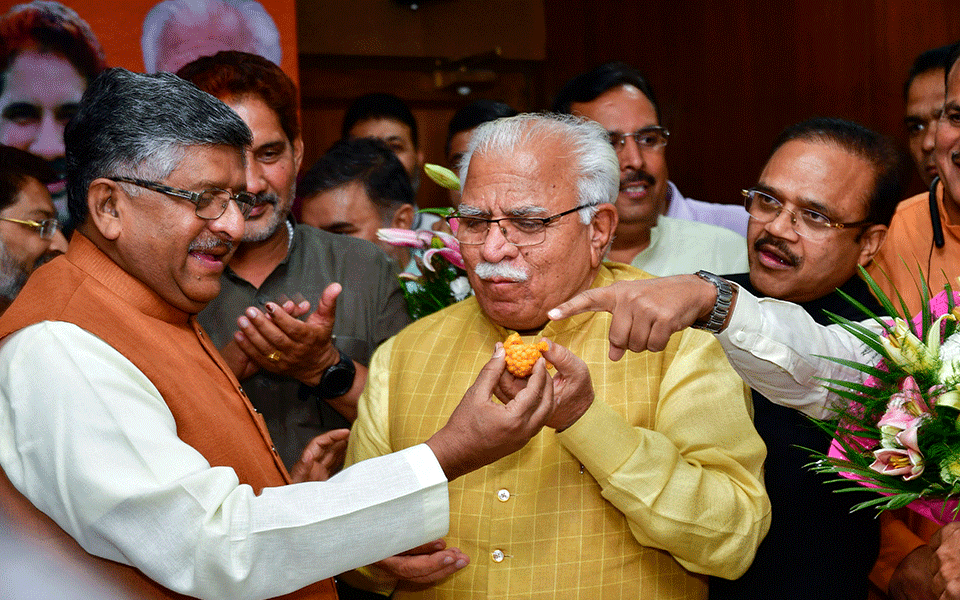
Chandigarh: Haryana Governor Satyadeo Narain Arya invited the BJP to form the next government in the state on Saturday, the party's chief minister-elect Manohar Lal Khattar said here. The announcement came after the Bharatiya Janata Party (BJP) staked claim to form the government in Haryana with the support of the Dushyant Chautala-led Jannayak Janata Party (JJP).
The swearing-in ceremony will take place on Sunday. "The Haryana governor has invited us to form the government on Sunday," Khattar said. He added that the oath-taking ceremony will take place at 2.15 pm on Sunday, the day Diwali will be celebrated across the country.
Khattar said Chautala would take oath as the deputy chief minister. He added that a total of 57 MLAs -- 40 of the BJP, 10 of the JJP and seven Independents -- staked claim before the governor for forming the government in Haryana. "The governor accepted it and invited us to form the government on Sunday," Khattar said.
Earlier, Khattar and his cabinet colleagues submitted their resignations to the governor, which were accepted. The governor asked Khattar to continue as the interim chief minister till the new government took over.
Khattar said some ministers would take oath on Sunday. He, however, did not specify the number. In the 90-member Haryana Assembly, a minimum strength of 46 MLAs is required to form the government.
Let the Truth be known. If you read VB and like VB, please be a VB Supporter and Help us deliver the Truth to one and all.
Tribals, Scheduled Castes preserved India's identity and soul despite foreign invasions: Bhagwat
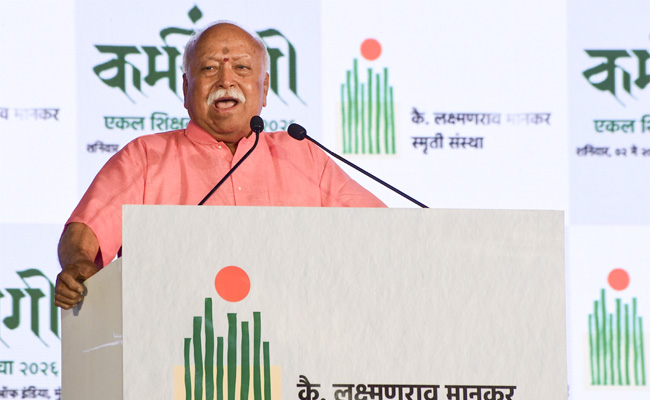
Mumbai (PTI): RSS chief Mohan Bhagwat has said that despite foreign invasions and hardships, tribal communities and Scheduled Castes preserved the country's identity and soul, stressing the need to integrate them into the mainstream development process.
He was speaking on Saturday at the Karmayogi awards ceremony in Mumbai, where Union Road Transport and Highways Minister Nitin Gadkari was also present.
"Human life is defined by giving back to the world, as we are all part of one great family. A person works and spends for the betterment of society, not as a favour, but out of duty. In serving others, we foster our own development. By helping others to thrive, we elevate ourselves and grow as human beings. This principle is the core value of this Indian land, commonly known as a Hindu society," Bhagwat said.
"This is the society's enduring ethos, which has survived for thousands of years. For various reasons, partly because of our indifference and partly because of foreign invasion, those who preserved this ethos paid a heavy price," he said.
The foreign invaders found that this ethos, this value system of the society is its soul and the key to keeping it alive. So they ensured that those who tried to preserve this soul would be uprooted and face extreme hardships, the Rashtriya Swayamsevak Sangh (RSS) chief noted.
But despite foreign invasions and hardships, tribal communities and Scheduled Castes preserved the country's identity and its soul, he said.
"Despite such adversities, the country's core identity remained intact among tribal communities and those belonging to SC and ST groups," he said, emphasising the need to integrate them into the mainstream development process while ensuring they receive equal access to services and facilities.
Referring to global developments, Bhagwat said the present world is "stumbling forward" and struggling to maintain balance, and asserted that India could emerge as a stabilising force.
The country must not only safeguard its own interests but also extend support to the world, he said.
"The world should get to see that the country is not only solving its own misery and sorrow but also helping the world to address similar issues," he said.
The RSS chief stressed that service to society is not a favour but a duty that contributes to one's own development.
Helping others grow also elevates individuals and strengthens the collective fabric of society, he said.
The so-called educated and developed sections have, over time, distanced themselves from these communities, Bhagwat pointed out, and called for the need to bridge this gap.
The identities preserved by these communities represent the true identity of Indian society, he said and underlined that without identity, existence itself is at risk.