Haryana IPS officer's 'suicide': Family gives consent, autopsy to be conducted soon, say police
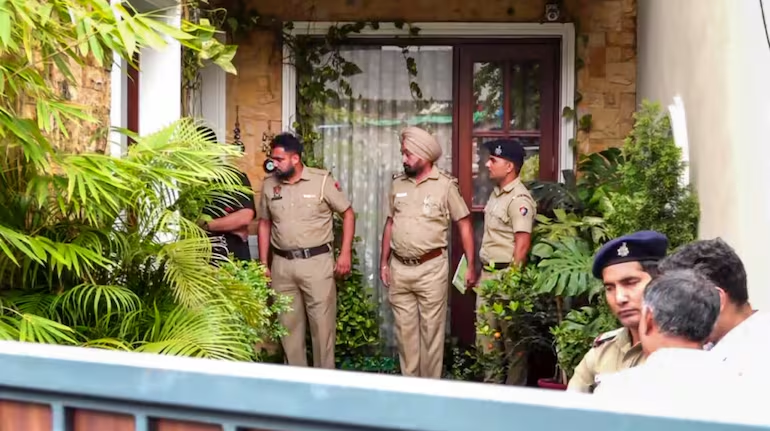
Chandigarh (PTI): Ending an impasse over the autopsy of Haryana IPS officer Y Puran Kumar, who allegedly committed suicide here on October 7, his family has given consent to conduct his post-mortem examination, a police official said on Wednesday.
The development came a day after Chandigarh Police moved court seeking direction to Kumar's family to identify the body for post-mortem.
The family of the deceased officer, including his wife and IAS officer Amneet P Kumar, arrived at the PGIMER here on Wednesday to identify the body and complete other formalities, and the post-mortem will be conducted at PGIMER soon, the official said.
On police's plea, a local court had issued a notice to Kumar's wife to file a reply either personally or through counsel on October 15, failing which the application will be decided on merit.
Inspector General Y Puran Kumar, 52, allegedly shot himself dead on October 7. However, a post-mortem could not be conducted as his family refused to give consent until action is taken against the Haryana officers who have been named in a 'final note' of the deceased Dalit senior officer.
Chandigarh Police has constituted a six-member special investigation team to probe the case.
Amid opposition's attack and demand from Kumar's family for action against officers accused of harassing him, the Haryana government on Tuesday sent DGP Shatrujeet Kapur on leave, and given the additional charge of Haryana DGP to O P Singh, a 1992-batch IPS officer.
Last week, it had transferred Rohtak Superintendent of Police Narendra Bijarniya.
Kumar's body has been kept at the Post Graduate Institute of Medical Education and Research (PGIMER).
On Tuesday, Chandigarh Police said it was constrained to approach a local court for direction to the family to come forward for identification of the body for the post-mortem.
Earlier, they requested the family through the investigating officer, the senior superintendent of police and inspector general of police for the autopsy.
In a statement on Tuesday, Chandigarh Police said that it is absolutely vital at this stage that the post-mortem be conducted at the earliest to preserve important forensic evidence and in the interest of justice.
Police had earlier said that a board of doctors was constituted for the autopsy in the presence of executive magistrate, ballistic expert, toxicology expert, forensic expert, and fingerprint expert with arrangements made for videography and photography.
An eight-page 'final note' purportedly left behind by Kumar accused eight senior IPS officers -- including Haryana DGP Kapur and now-transferred Rohtak SP Bijarniya -- of "blatant caste-based discrimination, targeted mental harassment, public humiliation and atrocities".
Kumar's wife had demanded that Kapur and Bijarniya be named in the FIR and arrested for alleged abetment of her husband's suicide.
Meanwhile, adding a twist to the suspected suicide of IG Puran Kumar, who served in Rohtak, an assistant sub-inspector in the district, Sandeep Kumar, allegedly shot himself dead on Tuesday, purportedly levelling corruption allegations against the late senior officer.
ASI Sandeep Kumar's alleged suicide came in the backdrop of the escalating row over Puran Kumar's death, which shook up the police top brass and raked up a political storm.
On Tuesday, Congress leader Rahul Gandhi visited Puran Kumar's family and called for the respect of all Dalits. He asked Prime Minister Narendra Modi and the Haryana government to take immediate action and arrest the officials responsible.
After Puran Kumar's suicide, several political leaders cutting across party lines had been visiting the family at their Sector 24 residence to offer condolences.
Many opposition leaders had been demanding action in Puran Kumar's alleged suicide case.
Members of several Dalit outfits and some opposition parties have staged protests at different places in Haryana, demanding strict action against the accused in the case.
Let the Truth be known. If you read VB and like VB, please be a VB Supporter and Help us deliver the Truth to one and all.
Siddaramaiah, I will abide by Cong high command decision on leadership issue, says Shivakumar
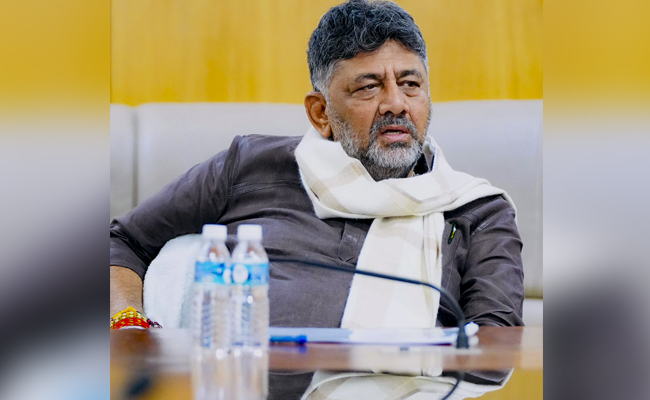
Bengaluru (PTI): Karnataka Deputy Chief Minister D K Shivakumar on Sunday said both he and Chief Minister Siddaramaiah will abide by any decision takeb by the Congress high command on the leadership issue in the state.
Speaking to reporters after returning from Delhi, the Congress state president said, he has full faith in the party leadership and that it would take an approapriate decision at the appropriate time.
The remarks comes amid speculations within the party and political circles about a possible leadership change and cabinet reshuffle after May 4, when the results for assembly elections in four states and one union territory, along with bypolls to two assembly segments in the Karnataka are announced.
"I will not speak about political issues before the media. I have already said that when the time comes you will get to know. So I will not tell you," Shivakumar said in response to a question on discussions with the Congress high command during his Delhi visit over the last couple of days.
He asserted that there are no issues within the party, and whatever has been already decided will take place accordingly.
Responding to a question on senior Minister Satish Jarkiholi's reported statement about internal differences, the Deputy CM said, "nothing like that, they (high command) will do what they have to do at the appropriate time."
"There are no issues, we have faith in our party, they will do what they have to," he added.
Asked about the issue of leadership change as the government is about to complete three years in office, Shivakumar said, "... I have never discussed this issue. The CM and I have both said that we will accept whatever and whenever the high command decides, and we will abide by it."
He declined to comment when asked whether any "good news" can be expected by his birthday on May 15.
The leadership tussle within the ruling party has intensified amid speculation about a possible change of chief minister after the Congress government completed the halfway mark of its five-year term on November 20, 2025. The speculation has been fuelled by the reported "power-sharing" arrangement between Siddaramaiah and Shivakumar at the time of government formation in 2023.
Responding to a question on the BJP's criticism against the Congress government over its decision on internal reservation for Scheduled Castes, alleging injustice to several communities and questioning its intent behind the revised quota formula, Shivakumar said the BJP could not do anything on internal reservation while in power, but the Congress has kept its promise.
"We have found a solution and tried to do justice to all sections among SCs. We have fulfilled the promise made and every one should go together," he said.
Shivakumar warned his party workers against erecting flex banners for his birthday on May 15.
"For May 15, I want to tell everyone that no one should put up flex banners or advertisements for my birthday. If flex are installed I will ensure that cases are registered by authorities against those responsible, whether they are party workers or followers....no one should put such things on roads, this is my personal request," he said, adding that he has asked commissioners of the city corporations to register cases and impose heavy fines.