Haryana IPS officer's 'suicide': Family will get justice, says CM Saini
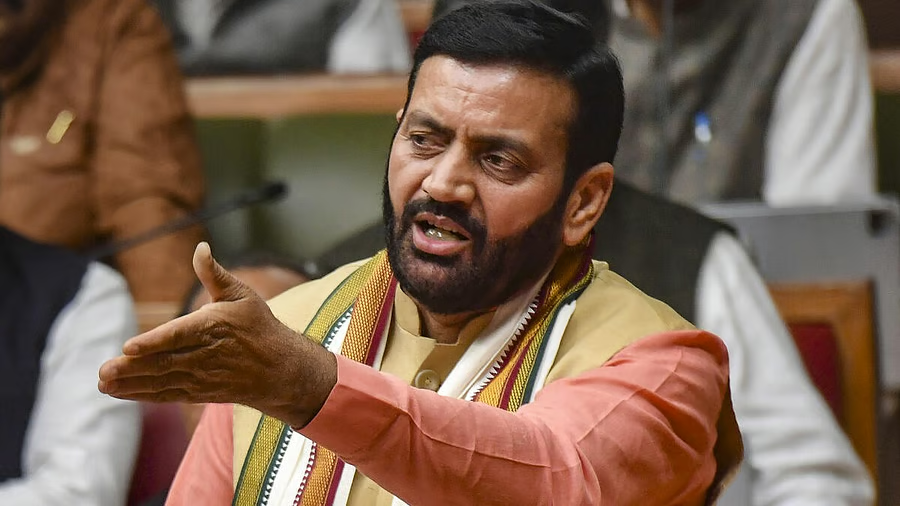
Chandigarh (PTI): In his first public comments over a case involving an IPS officer's "suicide", Haryana Chief Minister Nayab Singh Saini assured the deceased's family members on Saturday that they will get justice.
Y Puran Kumar, 52, a 2001-batch Indian Police Service (IPS) officer, allegedly shot himself dead at his Sector-11 residence here on Tuesday. He has left behind a "final note".
The Bharatiya Janata Party (BJP) government in Haryana is facing flak from the opposition over the alleged suicide of the officer, with leaders demanding an independent probe into his death.
Addressing a gathering of BJP workers in Panchkula, Saini said Kumar's family members have told him that they want justice.
"I have said that we will probe the matter and whosoever is found guilty, action will certainly be taken against him, no matter how big a person he may be," the chief minister said.
He further said he has spoken to the deceased's wife, Indian Administrative (IAS) officer Amneet P Kumar.
"We are also in touch with the Centre for the resolution of this issue," he said.
Saini asked the opposition parties not to indulge in politics over the issue.
If the deceased's family feels that injustice has been done with it, "we will ensure justice", he said.
"The family will get justice," the chief minister asserted.
Describing Puran Kumar's death as unfortunate, Saini said he had asked two officers to accompany the deceased's wife on her way back to India from Japan after she was informed of her husband's demise.
Amneet Kumar was part of a delegation led by Saini on a three-day tour of Japan when her husband allegedly shot himself in Chandigarh.
She has alleged that her husband's death was the result of "systematic persecution" by high-ranking officers.
After arriving from Japan, Saini met Amneet Kumar here to convey his condolences.
The Chandigarh Police registered an FIR on Thursday on charges of abetment to suicide and under the provisions of the Scheduled Castes and Scheduled Tribes (Prevention of Atrocities) Act, based on the deceased officer's "final note".
In the eight-page "final note", Puran Kumar has named many senior IPS officers, specifically referring to Haryana Director General of Police (DGP) Shatrujeet Kapur and Rohtak's Superintendent of Police (SP) Narendra Bijarniya, for allegedly harassing and maligning him.
The Chandigarh Police constituted a six-member Special Investigation Team (SIT) on Friday for a "prompt, impartial and thorough" probe in the matter in a time-bound manner.
Chandigarh's Inspector General (IG) Pushpendra Kumar will lead the SIT.
In her complaint to the Chandigarh Police on Wednesday, Amneet Kumar sought an FIR against Kapur and Bijarniya under section 108 of the Bharatiya Nyaya Sanhita (abetment to suicide) and the relevant provisions of the SC-ST Act, demanding their immediate arrest.
In his "final note", Puran Kumar has named eight senior IPS officers, including Kapur and Bijarniya.
A "will" and the "final note" were among the articles found at the scene where the officer's body was found on Tuesday, according to police.
Let the Truth be known. If you read VB and like VB, please be a VB Supporter and Help us deliver the Truth to one and all.
Tigress found dead in Chandrapur after attacking forest guard
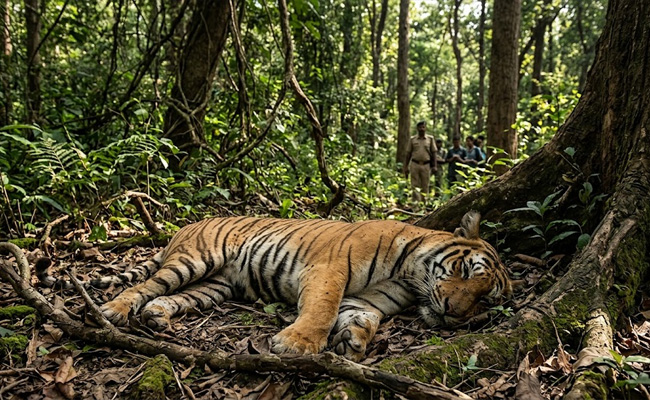
Chandrapur (PTI): A tigress was found dead in a forest range in Maharashtra's Chandrapur district on Sunday, just an hour after critically injuring a forest guard during an operation to steer her and her three cubs away from human settlement, officials said.
The tigress, identified as T-84, was found dead in the vicinity of Ratnapur village under the jurisdiction of Sindewahi Forest Range, they said.
The exact cause of the big cat's death will be ascertained after an autopsy, a senior officer of the forest department said.
According to officials, the tigress, aged 9 to 10 years, had wandered close to the village, along with her three cubs, and locals had attempted to drive her away from the spot, after which she retreated into a field.
On being alerted, a team of forest guards and other staff tried to move the tigress back toward the forest, and during this process, the three cubs got separated and the tigress attacked forest guard Sajjan Parekar, who sustained critical injuries, they said.
The injured forest guard was immediately admitted to a hospital in Sindewahi for primary treatment and later shifted to Chandrapur for further medical care.
An hour after the attack, the tigress was found dead in a paddy field, the official said.
According to preliminary information, the tigress's organs were intact and in good condition. The carcass has been sent to the Transit Treatment Centre (TTC) at Chandrapur for a high-level examination and post-mortem.
The forest department has launched a search operation to track the missing cubs, the official said.