Haryana Police implement 12-layer blockade on the Punjab-Haryana border to stop farmers
New Delhi: In a renewed show of defiance against the Modi government, farmers from Punjab and Haryana are embarking on a journey to Delhi for the 'Delhi Chalo' protest scheduled for February 13.
The agitators, raising slogans against the government, have formed a lengthy cavalcade comprising tractor trailers, cars, bikes, and buses, aiming to voice their demands promised by Prime Minister Narendra Modi after the conclusion of the farmers' protest in November 2021.
Departing from various locations such as Amritsar in Punjab to Ambala and Kurukshetra in Haryana, the highways and villages bear witness to farmers loading their tractors with essential supplies such as ration, tents, beds, and wood, signalling their commitment to reaching Delhi despite the hurdles.
The call for the protest has been issued by the non-political Sanyukt Kisan Morcha and the newly formed Kisan Mazdoor Morcha (KMM), led by prominent farmer union leaders Jagjeet Singh Dallewal and Sarvan Singh Pandher. Notably, the umbrella organization that orchestrated the 2020 farmers' protest, Samyukt Kisan Morcha, has distanced itself from the current demonstrations, opting for a separate agitation on February 16.
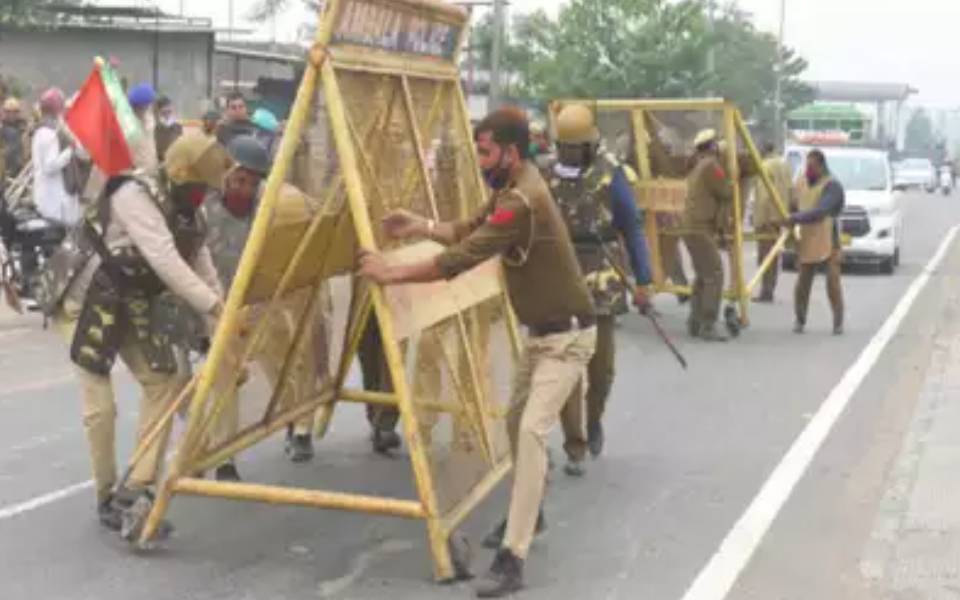
While the farmers mobilize towards Delhi, the Haryana government has implemented a formidable 12-layer blockade on the Punjab-Haryana border highway along the Ghaggar river. Concrete walls, barricades entwined with concertina wires, iron nails embedded in concrete to deflate tractor tires, and gravel-filled intersections between barricades have been erected by the Haryana police.
Additionally, the police dug up the Ghaggar riverbed to prevent farmers from crossing over to the Haryana border. The authorities conducted a mock drill using teargas on the highway and randomly checked commuters' Aadhar cards for identity. Reports indicate that police teams are visiting villages to monitor farmers' movements and conducting raids at their residences. To prepare for potential detentions, two large stadiums have reportedly been converted into temporary jails by the Haryana government.
In response to the farmer's march, the Delhi Police imposed Section 144 of the Code of Criminal Procedure, prohibiting gatherings, processions, and rallies.
Simultaneously, farmers have been invited for a second round of talks in Chandigarh with Union ministers Piyush Goyal, Arjun Munda, and Nityanand Rai. The initial meeting occurred on February 8.
Reacting to the situation, Sarvan Singh Pandher, coordinator of Kisan Mazdoor Ekta, stated, "These are not our demands but the commitments made by Prime Minister Narendra Modi. There is nothing new in this protest. PM Modi had promised us a law on MSP, which was our right. We are forced to conduct this protest, as the government backed out on its promises."
Amid these developments, farmer union leader Manjit Singh Rai from BKU (Doaba) expressed support for the protest. Speaking to The Wire, Rai emphasized that more farmer unions would join shortly, making the 'Delhi Chalo' protest larger than previous demonstrations.
Condemning the Haryana government's actions, Rai stated, "The government should remember that we are citizens of this country and want to reach Delhi to raise our demands. We are not coming from Pakistan or the Taliban. Why is the Modi government afraid of farmers? It is a totally unjust attitude."
Addressing allegations of opposition involvement in instigating the protests, Rai asserted that farmers were advocating for their rights independently. He questioned the government's stance on waiving corporate loans but not farmers' debts, highlighting the global unity among farmers against corporate influence.
Punjab Chief Minister Bhagwant Mann echoed concerns, urging the Union government not to create divisions between Punjab and India. Mann emphasized the need for the government to acknowledge farmers' legitimate demands.
As the farmers advance towards Delhi on February 13, tensions escalate, reminiscent of the 2020 protests against the now-repealed farm laws. Despite the repeal, farmers remain steadfast in their pursuit of justice and express determination to hold the government accountable for unfulfilled promises.
Let the Truth be known. If you read VB and like VB, please be a VB Supporter and Help us deliver the Truth to one and all.
Iran foreign minister Araghchi meets Pakistan Army chief Munir
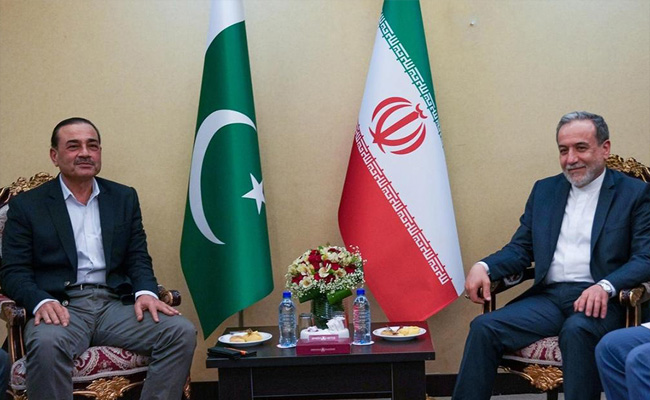
Islamabad (PTI): Iranian Foreign Minister Abbas Araghchi on Saturday met Pakistan Army chief Field Marshal Asim Munir here, as Islamabad continued its efforts to facilitate engagement between the US and Iran.
The meeting, according to a short video posted by the Iranian embassy on social media, was also attended by Iranian foreign ministry spokesperson Esmaeil Baghaei, and Iran's ambassador Reza Amiri Moghadam.
Araghchi calls on Munir, the embassy said in the video caption.
It did not provide further details about the discussions.
Araghchi arrived here late Friday for engagements with the Pakistani leadership. He was received by senior officials, including Munir, foreign minister Ishaq Dar and interior minister Mohsin Naqvi.
ALSO READ: Fire engulfs over 100 jhuggies in Delhi's Shakur Basti; no casualties
However, there is no clarity on whether direct talks between Washington and Tehran will take place during the visit.
"No meeting is planned to take place between Iran and the US. Iran's observations would be conveyed to Pakistan," Baqaei said in a social media post on Saturday.
Araghchi, before leaving for Islamabad, said that he was embarking on a timely tour of Islamabad, Muscat, and Moscow, and the purpose of his visits is to "closely coordinate with our partners on bilateral matters and consult on regional developments".
"Our neighbours are our priority," he said.
As the Iranian team landed in Islamabad, White House Press Secretary Karoline Leavitt said that US Special Envoy on the Middle East Steve Witkoff and President Donald Trump's adviser Jared Kushner would be leaving for Pakistan on Saturday "to engage in direct talks" with representatives of the Iranian delegation.
However, the US team has not yet arrived.
Meanwhile, Pakistan's Deputy Prime Minister and Foreign Minister Dar, in a social media post, expressed hope for "meaningful engagements" between the two warring parties to promote regional peace and stability.
The first round of US-Iran talks held on April 11 and 12 failed to produce a breakthrough, prompting a flurry of diplomatic efforts by host Pakistan to cool tensions and revive hopes for another round of dialogue.
On Tuesday, Trump extended the two-week ceasefire with Iran indefinitely to give Tehran more time to prepare a unified proposal to end the war, just hours before the truce was set to expire.
The Iran war began on February 28 with US-Israeli strikes.
_vb_19.jpeg)