Haryana Police uses water cannons, tear gas to disperse Punjab farmers at Shambhu border
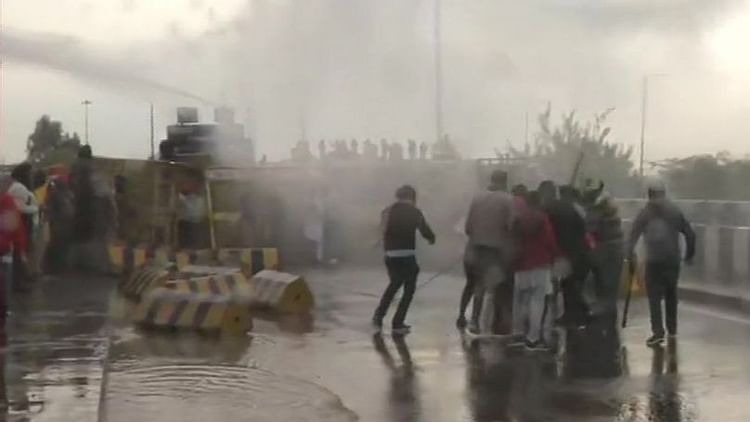
Ambala: The Haryana Police on Thursday used water cannons and tear gas to disperse a group of farmers from Punjab who allegedly tried to jump police barricades to enter Haryana as part of their 'Delhi Chalo' march against the Centre's new farm laws.
The Haryana Police officials at the Shambhu inter-state border with Punjab used loudspeakers, asking farmers who had assembled on the Punjab side to disperse when some of them tried to cross and remove the barricades.
The situation remained tense at the Shambu inter-state border on the national highway as protesting farmers threw police barricades into the Ghaggar river.
Some of the protestors were also seen waving black flags.
Multi-level barricading has been put by Haryana Police to prevent the farmers from moving towards the national capital.
A farmer from Punjab present at the site told reporters, It is condemnable that Haryana Police is using such measures to suppress an assembly of peaceful protesters. We are protesting in a peaceful manner, but they want to prevent us from using our democratic right to protest .
Earlier on Wednesday, a large group of Haryana farmers near Mohra village in Ambala jumped over the barricades following which the police resorted to the use of water cannon against them.
A splinter group had, however, managed to proceed to Tiyora-Tiyori village on the Ambala-Kurukshetra border, where police again used water cannons to stop their march to Delhi.
This group of Haryana farmers, which was being led by state BKU chief Gurnam Singh Charuni, had reached Karnal as part of their march to Delhi.
Haryana on Thursday completely sealed its borders with Punjab as farmers from the adjoining state started assembling in big numbers as part of the Delhi Chalo march.
The BJP government in Haryana had earlier said it will seal its borders with Punjab on November 26-27 in view of the farmers' march to Delhi.
The Delhi Police on Wednesday asserted that it had rejected requests received from various farmer organizations to protest in the national capital against the Centre's new farm laws on November 26 and 27. A day earlier, it had said that legal action would be taken against the protesting farmers if they come to the city for any gathering amid the COVID-19 pandemic.
Let the Truth be known. If you read VB and like VB, please be a VB Supporter and Help us deliver the Truth to one and all.
4 workers die after being buried under coal slurry in Jharkhand's Dhanbad
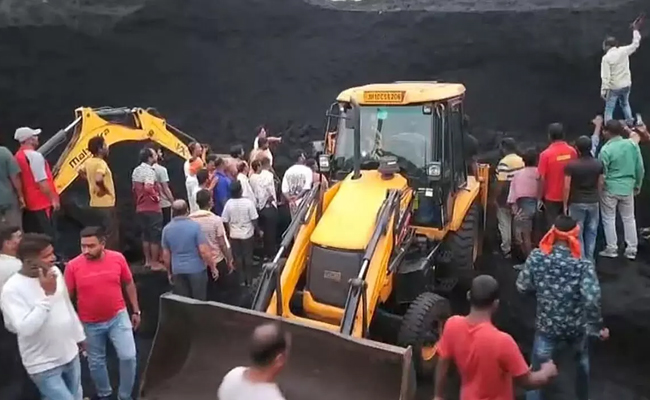
Dhanbad (Jharkhand) (PTI): At least four workers died after being buried under coal slurry in Jharkhand's Dhanbad district on Saturday, a police official said.
The incident took place at Moonidih coal washery in the command area of Bharat Coking Coal Limited (BCCL).
"Bodies of all four workers were dug out of debris during a rescue operation," Putki police station in-charge Waqar Hussain told PTI.
The incident took place when coal slurry was being loaded into trucks by workers, during which a large chunk of slurry fell and trapped several workers underneath, officials said.
The deceased have been identified as Manik Bauri, Dinesh Bauri, Deepak Bauri, and Hemlal Gope.
Meanwhile, the family members of the deceased and local villagers placed the bodies in front of the washery gate and began a protest.
They demanded compensation, jobs for dependents and action against those responsible for the incident.
Police and administration officials are trying to pacify the protesters, an official said.