Have reports of terrorists being trained to carry out operations through sea: Navy chief
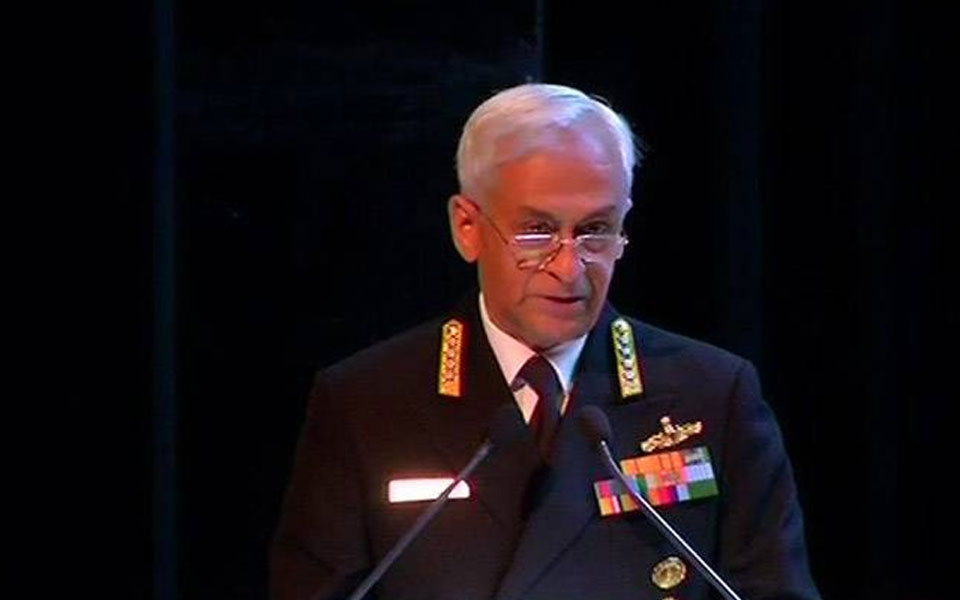
New Delhi : Weeks after the Pulwama attack, Navy Chief Admiral Sunil Lanba on Tuesday warned that there are reports about terrorists being trained to carry out operations through the sea.
Addressing a gathering of global experts at the Indo-Pacific Regional Dialogue here, Lanba said the Pulwama attack was perpetrated by extremists that were "aided by a State" that seeks to destabilise India.
"We also have reports of terrorists being trained to carry out operations in various modus operandi, including through the medium of the sea," he said.
The 26/11 attack was carried out by 10 sea-borne terrorists of the Lashkar-e-Taiba, who hijacked an Indian fishing trawler to reach Mumbai and unleash mayhem.
The Navy chief said this part of the world had witnessed multiple forms of terrorism in recent years and few countries in the region had been spared.
The global nature that terrorism has acquired in the recent times has further enhanced the scope of this threat, Lanba said.
India, however, faces a "far more serious" version of "state-sponsored" terrorism, he said.
"We recently saw the horrific scale of the extremist attack in Jammu and Kashmir about three weeks ago. This violence was perpetrated by extremists aided and abetted by a State that seeks to destabilise India," the Navy chief said without naming Pakistan.
On February 14, a suicide bomber of the Pakistan-based Jaish-e-Mohammed (JeM) rammed an explosive-laden vehicle into a bus in Jammu and Kashmir's Pulwama district, killing 40 Central Reserve Police Force (CRPF) personnel.
"We have seen how quickly terror groups evolve across the globe. A particular brand of terror can well become a global problem in near future," Lanba warned.
The Indian security establishment is continuously working to address this menace, he said, noting that "it is imperative that the global community works in concert to contain and eliminate terrorism in all its forms".
Lanba also emphasised the importance of the Indo-Pacific Region. "There is a renewed focus of the world on the seas. This is principally due to the geoeconomic and geopolitical significance of the maritime domain."
India is a martime nation and, recently, there have been an increasing attention to harness potential of the maritime domain for the country's growth and regional development, he said.
This event seeks to "identify and conceptualise challenges and opportunities that lie in the waters, and evolve strategy for mutual benefits of all stakeholders," Lanba said.
"It is widely accepted that (the) Indo-Pacific Region has been growing in geopolitical significance in recent years due to economic, political and other reasons," he said.
Lanba underlined the region's ancient and historical link with India and its significance for the country.
Let the Truth be known. If you read VB and like VB, please be a VB Supporter and Help us deliver the Truth to one and all.
SC to hear on May 4 PIL seeking stringent guidelines for issuing Aadhaar to adolescents, adults
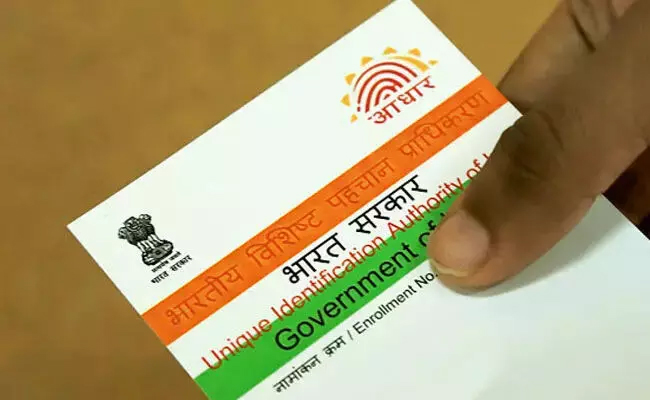
New Delhi (PTI): The Supreme Court is scheduled to hear on Monday a plea seeking a direction to the Unique Identification Authority of India to issue new Aadhaar cards only to citizens up to the age of six years, and frame stringent guidelines for its issuance to adolescents and adults to stop infiltrators from masquerading as Indian citizens.
As per the apex court's causelist of May 4, the plea would come up for hearing before a bench of Chief Justice Surya Kant and Justice Joymalya Bagchi.
The Public Interest Litigation (PIL) filed by lawyer Ashwini Upadhyay has also sought a direction to the authorities to install display boards at common service centres stating that the 12-digit unique identification number is only a "proof of identity" and not a proof of citizenship, address or date of birth.
Besides all the states and Union Territories, the plea has made the UIDAI -- which is the authority that issues Aadhaar -- and the Union ministries of home, law and justice, and electronics and information technology as parties.
The plea, filed through advocate Ashwani Dubey, said Aadhaar, originally intended as a proof of identity, has increasingly become a "foundational document" enabling individuals to obtain other identification documents, such as ration cards, domicile certificates and voter identity cards.
"The UIDAI has issued 144 crore Aadhaar and 99 percent Indians have been enrolled. Therefore, the petitioner is filing this writ petition as a PIL under Article 32, seeking a direction to UIDAI to issue new Aadhaar to children only and frame new stringent guidelines for adolescents and adults, so as to stop infiltrators from getting it and masquerading as Indian citizens," the plea said.
It said the need to file the plea arose when the petitioner came to know the manner in which infiltrators are able to procure Aadhaar through a verification process that is weak and can be easily manipulated.
"Foreigners apply for Aadhaar under the 'foreign' category. But infiltrators apply for Aadhaar under the 'Indian citizen' category and get it easily made. Thereafter, they obtain a ration card, birth and domicile certificate, driving licence, et cetera, essentially becoming indistinguishable from Indian citizens…," it said.
Besides seeking other directions, the plea has raised legal questions, including whether the Aadhaar Act 2016 has become "temporally unreasonable" for failing to keep up with the legislative intent of distinguishing foreigners from Indian citizens.
It said the alleged misuse of Aadhaar undermines targeted welfare delivery and leads to diversion of public resources.