Having nose like grandmother does not ensure power: Union minister to Priyanka Gandhi
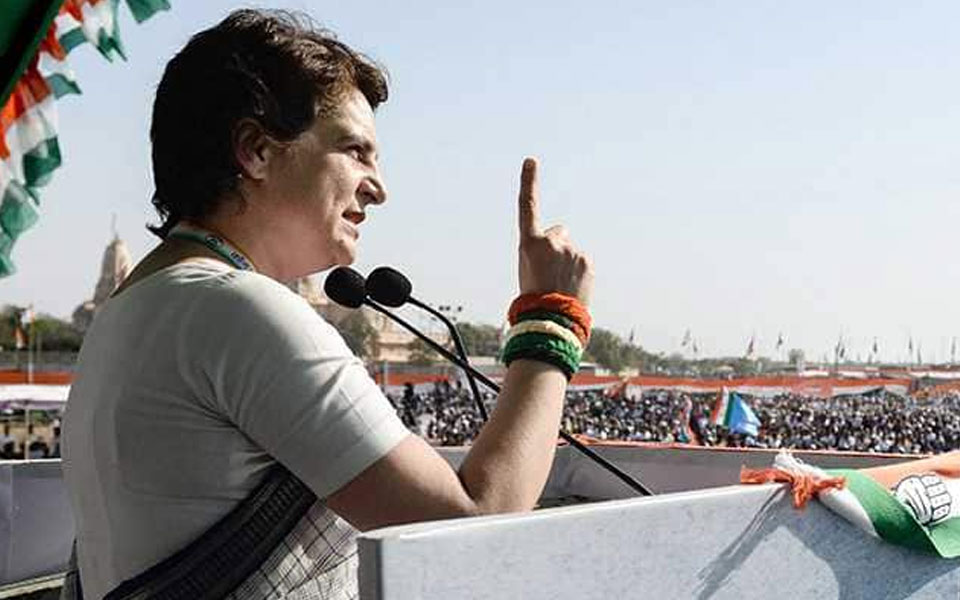
Ahmedabad: Union minister Mansukh Mandaviya on Tuesday courted controversy when he hit out at Congress general secretary Priyanka Gandhi Vadra, saying that having identical features like former prime minister Indira Gandhi did not ensure that one gets power.
"It is being talked about in the Congress that she (Priyanka) has the nose like her grandmother (Indira)," Mandaviya said.
"If you get power by having a nose like your grandmother, then won't there be a president in every household in China?" the BJP leader asked at the party's 'Vijay Sankalp' rally at Anand in Gujarat.
Many leaders of Congress had openly said Priyanka Gandhi Vadra reminded them of her late grandmother.
Vadra, who is the Congress's incharge of eastern Uttar Pradesh, had reportedly said she was often likened with Indira Gandhi because people loved the former prime minister.
Last month, BJP MP Harish Dwivedi had also made personal comments on Vadra.
Dwivedi had said Vadra wears "jeans and top" in Delhi and "saree and sindoor (vermilion)" when she is on an election campaign.
Let the Truth be known. If you read VB and like VB, please be a VB Supporter and Help us deliver the Truth to one and all.
Maharashtra sets up state vaccination task force to strengthen immunisation programme

Mumbai (PTI): The Maharashtra government has set up a State Vaccination Task Force to strengthen the regular immunisation programme and review the progress of related campaigns, a health department official said on Monday.
The State Vaccination Task Force will comprise at least 29 members and will be headed by the administrative head of the health department, he informed.
The government has also constituted separate district-level and municipal vaccination task forces to improve implementation and address challenges at the grassroots level, he said.
Municipal task forces, chaired by respective civic commissioners, have been constituted in view of the vast urban population in Maharashtra and the role of civic bodies in implementing different health programmes.
The district-level task forces will function under the chairmanship of collectors.
"Complete immunisation of children at the appropriate age is an extremely simple, cost-effective and highly effective measure to reduce child mortality and the prevalence of diseases among kids. Immunisation is a powerful tool for reducing illness in children," maintained the official.
To ensure full vaccination of all children, the state government implements various campaigns from time to time as per the central government guidelines, he pointed out.
"Active participation and cooperation of other relevant government departments are essential (in making these campaigns successful)," according to the official.
The state-level body will review the regular immunisation programme, associated campaigns and vaccine-preventable diseases in detail. It will also conduct focused assessments of high-risk districts and municipal corporations, including vacancies at district, municipal and sub-district levels, availability of cold chain equipment, resource gaps and training requirements, he noted.
The state task force will review allocation and utilisation of funds for immunisation and ensure timely action by officers concerned based on reports from district and municipal task forces and state-level monitoring mechanisms, the official said.
It will also ensure active coordination and participation of other government departments in immunisation drives, while district and municipal task forces will carry out similar functions at their respective levels, the official added.