Hazare's fast enters 2nd day; locals in his village observe bandh
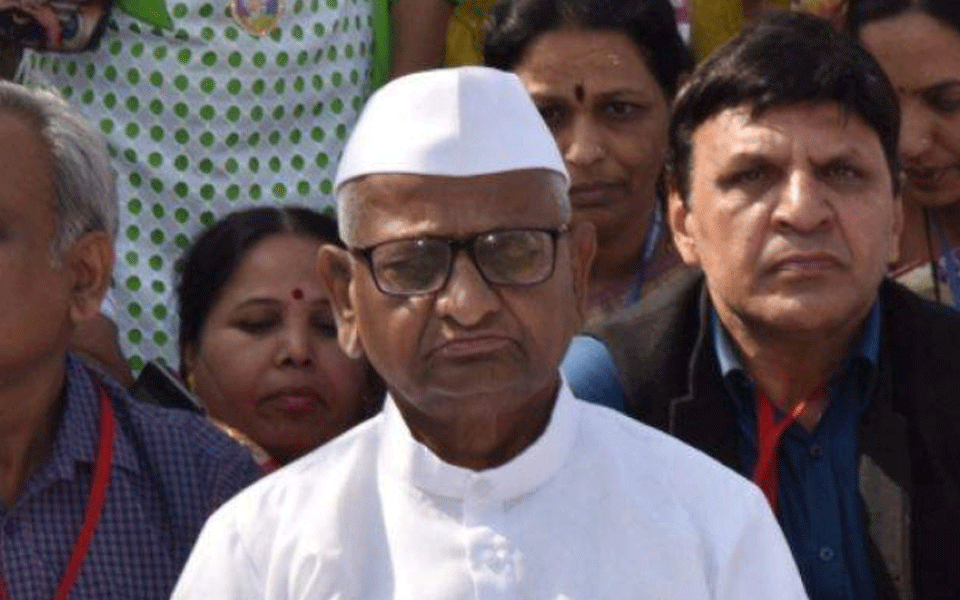
Ralegan Siddhi, Jan 31: Social activist Anna Hazare's hunger strike entered the second day on Thursday as he remained defiant on his demand for appointment of anti-corruption watchdogs at the Centre and in Maharashtra and resolution of farmers' issues.
A bandh was also observed by locals in Hazare's native Ralegan Siddhi village in Maharashtra's Ahmednagar district in support of his demands.
Hazare is sitting on a hunger strike in his village since Wednesday against "non-fulfilment" of assurances by the Centre and the Maharashtra government on the appointment of Lokpal and passage of the Lokayukta Act in the state.
The 81-year-old Army man-turned-activist has also been demanding appointment of Lokayuktas in states where such statutory anti-corruption watchdogs do not exist.
He has also been demanding implementation of the Swaminathan Commission recommendations on ways to address agrarian distress, besides some electoral reforms.
Locals of Ralegan Siddhi village issued a statement on Thursday to local tehsildar, as an official representative of the state government, to look into Hazare's demands.
Doctors conducted a check-up of Hazare and asked his caretakers to monitor the activist's condition closely.
"He is over 80 years' old. He needs to be looked after," the doctors told Hazare's close aides.
Hazare had earlier declined to meet state government envoy and minister Girish Mahajan for talks over his demands.
However, Mahajan said on Wednesday that talks were going on with Hazare and his supporters.
"There will be some solution," Mahajan, a confidant of Chief Minister Devendra Fadnavis, told reporters in Nashik.
The anti-corruption crusader had earlier told PTI that he welcomed the Maharashtra Cabinet's decision to bring the office of state chief minister under the ambit of Lokayukta.
"However, the strike will continue till the government fulfils promises they made before coming to power about passage of Lokayukta Act, appointment of Lokpal (at the Centre) and to tackle farmers' issues," he said.
Hazare had written a letter to Fadnavis Monday, saying he would launch the agitation in his village from Wednesday.
"It has been five years since the Lokpal Act was passed. Yet, the Narendra Modi government has not appointed Lokpal...Lokayukta Act has not been passed in Maharashtra for four years," Hazare observed in his letter dated January 28.
The activist said Fadnavis had mediated when he had launched the agitation at Ramlila Maidan in Delhi in March last year. Hazare said he had withdrawn that agitation after the Centre assured in writing it would fulfil his demands.
"Nine months have passed, yet the demands have not been fulfilled," he had said in the letter.
The Fadnavis Cabinet had on Tuesday decided to bring the office of chief minister under the purview of Lokayukta.
Hazare welcomed the government's decision to set in motion the process to appoint Lokayukta, but said that does not mean he will not stage hunger strike. "The agitation will go on until the Act is in place," he had said.
The Lokayukta is a statutory body that is empowered to probe complaints of abuse of position and corruption against public servants.
Let the Truth be known. If you read VB and like VB, please be a VB Supporter and Help us deliver the Truth to one and all.
AIITA welcomes Karnataka’s ban on obscene songs in school events
Bhatkal: The Karnataka unit of the All India Ideal Teachers Association (AIITA) has welcomed the Karnataka government’s decision to strictly ban school children from dancing to obscene songs during educational and cultural programmes in government, aided, and private schools across the state.
AIITA Karnataka State President M. R. Manvi congratulated the government for taking what he termed an important step to preserve the sanctity of education.
“Such decisions to safeguard the dignity of school children and uphold the values of education are the need of the hour. This rule should not be limited to government schools alone but must be strictly implemented in all private educational institutions as well,” he said.
He further urged the government to address other concerns within school programmes.
“The government should not only prohibit obscene dances in the name of school anniversaries, but also ensure that plays and dialogues that incite religious hatred are avoided. Schools should be centres of harmony, not platforms for spreading hatred,” he added.
According to a recent circular issued by the Department of School Education and Literacy, obscene dances are adversely affecting the mental health and moral values of students.
In this regard, schools have been advised to use songs that promote nationalism, positive thinking, the greatness of Kannada culture, and value-based traditions instead of inappropriate content during programmes.
The circular also emphasises that students should be dressed in decent attire.
AIITA also backed the department’s warning that disciplinary action would be taken against head teachers if such guidelines are violated. The association has further demanded that district Deputy Directors of Public Instruction strictly monitor the implementation of these rules.