HC stays order directing FIR against ex-Sebi chief Buch, 5 others
_vb_61.jpeg)
Mumbai (PTI): The Bombay High Court on Tuesday stayed for four weeks a special court's order directing FIR against former Sebi chairperson Madhabi Puri Buch and five other officials for alleged stock market fraud and regulatory violations, noting it was passed mechanically.
A single bench of Justice Shivkumar Dige said the special court order of March 1 also did not attribute any specific role to the accused in the matter.
"After hearing all the parties concerned and after going through the order of the special court, it appears that the order is passed mechanically without going into details and without attributing any specific role to the applicants (Buch and others)," Justice Dige said.
"Hence, the order is stayed till next date. Four weeks time is given to the complainant in the case (Sapan Shrivastava) to file his affidavit in reply to the petitions," the court said.
The HC's judgement came on petitions filed by Buch, three current whole-time Sebi directors Ashwani Bhatia, Ananth Narayan G and Kamlesh Chandra Varshney, Bombay Stock Exchange's Managing Director and Chief Executive Officer Sundararaman Ramamurthy and its former chairman and public interest director Pramod Agarwal.
The pleas sought quashing of the order passed by the special court directing the Anti-Corruption Bureau (ACB) to register an FIR against them pertaining to certain allegations of fraud committed in 1994 while listing a company on the BSE.
The pleas said the order was illegal and arbitrary.
The special court had passed the order on the complaint filed by Sapan Shrivastava, a media reporter, seeking investigation into the alleged offences committed by the accused, involving large scale financial fraud, regulatory violations and corruption.
Solicitor General of India, Tushar Mehta, appearing for the three Sebi officials, said there has been complete non-application of mind by the special court in passing the order.
"Based on a vague and vexatious complaint, the special court has ordered an FIR. For something allegedly done in the year 1994, how can the current members of Sebi be held responsible," Mehta argued.
He claimed that complainant Shrivastava was an extortionist who was working under the garb of being a public spirited person.
Senior counsel Amit Desai, appearing for Ramamurthy and Agarwal, said to take such an action against senior members of the BSE was an "attack on the economy itself" especially on such frivolous allegations.
"If there was any merit in the allegations, then yes, every public servant is open for prosecution, but not on some bald allegations like the present case," Desai said.
Buch's advocate Sudeep Pasbola reiterated the arguments put forth by Mehta and Desai.
Public prosecutor Hiten Venegaonkar, appearing for the ACB, said the bureau would comply with whatever order is passed by the HC.
Shrivastava, who appeared in person, refuted the allegations made against him by Mehta and sought time to respond to the petitions.
The petitions claimed the special court order was "manifestly erroneous, patently illegal and passed without jurisdiction".
"The court has failed to consider that the complainant has failed to make out a prima facie case against the applicants for failing to discharge their duties as officers of the Sebi," the pleas said.
There was no material submitted by the complainant to support the allegations made by him, they added.
"At the relevant point of time, there was no requirement for obtaining an NOC from Sebi for listing of any shares on the BSE," the pleas said.
No vicarious liability can be fastened on Sebi officials in respect of the alleged offence, as per the pleas.
The order was not legally sustainable as the petitioners were not even issued a notice or heard before decision was taken, the pleas pointed out.
They sought quashing of the special court order and stay on its execution by way of interim relief.
Buch, India's first woman chief of the Securities and Exchange Board of India (Sebi), completed her three-year tenure on February 28.
Special ACB court judge S E Bangar, in his March 1 order, noted there was prima facie evidence of regulatory lapses and collusion, requiring a fair and impartial probe.
The ACB court also said it will monitor the probe, and sought a status report within 30 days.
The Sebi in a statement on Sunday said the application had sought directions for the police to register an FIR and investigate into the alleged irregularities in granting listing permission to a company on the Bombay Stock Exchange in 1994, without complying with the provisions of the SEBI Act, 1992, SEBI (ICDR) Regulations, 2018, and the SEBI (LODR) Regulations, 2015, the statement said.
"Even though these officials were not holding their respective positions at the relevant point of time, the court allowed the application without issuing any notice or granting any opportunity to SEBI to place the facts on record," it said.
The BSE had said the application sought directions for registration of an FIR and investigations into alleged irregularities in the listing of Cals Refineries Ltd at BSE in 1994.
"The officials named in the application were not in their respective positions at the time of listing and were not connected with the company at all," it said, adding the application is "frivolous and vexatious in nature".
Let the Truth be known. If you read VB and like VB, please be a VB Supporter and Help us deliver the Truth to one and all.
Sujit Nair raises concerns over speculation of DMK-AIADMK understanding to block TVK
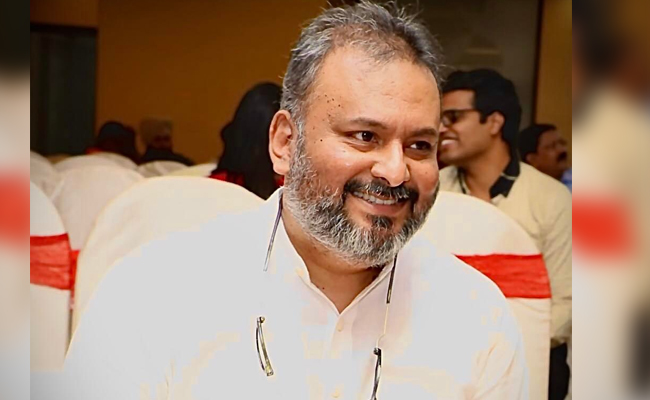
Chennai: Journalist and political commentator Sujit Nair has expressed concern over speculation that the Dravida Munnetra Kazhagam and the All India Anna Dravida Munnetra Kazhagam could explore a post-poll understanding to prevent Vijay-led Tamilaga Vettri Kazhagam from forming the government in Tamil Nadu.
In a social media post, Sujit Nair said the election verdict in Tamil Nadu reflected a clear public demand for political change and argued that the mandate should be respected irrespective of political preferences.
Referring to reports and political discussions surrounding a possible understanding between the DMK and AIADMK, he said he hoped such developments remained only speculative conversations and did not turn into reality.
Nair stated that if such an alliance were to take shape, it would raise serious questions about ideological politics in the country. He said TVK had emerged through a democratic electoral process and that the legitimacy to govern in a parliamentary democracy comes from the people’s verdict.
According to him, attempts to prevent an electoral winner from forming the government through unexpected political arrangements may be constitutionally valid, but many people could view them as politically opportunistic.
He further said that such a move could particularly affect the political image of the DMK, which has historically projected itself around ideology, social justice and opposition politics. Nair said that in ideological terms, the DMK appeared closer to TVK than to the AIADMK, and joining hands with its long-time political rival only to remain in power could weaken its broader political narrative.
He added that the same questions would apply to the AIADMK as well, as the party had spent decades positioning itself against the DMK and such an arrangement could create discomfort among its cadre and supporters.
Drawing a comparison with Maharashtra politics in 2019, Nair said he had expressed similar views when the Shiv Sena formed an alliance with the Indian National Congress and the Nationalist Congress Party after the Assembly elections.
He said post-poll alliances between long-standing political rivals often create a public perception that ideology and electoral mandates become secondary when political power equations come into play.
Nair also said such developments increase public cynicism towards politics and reinforce the belief among voters that ideology is often sidelined after elections.
He maintained that the Tamil Nadu verdict was emphatic and said respecting both the spirit and substance of the mandate was important for the credibility of democratic politics.