He apprehends harm from followers of Savarkar and Godse's ideology, Rahul Gandhi tells court
Pune, Aug 13 (PTI): Congress leader Rahul Gandhi has told a Pune court hearing a defamation case against him that he could face harm from the followers of the ideology of Vinayak Damodar Savarkar and Nathuram Godse, and providing "preventive protection" is the state's constitutional obligation.
Gandhi, who is facing a defamation case filed by Satyaki Savarkar, grand-nephew of Vinayak Damodar Savarkar, made the claim in an application before the special court for cases against MPs and MLAs here.
The case, the trial of which is yet to start, pertains to certain comments allegedly made by Rahul Gandhi against V D Savarkar, freedom fighter and Hindutva ideologue.
The application -- filed before Judicial Magistrate (First Class) Amol Shinde by Gandhi's lawyer Adv Milind Pawar -- said that complainant Satyaki Savarkar had admitted that he is also a direct descendant, through maternal lineage, of Nathuram Godse and Gopal Godse, principal accused in the assassination of Mahatma Gandhi.
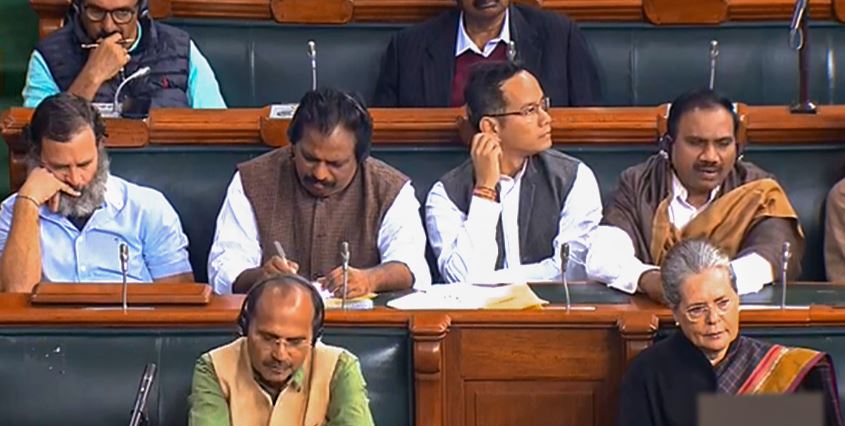
Gandhi is the Leader of Opposition in the Lok Sabha and recently held a press conference in New Delhi, placing before the nation evidence of electoral fraud by the Election Commission, the application said.
He also staged a protest in the Parliament premises, raising slogans such as "vote chor sarkar." "Furthermore, during the parliamentary debate on the subject of Hindutva, there was a heated exchange between the Prime Minister and Shri Rahul Gandhi, a matter well known to the public. Against this backdrop, there is little doubt that the complainant, his great-grandfathers (the Godses), those connected with the ideology of Vinayak Savarkar, and some followers of Savarkar who are presently in power, may harbor hostility or resentment towards Gandhi," the application said.
"In light of the documented history of violent and anti-constitutional tendencies linked to the complainant's lineage, and considering the prevailing political climate, there exists a clear, reasonable, and substantial apprehension that Rahul Gandhi may face harm, wrongful implication, or other forms of targeting by persons subscribing to the ideology of Vinayak Damodar Savarkar," the application stated.
Given the historical record of political violence linked to extremist factions and the complainant's political-ideological heritage, coupled with the present climate of heightened hostility, the apprehension is neither vague nor unfounded, it said, adding, "In such circumstances, preventive protection is not only prudent but is a constitutional obligation upon the state."
Advocate Pawar said this `Pursis' or application was submitted as a precautionary measure with the objective of "legally safeguarding the fairness, integrity, and transparency of the present proceedings."
"It cannot be ruled out that certain persons inspired by the unconstitutional ideology and views of Vinayak Damodar Savarkar, and possessing the same dangerous mindset as Nathuram and Gopal Godse, may pose a threat to Gandhi's life," the lawyer said.
The court has already granted bail to Gandhi in the case.
Reacting to the plea, Satyaki Savarkar said it was frivolous, and filed with the intention of delaying the trial. "The facts mentioned in the application by Gandhi have nothing to do with the present case," he told reporters.
Satyaki Savarkar has filed a complaint against Gandhi, alleging that in a speech made in London in March 2023, the Congress leader claimed that V D Savarkar had written in a book that he and five to six of his friends once beat up a Muslim man and he (Savarkar) felt happy.
Satyaki Savarkar said no such incident ever took place, and that V D Savarkar never wrote any such thing anywhere.
Let the Truth be known. If you read VB and like VB, please be a VB Supporter and Help us deliver the Truth to one and all.
Rickelton's ton in vain as SRH beat MI by 6 wickets
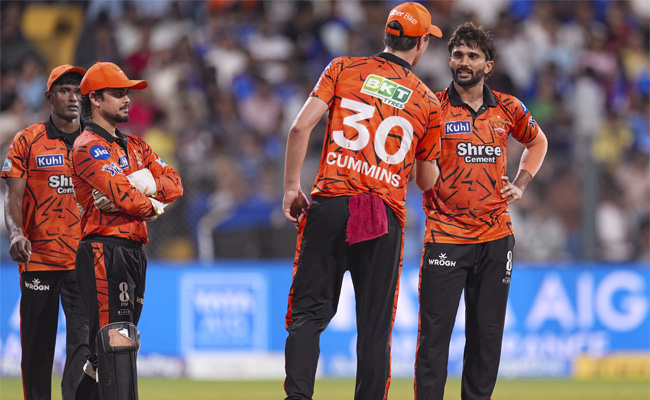
Mumbai (PTI): Ryan Rickelton's whirlwind unbeaten ton was overshadowed by Heinrich Klaasen's unbeaten 65 as Sunrisers Hyderabad defeated Mumbai Indians by six wickets in an IPL match here on Wednesday.
Chasing an imposing 244-run target, Travis Head (76 off 30) and Abhishek Sharma (45 off 24) shared 129 runs for the opening wicket to set the platform for SRH.
Klaasen (65 not out off 30 balls) then displayed his all-round hitting abilities to guide SRH home with the help of Nitish Kumar Reddy (21) and Salil Arora (30 not out off 10) in 18.4 overs.
Earlier, Rickelton's knock powered MI to 243 for five.
MI rode on a 93-run stand between Rickelton (123 not out off 55 balls) and Will Jacks (46 off 22) in 7.1 overs for the opening stand to power the side.
MI skipper Hardik Pandya scored a valuable 31 off 15 balls before being dismissed.
Praful Hinge (2/54), Eshan Malinga (1/29), Sakib Hasan (1/39) and Nitish Kumar Reddy (1/31) were the wicket-takers for SRH.
Brief Scores:
Mumbai Indian: 243 for 5 in 20 overs (Ryan Rickelton 123 not out; Praful Hinge 2/54).
Sunrisers Hyderabad: 249 for 4 in 18.4 overs (Travis Head 76, Heinrich Klaasen 65 not out; AM Ghazanfar 2/51).