Health ministry reviews Mpox situation, risk of large outbreak currently low for India
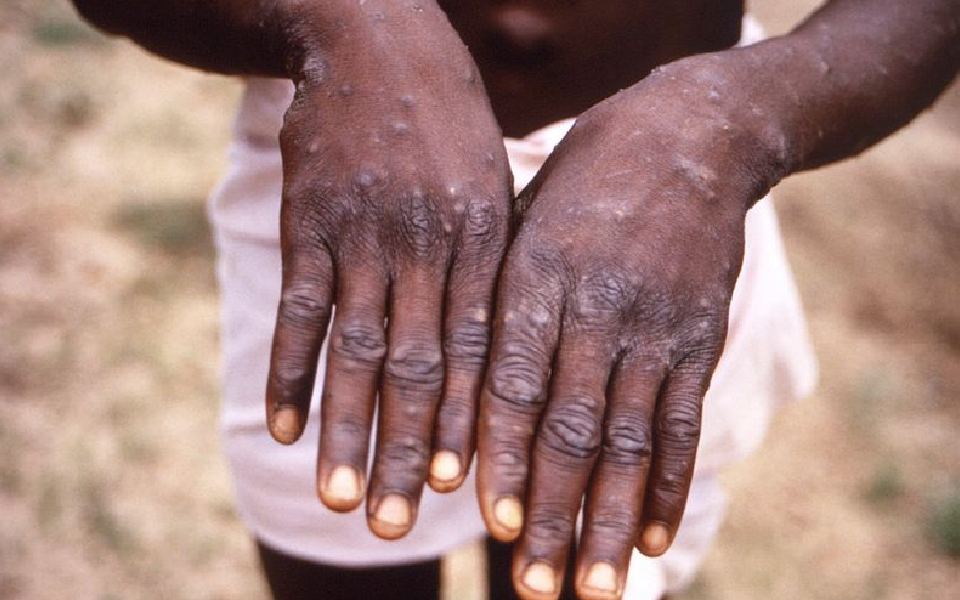
New Delhi, Aug 17: There are currently no reported cases of Monkeypox in India even though cautionary measures will be put in place to prevent and control the spread of the disease, the Union health ministry said on Saturday.
At a review meeting held during the day, although the possibility of a few imported cases being detected in the coming weeks was not entirely ruled out, it was assessed that the risk of a large outbreak with sustained transmission is low for India at present.
Since WHO first declared the outbreak a public health emergency of international concern in 2022, a total of 30 cases were detected in India with the last case being reported this March, the health ministry said in a statement.
There are no reported cases of Monkeypox in India as of now, it said.
The situation is being monitored closely by the ministry, the statement said.
In view of the World Health Organization (WHO) again declaring Monkeypox a public health emergency of international concern on August 14, a detailed review of the situation and the preparedness was taken by Union Health Minister J P Nadda at the meeting with the senior officials of his ministry.
It was decided that as a matter of abundant caution, certain measures such as sensitizing the health units at all airports, seaports and ground crossings; readying the testing laboratories (32); gearing up health facilities for detecting, isolating and managing any case are put in place.
At the meeting, it was noted that Monkeypox infections are usually self-limiting lasting between 2-4 weeks and patients generally recover with supportive management.
The transmission requires prolonged close contact with an infected case and is generally through the sexual route, direct contact with body/lesion fluid, or contaminated clothing/linen of an infected person, the statement said.
The WHO's declaration of 2022 was revoked in May 2023. Since 2022, WHO has globally reported 99,176 cases and 208 deaths due to Monkeypox from 116 countries.
A joint monitoring group meeting under the chairmanship of the Director General of Health Services consisting of experts from relevant fields was held on Friday to review the situation.
The meeting was attended by experts from the National Centre for Disease Control (NCDC), WHO, Indian Council of Medical Research (ICMR), National Centre for Vector Borne Disease Control Programme (NVBDCP), Directorate General of Health Services, central government hospitals, All India Institute of Medical Sciences AIIMS and others.
Let the Truth be known. If you read VB and like VB, please be a VB Supporter and Help us deliver the Truth to one and all.
Vartha Bharati–Sankalp predictions align closely with Karnataka bypoll results
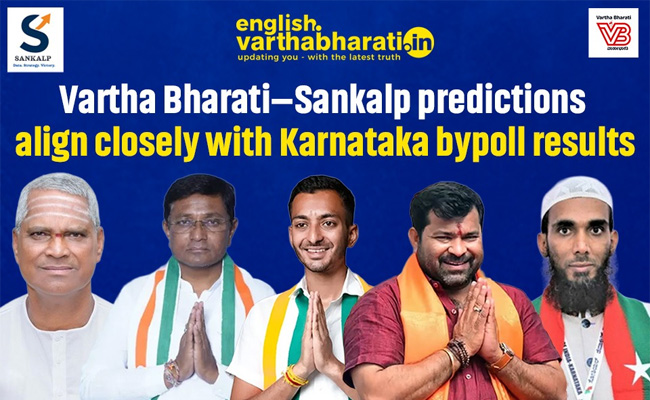
Bengaluru: The Vartha Bharati–Sankalp election analysis has shown a high level of accuracy in predicting the outcome of the recent Karnataka Assembly by-elections held in May 2026, correctly calling winners in both constituencies and closely estimating vote share trends.
The by-elections were held in Bagalkot and Davanagere South, drawing significant political attention as both seats were seen as key tests for the ruling Congress and opposition BJP.
According to the analysis, Vartha Bharati–Sankalp had made three major projections ahead of the results the winning party, vote share percentages, and margin of victory.
In both constituencies, the platform accurately predicted that the Congress would emerge victorious. The outcome matched the projections, with Congress candidates winning in Bagalkot and Davanagere South.
In terms of vote share, the predictions were largely in line with the final results. In Bagalkot, the BJP’s vote share was forecast in the range of 40 to 46 per cent, while the actual figure stood at 42.9 per cent. The Congress vote share, however, exceeded expectations, with the party securing 55.4 per cent against a projected range of 43 to 48 per cent.
The margin of victory in Bagalkot turned out to be significantly higher than anticipated. While the projection had placed the margin between 2,000 and 3,500 votes, the final margin was around 22,332 votes.
In Davanagere South, the predictions also remained largely accurate. The Congress vote share was projected between 43 and 51 per cent, and the final figure stood at 43.9 per cent. The BJP was expected to secure between 42 and 50 per cent but ended with 40.3 per cent.
The analysis had also identified the role of SDPI as a potential spoiler in the constituency. While its vote share was estimated around 6 per cent, the party eventually secured around 12 per cent of the vote.
The margin of victory in Davanagere South was predicted to be between 1,500 and 2,600 votes. The actual margin was higher at around 5,708 votes, though the contest remained relatively close as anticipated.
Overall, the performance of Vartha Bharati–Sankalp stood out for correctly identifying the winning parties in both seats and maintaining close accuracy in vote share estimates, with only limited deviations in specific cases.