High level Kerala delegation to source relief funds from diaspora
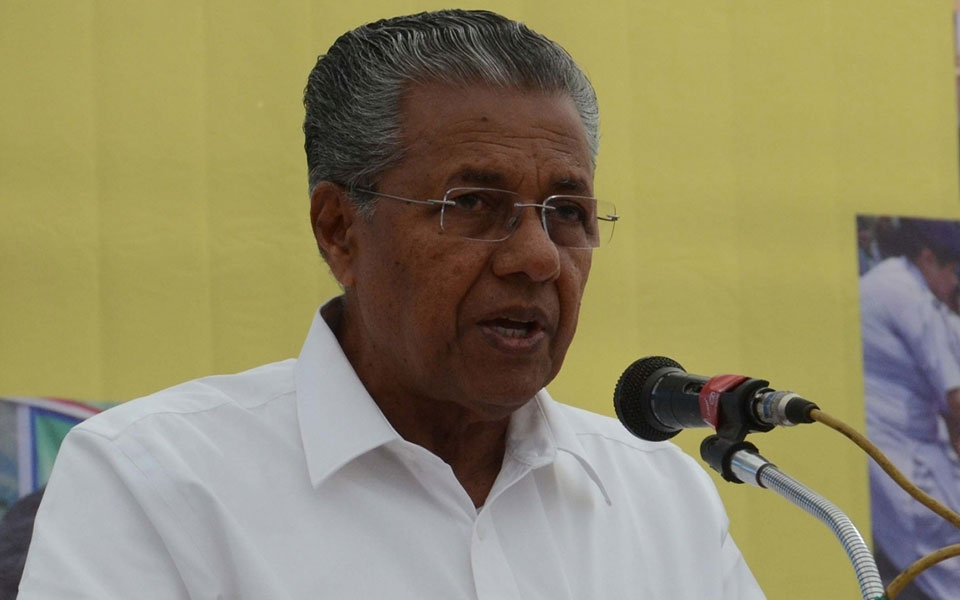
Thiruvananthapuram, Aug 31 : A high-level delegation led by a Kerala minister will travel to various Middle East countries and other nations to source funds for rebuilding the state in the wake of this month's devastating floods that have claimed 483 lives, Chief Minister Pinarayi Vijayan said on Friday.
The delegation will travel to the Middle East, the US, Australia, Germany, Canada, and along with the support of various Malyali organisation in these countries will seek funds for rebuilding the state, Vijayan told reporters after a cabinet meeting.
A delegation will also travel within India and meet up with all the Kerala-based organisation to seek funds.
"Similarly a fund collection drive will also be conducted in all the 14 districts of the state and each district will be headed by a Minister and it will take place between September 10 and 15.
"It has also been planned to initiate a collection in all the educational institutions in the state and it would take place on September 11," said the Chief Minister.
He also informed that international management consultant KPMG has agreed to provide free consultancy service and would be the consultant partner for rebuilding Kerala.
"The Sabarimala temple town has come under lot of damage and with the festival season slated to begin on November 17, it has been decided to hand over the restoration works to Tata Projects Ltd," he added.
An interest-free loan of Rs one lakh would be extended to all those who wish to buy household appliances, he said. Traders and others could avail a Rs 10 lakh in advance, which will bear interest, as an arrangement with a bank consortium is being worked out.
The contribution to the Chief Minister's Distress Relief Fund that began on August 15 has by now crossed Rs 1,000 crore.
The flood disaster has claimed 483 lives and the estimated value of destruction is more than the annual outlay of the state, besides it was the worst calamity to hit the state in a century. Some 14.50 lakh people are still putting up in over 3,000 relief camps following the incessant rain that lasted from August 8 to 16.
Let the Truth be known. If you read VB and like VB, please be a VB Supporter and Help us deliver the Truth to one and all.
Rupee falls 20 paise to 95.43 against US dollar in early trade

Mumbai (PTI): The rupee depreciated 20 paise to 95.43 against US dollar in early trade on Tuesday as market sentiments remained fragile after renewed military exchanges between US and Iranian forces in the Gulf region.
Forex traders said investor anxiety due to instability in the Gulf is causing massive capital flight into safe-haven assets, with the US dollar acting as the primary beneficiary.
Moreover, Brent oil prices is hovering near USD 113 per barrel, maintaining pressure on oil-importing economies like India.
At the interbank foreign exchange market the rupee opened at 95.30 then lost ground to touch 95.43 against the US dollar, in initial trade, registering a fall of 20 paise over its previous close.
Rupee fell 39 paise to close at an all-time low of 95.23 against the US dollar on Monday.
"With oil boiling rupee on Monday fell to a closing low of 95.0875 and this morning the opening was still lower as it becomes more and more vulnerable when dollar index rises due to safe-haven buying and oil prices rise due to the continuous fighting in the Gulf Region," Anil Kumar Bhansali, Head of Treasury and Executive Director, Finrex Treasury Advisors LLP, said.
The higher oil prices will keep rupee sold off against the dollar as oil companies and FPIs intensify dollar buying, Bhansali added.
Meanwhile, the dollar index, which gauges the greenback's strength against a basket of six currencies, was trading at 98.51, up 0.15 per cent.
Brent crude, the global oil benchmark, was trading lower by 1.07 per cent at USD 113.22 per barrel in futures trade.
"Market sentiments remained fragile after renewed military exchanges between US and Iranian forces when Iranian forces launched fresh attacks in the Gulf as both sides sought to assert control over the strategic waterway," Bhansali said.
On the domestic equity market front, Sensex declined 361.62 points to 76,907.78 in early trade, while the Nifty dropped 134.90 points to 23,980.60.
Foreign Institutional Investors purchased equities worth Rs 2,835.62 crore on Monday, according to exchange data.