High-power computing AI cloud being developed for armed forces: Par panel on defence

New Delhi (PTI): A parliamentary panel on defence has said that a "high-power computing AI cloud" is being developed effectively for the armed forces, and recommended that all technology-related programmes must follow laid-down time lines of their delivery to enable the forces to use and adapt themselves in a timely manner.
The Parliamentary Standing Committee on Defence, in its report presented in Parliament on Tuesday, also recommended that the efforts made by the Army towards women empowerment will "remain unabated" in the years to come so that a "level playing field for the women shall be created".
The report is titled "Action Taken by the Government on the Observations/ Recommendations contained in the Eighth Report of Standing Committee on Defence (18th Lok Sabha) on Demands for Grants of the Ministry of Defence for the year 2025-26 on Army, Air Force, Navy, Joint Staff, Ex-Servicemen Contributory Health Scheme and Directorate General of Armed Forces Medical Services."
In its report, the panel said, "During the oral evidence, a representative of the Navy informed the Committee that there are plans to increase the number of ships and submarines to 234 in the next few years."
"At present, there are a total of 61 ships under construction, which will be inducted into the Navy by the year 2030. The Navy submitted that out of this, 60 ships are being built in our Indian shipyards. The Committee have also been informed that apart from under-construction projects, the Navy has been given the government's Acceptance of Necessity for these inductions of which construction will start in the next one to two years," it said.
Appreciating the efforts made by the Navy towards achieving indigenisation, the panel recommend that concerted efforts be made to expedite completion of the ongoing projects so that the Navy attains "greater degree of 'Aatmanirbharta' in near future".
The Defence Ministry, in its action taken reply, has said that currently, 60 of the 61 warships under construction are being built in India, while contract conclusion in respect of 62 more ships and submarines, and 120 fast interceptor craft, to be built in domestic shipyards, is also at an "advanced stage".
Achieving higher indigenous content across weapons, sensors and equipment that supports the growth of the Indian shipbuilding sector continues to be a key focus area. Ongoing shipbuilding projects are being actively pursued with concerned shipyards for timely fructification, the government said.
"To achieve timely completion of ongoing projects, the production directorate at NHQ (naval headquarters) are reviewing the progress of these ongoing projects through Warship Oversee Team (WOT) using a structured review mechanism. In the last 10 years, an average of 65 per cent of the total expenditure has been focused towards indigenous procurement. During FY 2023-24, the ratio of 83.91:16.09 between Indian and foreign sources has been achieved," it told the panel.
The Committee had expressed hope that the country marches ahead in indigenous content in ship design and construction so as to achieve the goal of self-reliance, thereby supporting the domestic industrial-military ecosystem.
The panel further said it has been informed that a "high-power computing AI cloud is being developed effectively for all the three Services."
"The Committee understand that conventional wars were fought in only three modes i.e., land, air and water, but recently there is a paradigm shift in the technology used in fighting a war.
"There have been innovations and experiments in western countries, and the use of drones, including sea-drones, space, cyberspace, kinetic and non-kinetic format etc. has enveloped the sphere of war, which can be fought from very distant locations through a remote-controlled methodology," it said.
The panel said it is "confident that the technology-related National Missions, National Quantum Mission and high-power computing AI cloud will definitely enable our armed forces to develop a robust digital infrastructure, besides improving the existing weaponry".
"While appreciating all these critical developments, the Committee, can here, only recommend that all the initiatives/programs must follow laid-down time lines of their technological delivery to enable the Forces to use and adapt themselves in a timely manner," it added.
The government has replied that modernisation of the Indian Army is progressing as part of a "deliberate and comprehensive 'Integrated Capability Development Plan' ensuring induction of modern military platforms as well as rapid embracement of new technologies to ensure 24x7 operational readiness in defence of the country".
The Committee also said it is "happy to learn that a number of steps have been taken to ensure induction of more women in Indian Army".
On the IAF, he said, during deliberations, a representative of the Indian Air Force apprised the Committee that the "capability of Su-30 is being upgraded through indigenous upgraded programme and will be executed by HAL, DRDO and private industry under the supervision of IAF".
On Navy's manpower, it said, during deliberations, a representative of the Navy informed the Committee that the "Indian Navy has 10,045 officers, 59,828 sailors, 11,634 Agniveers and 32,171 defence civilians".
"The Committee have been informed that all personnel are fully trained for their work and are fully capable of maintaining combatability and operational preparedness of the Navy," it said.
Let the Truth be known. If you read VB and like VB, please be a VB Supporter and Help us deliver the Truth to one and all.
TVK falls short within touching distance; what next to ensure majority
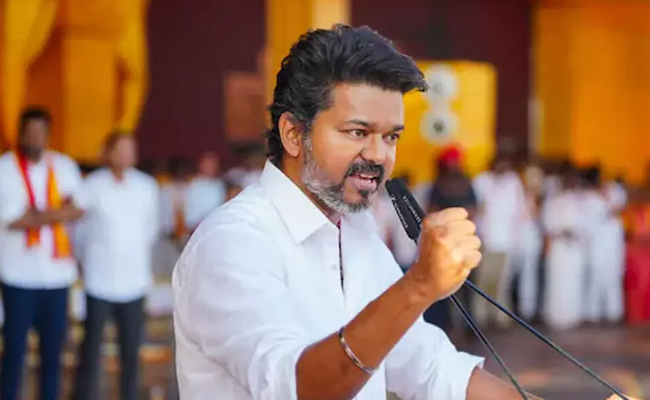
Chennai (PIT): With TVK falling 10 short of a majority, its leader Vijay has the option of forming a minority government in Tamil Nadu without any outside support, analysts said on Tuesday.
Senior political analyst Sumanth Raman told PTI that the TVK is likely to opt to be a minority government with outside support.
"Since it is the single largest party, TVK has the option to go for that. I don't think he (Vijay) will opt for official support from other political party's MLAs", he said.
"If he opts for minority government, the only thing is that, Vijay will have to prove the support once again after six months".
Raman also pointed out that in 2006 when DMK won only 92 seats, the then party president, the late M Karunanidhi formed a minority government with outside support.
In a completely unexpected turn of events in the Tamil Nadu Assembly elections, the TVK has emerged victorious, putting an end to the almost six decade-long dominance of the two major Dravidian parties--DMK and AIADMK.
By clinching victory in its debut electoral contest, the party has elevated its status to that of a recognised political entity. However, the Vijay-led TVK did not secure a mandate large enough to form a government with an absolute majority on its own, requiring another 10 to cross the finish line. Experts have varied opinions.
Specifically, to attain a simple majority, a political party must win at least 118 out of the total 234 constituencies. The TVK, however, secured victory in 108 constituencies. Given that the TVK fell short of the majority mark, what might unfold next?
TVK leader Vijay has won in both constituencies he contested--Perambur in Chennai and Tiruchirappalli East. As per the election commission rule, he will have to resign from one of these seats. TVK sources said that the leader is likely to surrender the Tiruchirappalli assembly seat.
If Vijay does so, the party's total tally of seats will decrease by one. Then it will be 107. Adding to the number games, TVK appointed Speaker of the Assembly will be ineligible to cast a vote during a confidence motion and the party's effective voting strength will be reduced by yet another seat, which comes to 106.
Accordingly, the TVK requires the support of an additional 12 members to demonstrate its majority. As of now, within the DMK alliance, the Congress party has secured five seats, the two Communist parties have won two seats each (totaling four), while the DMDK has secured one seat, the Indian Union Muslim League (IUML) has won two seats and the VCK has secured two seats.
Within the AIADMK alliance, the PMK has grabbed four seats, the BJP has won one seat, and the AMMK has secured one seat. Going by the calculations, if TVK gets the support of other parties within both alliances, it would gain an additional 21 seats.
TVK could potentially secure a total of 129 seats (108 + 21). However, the TVK does not require the support of all those parties, and the backing of just 12 members would suffice.
As Vijay is expected to visit Lok Bhavan on Wednesday (May 6) to meet the governor Rajendra Vishwanath Arlekar to stake claim to form government, the governor is expected to offer the TVK two options.
First, he may summon the TVK chief and instruct him to demonstrate his majority on the floor of the legislative assembly. Alternatively, he might ask Vijay to gather letters of support from "allied" parties and submit them to him.
If the TVK secures support exceeding 118 seats, the governor would invite the party form the government. If TVK fails to garner support from other political parties, it will be denied the opportunity to form the government.
In such a scenario, the governor has the option to invite the DMK, the party holding the second-highest number of seats to form the government.
If DMK too is unable to form a government, the state of Tamil Nadu will come under governor's rule for the subsequent six months. Following this period, fresh legislative Assembly elections will be once again held across all 234 constituencies.
Another political analyst Durai Karuna ruled out that TVK will go for a minority government.
"If he (Vijay) gives an appeal, many political parties including Congress, VCK and left parties will join TVK", he claimed. "In addition, the AIADMK, which has decided to organise MLAs meeting on Wednesday, might also announce that it would support TVK unconditionally".
He said a clear picture on Vijay's decision will emerge in a couple of days.
Tharasu Shyam, political critic, claimed that Congress was "holding talks with Vijay."
"From now on, the DMK must change its approach and this applies equally to the AIADMK," he said in an apparent reference to some reported difference of opinion between allies DMK and Congress over seat-sharing and power-sharing ahead of the April 23 polls.
Incidentally, AICC in-charge for Tamil Nadu, Girish Chodankar, on Tuesday admitted that the Congress party leadership's decision to stick with the DMK alliance went against strong grassroots sentiment favouring the TVK.
"The local leaders, the grassroots level leaders, were suggesting if Rahul Gandhi, who has a large acceptance in Tamil Nadu, joins the campaign with Vijay, it will create a big impact and we can sweep the Tamil Nadu polls, and get somewhere around 180-190 seats," Chodankar told PTI Videos.