Himachal Congress urges EC to take action against carrying of EVMs in private car
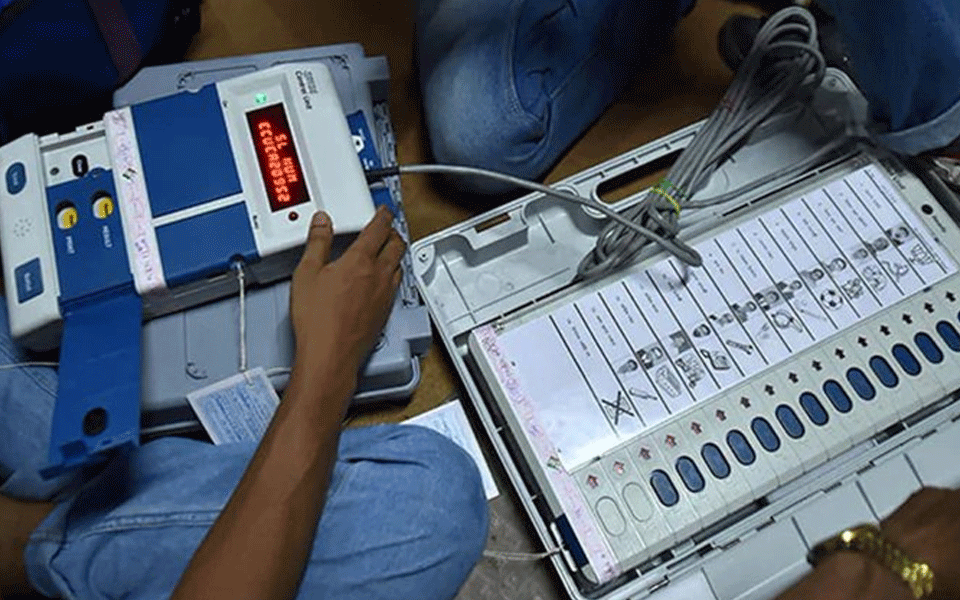
Shimla (PTI): The Congress on Saturday complained to the Election Commission against carrying of EVMs in private vehicles which is in violation of the rules.
In a complaint to the Chief Election Officer, Himachal, the Legal and Human Rights Department of the state Congress said the EVM machines have been seen to be carried to their stations (strong rooms) in unauthorised private vehicles.
Terming it an "utterly unfortunate incident" in his Vidhan Sabha constituency, Rampur, Congress legal cell working chairman Pranay Pratap Singh said that as per the protocol, the vehicles hired to carry such machines to the strong rooms are to be requisitioned beforehand by the Election Commission or the returning officers.
"But in the case in hand, the machines were transferred in a private vehicle which had no prior authorisation or requisition from either the Returning Officer or the Election Commission," said Singh on the car in question.
"It is most humbly requested to you to kindly take cognisance in the said matter at the earliest as if not done so, the ruling BJP party shall make a mockery out of the elections and will curtail not just the fundamental rights of the citizens but the independent powers and functions of the Election Commission of India too," the Congress complaint to CEO read.
"Necessary actions with regard to the violations of the Model Code of Conduct must be taken on immediate basis and a criminal complaint against the offenders shall be filed at the earliest," the complaint also said.
Earlier, the Himachal Congress in another complaint alleged that the BJP had been circulating a "fake letterhead" in the name of Rajeev Shukla, AICC in-charge for Himachal, with a motive to influence the voting patterns in favour of the BJP candidates.
The party in its complaint said that Shukla never wrote or signed any such letter.
"This letter is disseminating frustration level of BJP This forged letter is nothing but a feeble attempt to damage the Congress but the BJP is not aware that the people of Himachal Pradesh are wise and intelligent enough to construe their malafide intentions," the complaint said, seeking strict action and registration of an FIR against the BJP.
Let the Truth be known. If you read VB and like VB, please be a VB Supporter and Help us deliver the Truth to one and all.
Two arrested in K'taka for assaulting minors, uploading CSAM content

Bengaluru (PTI): Two men were arrested for allegedly sexually assaulting two minor girls, recording the acts on mobile phones and uploading the videos online as child sexual abuse material, police said on Thursday.
The accused have been identified as Kiran Kumar (29), hailing from Chitradurga district, and Aditya M K (20), hailing from Shivamogga district, they said.
A probe was initiated after information was received from the NCRP portal regarding a suspected instance of creation of Child Sexual Abuse Material (CSAM) for online dissemination, police said.
Accordingly, a case was registered at Kaggalipura Police Station under relevant sections of the IT Act on May 10, they added.
Investigation revealed that two minor girl victims were exploited and videos were created and uploaded to the internet. The child victims have subsequently recorded their statements as per procedure and further necessary legal steps have been taken, Pronab Mohanty Director General of Police, Cyber Command, said in a statement.
Based on the statements of the victims, the accused persons, who allegedly assaulted the minors, recorded the acts on mobile phones and uploaded the videos online, were arrested, he said.
Following the probe, sections 65(2) (rape) and 70 (gangrape) of the Bharatiya Nyaya Sanhita, along with relevant sections of the POCSO Act, have been added to the FIR, police said.
Officials collected relevant information and on May 12, arrested the accused persons and seized three mobile phones belonging to them, in which the videos had allegedly been recorded, he said.
The accused were later produced before the court and taken into police custody for further investigation, he added.
According to him, in CSAM cases, police usually apprehend offenders who have downloaded such content or have kept them in their possession after obtaining them from elsewhere, usually the internet.
"The present case is one of the very few instances where content creators and uploaders have been apprehended," Mohanty added.