Hindu Ekta Sammelanams in Kerala mask sangh outreach through temple gatherings
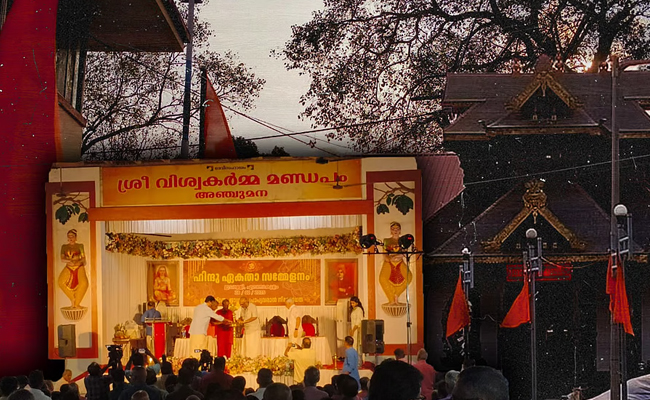
Kochi: Temple premises in several parts of Kerala have been increasingly organizing programs calling for Hindu unity as the Rashtriya Swayamsevak Sangh celebrates its centenary year with outreach events across the country.
The News Minute reported that one such programme held on February 28 near Edappally in Kochi began with traditional performances, including chenda melam and a Thiruvathira dance at the Anjumana Devi temple ground, and transitioned into a “Hindu Ekta Sammelanam”. Organisers were quoted as saying that the objective of the event was “to bring together members of different Hindu communities by transcending caste, regional and linguistic differences.”
The RSS is celebrating its centenary year by nationwide series of conferences. These began on October 2, 2025. Reports indicate that more than one lakh such meetings are planned across India in 2026, with over 1,000 events scheduled in Kerala between February and March.
At the Edappally programme representatives of the Hindu Aikya Vedi and other spiritual leaders expressed their thoughts. Hindu Aikya Vedi state president R V Babu said the events are organised to strengthen a sense of unity among Hindus and encourage people to move beyond caste divisions.
Participants at the gathering included members of various organisations such as the Nair Service Society, Sree Narayana Dharma Paripalana Yogam and representatives of other community groups. Some attendees said they viewed the events primarily as religious or cultural programmes organised around temples in their localities.
Criticizing the gatherings, leaders of the Communist Party of India (Marxist) said that temple premises are being used to advance a political agenda under the cover of religious and cultural programs. The party’s youth wing, the Democratic Youth Federation of India, has opposed some of the events at the local level, arguing that religious spaces should not become platforms for ideological mobilisation.
Some attendees clarified that they participated viewing the programmes as temple-based community events rather than political meetings. Others acknowledged that discussions during the sessions included references to electoral participation and broader social themes.
Similar objections were raised in Kozhikode district, where local CPI(M) workers opposed a gathering linked to a temple committee. He argued that religious spaces should not be used for political mobilization, when Kerala is expected to go to Assembly polls in 2026.
Let the Truth be known. If you read VB and like VB, please be a VB Supporter and Help us deliver the Truth to one and all.
Explosive device kills 13, injures 38 on bus in southwestern Colombia as violence persists
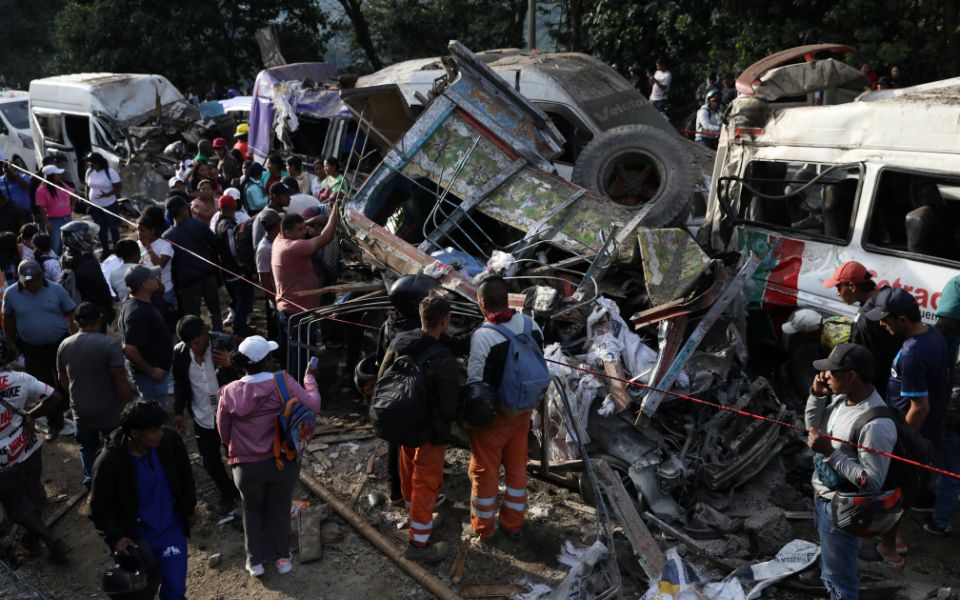
Bogota (Colombia) (PTI): An explosive device killed 13 people travelling on a bus in southwestern Colombia on Saturday, an attack the country's army chief described as a “terrorist act" that also left at least 38 injured as violence linked to drug trafficking in the region escalates.
Octavio Guzman, the governor of the region of Cauca, said on X that the device was set off while the bus was travelling along the Panamerican Highway in the municipality of Cajibio. Five children were among the injured, Cauca Health Secretary Carolina Camargo told Noticias Caracol, a TV news program.
Gen. Hugo Lopez, commander of Colombia's Armed Forces, told a news conference that it was a “terrorist act" and blamed the network of a man known as “Ivan Mordisco” — one of Colombia's most wanted figures — and the Jaime Martínez faction. Both are dissidents of the now-defunct Revolutionary Armed Forces of Colombia that operate in the region.
Neither Ivan Mordisco nor the Jaime Martínez faction abide by the peace agreement signed with the state in 2016.
Colombian President Gustavo Petro condemned the attack on X.
“Those who carried out the attack and killed seven civilians — and wounded 17 others — in Cajibío — many of them Indigenous people — are terrorists, fascists, and drug traffickers,” he wrote.
The attack is the latest in a spate of explosions that have attempted to target public infrastructure. At least 26 incidents have taken place in the past two days in southwestern Colombia, which Lopez said have only affected civilians.
They included a shooting at a police station in the rural area of Jamundi, and an attack on a Civil Aviation radar facility in El Tambo, where authorities took down three explosives-laden drones earlier on Saturday. No one was hurt.
On Friday, two vehicles rigged with explosives were detonated near military units in Cali and Palmira, causing material damage.
The escalation of violence in that region — a territory contested by illegal armed groups linked to drug trafficking — prompted the mobilisation of high-ranking officials on Saturday. Led by Defence Minister Pedro Sanchez, the delegation that includes regional governors and local authorities, was meeting in Palmira when the deadly explosion occurred.
“These criminals seek to instil fear, but we will respond with firmness,” Sanchez said on X.
Meanwhile, Francisca Toro, governor of Valle del Cauca, has called upon the national government to provide “immediate support.” In a message on X, Toro called for a reinforcement of public security forces, enhanced intelligence operations and “decisive actions” against crime in the face of a “terrorist-level escalation.”
According to authorities, Cauca and Valle del Cauca serve as a critical hub for illicit activities of illegal armed groups vying for control over sea and river access routes leading to the port of Buenaventura — a key transit point used to traffic drugs to Central America and Europe.
The government has also offered a reward of more than 1 million dollars for information leading to the capture of “Marlon,” who is identified as the leader of the region's dissident group. On Friday, local authorities offered more than USD 14,000 for information leading to the identification and location of those behind the attacks in Cali and Palmira.