Hindu Mahasabha leader arrested for businessman's murder, sent to jail
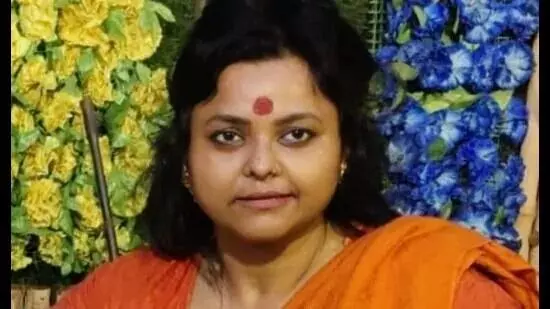
Aligarh (PTI): All India Hindu Mahasabha national general secretary Pooja Shakun Pandey has been arrested in connection with the murder of local businessman Abhishek Gupta, police said on Saturday.
She was produced in court and sent to jail on Saturday.
Pandey was arrested near Lodha bypass on Agra-Jaipur highway in Rajasthan's Bharatpur district late on Friday night, police said.
This is the fourth arrest made in the case.
Earlier, police had arrested Pooja's husband Ashok Pandey and sharp shooters Mohammad Fazal and Asif, who carried out the killing on the couple's instructions.
Gupta was shot dead on September 26, while boarding a bus along with his father and a relative at the main Khereshwar Mandir crossing on the outskirts of Aligarh city. He was rushed to the Jawaharlal Nehru Medical College Hospital, but doctors declared him dead on arrival.
According to investigators, the murder was a contract killing, allegedly ordered by the Pandey couple following a monetary dispute with Gupta. The couple is said to have been harassing the businessman for a long time.
Police said both the hired shooters were familiar with the Pandey couple and had been regular visitors at their residence.
Confirming the arrest, Aligarh Senior Superintendent of Police Neeraj Kumar said all the key accused in the case have been held now and a detailed charge sheet will be filed soon.
Pooja Pandey carried a reward of Rs 50,000 on her arrest, he added.
Let the Truth be known. If you read VB and like VB, please be a VB Supporter and Help us deliver the Truth to one and all.
AAP activists detained during Mumbai protest against Raghav Chadha
_vb_69.jpeg)
Mumbai (PTI): Police on Sunday detained some Aam Aadmi Party activists in Mumbai after they staged a demonstration against Rajya Sabha member Raghav Chadha, who has crossed over to the BJP, in Khar area.
Aam Aadmi Party's Mumbai unit president Preeti Sharma Menon claimed the police prevented AAP workers from protesting peacefully against "traitor" Chadha and detained local leader Ruben Mascharanhas.
A Khar Police official confirmed that Mascharanhas and some other activists have been taken to the police station, without elaborating.
"@CPMumbaiPolice @mumbaipolice has no other work but to guard Raghav Chaddha’s Mumbai residence. @aapmumbai volunteers were prevented from protesting peacefully against the GADDAR. Ruben has been detained at the Khar Police Station. But BJP is allowed to block roads at their whim," Menon stated.
The AAP's Mumbai unit had planned a protest in the Khar area against Chadha and six other Rajya Sabha MPs of the party who recently joined the BJP.
"Without any detention order or any written communication, I have been taken to the Khar Police Station. Why is @MumbaiPolice so scared of @AAPMumbai's peaceful protest against 'Gaddar' Raghav Chaddha and Sandeep Pathak? We are @ArvindKejriwal's soldiers, we are not going to be cowed down," Mascharanhas said in another post.
The AAP suffered a jolt on Friday when seven of its Rajya Sabha members, including Chadha, Ashok Mittal and Sandeep Pathak, quit the party, with Chadha saying all of them have merged with the BJP, asserting that the Arvind Kejriwal-led party had strayed from its principles, values and core morals.
VIDEO | Mumbai: AAP workers protest outside Rajya Sabha MP Raghav Chadha’s residence.
— Press Trust of India (@PTI_News) April 26, 2026
On Friday, the AAP suffered a jolt when seven of its Rajya Sabha MPs Raghav Chadha, Ashok Mittal, Sandeep Pathak, Harbhajan Singh, Rajendra Gupta, Vikram Sahni and Swati Maliwal quit and merged… pic.twitter.com/GWKCSvDrOJ