Hindus, Indian Muslims should not worry about NRC: Dilip Ghosh
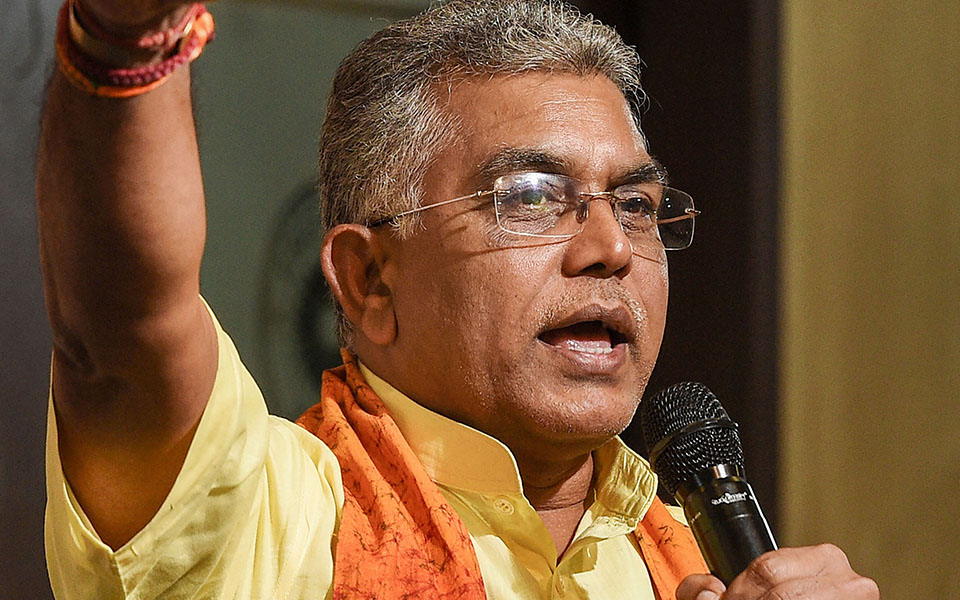
Kolkata, Sep 30: West Bengal BJP president Dilip Ghosh on Monday said Hindus and Indian Muslims have nothing to worry about NRC, as the exercise would be done only to weed out infiltrators.
Ghosh's comment comes in the backdrop of a panic gripping the people of West Bengal following repeated announcement of BJP leaders that the National Register of Citizens (NRC) would be implemented after the party comes to power in the state.
Hundreds of people are seen queueing at government and municipal offices across West Bengal to collect their birth certificates and other documents to be in readiness, should NRC be implemented in the state despite assurances by the TMC government that it would not be allowed in the state.
"The Hindus and Indian Muslims have nothing to worry about NRC. The Hindu refugees would be accorded citizenship under Citizenship (Amendment) Bill. The Muslims who are living in India for the last several decades and have proper documents would not be affected. They will remain citizens of the country," Ghosh said.
The Citizenship (Amendment) Bill, 2019 provides for according Indian citizenship to Hindus, Jains, Christians, Sikhs, Buddhists and Parsis from Bangladesh, Pakistan and Afghanistan after seven years of residence in India, even if they do not possess any document. The legislation was passed by Lok Sabha during its winter session on January 8 but could not be cleared by the upper house.
"Only those who had infiltrated from Bangladesh should be worried as once the NRC is implemented, they would be identified and thrown out of the country," he said while addressing a discussion on the NRC.
Indian Muslims should be worried that infiltrators are eating into their jobs and livelihood, the BJP leader said.
Some senior party leaders have said the Bill would be reintroduced in the winter session of Parliament.
Ghosh alleged that TMC is opposing NRC in West Bengal in order to protect Bangladeshi Muslim infiltrators who are its vote bank.
TMC has been against the updation of the NRC calling it an "anti-Bengali" move by BJP.
In Assam, the only state in the country where the exercise was carried out, names of over 19 lakh people were omitted from the final list which was published on August 31.
Suspicion was raised by some quarter that about 12 lakh of them are Hindus.
The omission of the large number of Hindu Bengalis from the final NRC list in BJP-ruled Assam has apparently created panic among the people of West Bengal and has allegedly led to 11 deaths so far.
Let the Truth be known. If you read VB and like VB, please be a VB Supporter and Help us deliver the Truth to one and all.
Karnataka launches state-led Centre of Excellence for Space Technology in Bengaluru
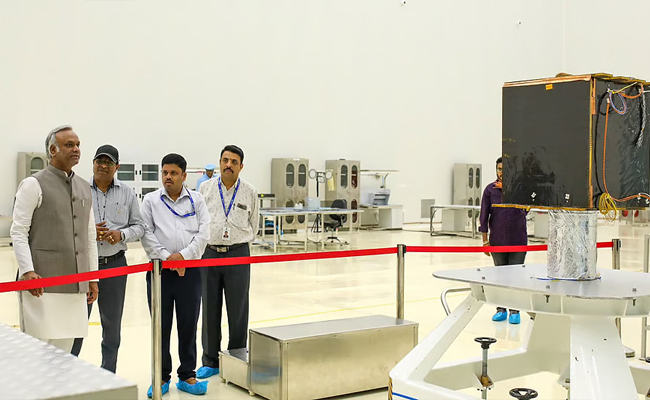
Bengaluru (PTI): In a significant boost to India’s rapidly expanding space economy, the Karnataka government on Friday launched the country’s first state-led Centre of Excellence for Space Technology here, officials said.
The initiative is aimed at strengthening India’s capabilities to translate space innovation into scalable commercial outcomes, they said.
The Centre, established by the Government of Karnataka through the Karnataka Innovation and Technology Society in collaboration with SIA (Satcom Industry Association India) -India, was inaugurated by Minister for Electronics, IT/BT, and Rural Development and Panchayat Raj, Priyank Kharge, in the presence of senior officials and industry leaders, officials said.
Speaking at the launch, Minister Kharge said that Karnataka has consistently been at the forefront of India's technology and innovation journey. With the launch of this Centre of Excellence for Space Technology, we are extending that leadership into one of the most strategic sectors of the future.
"Our focus is not just on advancing research, but on creating an ecosystem where innovation can translate into real-world applications, economic growth, and high-quality jobs. This Centre will play a critical role in positioning Karnataka as a key driver of India's space economy," he said.
According to an official statement, the CoE SpaceTech Foundation has been established under a Memorandum of Agreement between KITS and SIA-India to drive research and innovation in space technologies, industry-aligned training, startup incubation and cross-sector applications, it said.
The Centre has also formalised strategic MoUs with multiple industry and academic partners to support research in space biotech and microgravity, enable collaboration, build talent pipelines, and provide startups with training and market access, it added.