Hope Centre will declare cows 'protected national animal', says Allahabad HC
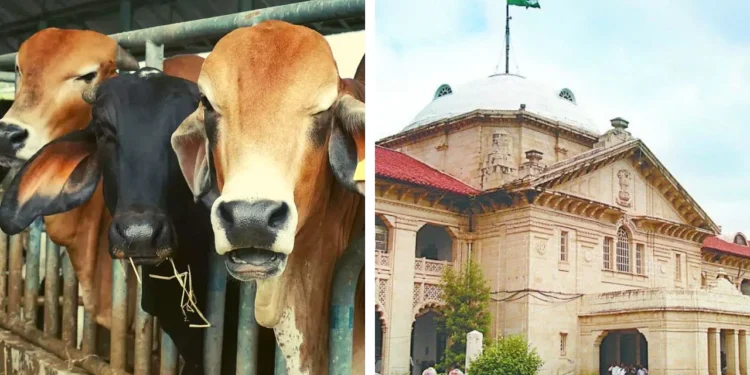
Lucknow, Mar 4: The Lucknow bench of Allahabad High Court has expressed hope that the Centre will take an appropriate decision to ban cow slaughter and declare it as a "protected national animal".
"We live in a secular country and must have respect for all religions. In Hinduism, the belief is that the cow is the representative of divine and natural beneficence. Therefore it should be protected and venerated," Justice Shamim Ahmad said on February 14, dismissing a plea seeking the quashing of criminal proceedings against a person under the Uttar Pradesh Prevention of Cow Slaughter Act, 1955.
The petitioner, Barabanki resident Mohammad Abdul Khaliq, had pleaded that the police booked him without any evidence and hence the proceedings pending against him in the court of additional chief judicial magistrate should be quashed. Dismissing the plea, the bench held that from the facts on record, a prima- facie case was made out against the petitioner.
While passing the order, the judge observed, "The cow has also been associated with various deities, notably Lord Shiva (whose steed is Nandi, a bull) Lord Indra (closely associated with Kamadhenu), Lord Krishna (a cowherd in his youth), and goddesses in general."
"According to legend, she emerged from the ocean of milk at the time of Samudramanthan (the great churning of the ocean by the gods and demons). She was presented to the seven sages and with time came into the custody of sage Vasishta."
The judge further said that a cow's legs symbolise the four Vedas and her milk is four "purushartha" (or human objectives -- "dharma" or righteousness, "artha" or material wealth, "kama" or desire and "moksha" or salvation.
"Her horns symbolise the gods, her face the sun and moon, and her shoulders "Agni" (the god of fire). The cow has also been described in other forms: Nanda, Sunanda, Surabhi, Susheela and Sumana," Justice Ahmad said.
He said that the origin of the veneration of the cow can be traced to the Vedic period.
"The Indo-European peoples who entered India in the second millennium BCE were pastoralists. Cattle had a major economic significance that was reflected in their religion. The slaughter of milk-producing cows was increasingly prohibited. It is forbidden in the Mahabharata, and in the "Manusmriti"."
A cow which produces milk was said to be "unslayable" in the Rigveda, the court said, adding, "The degree of veneration afforded to cow is indicated by the use in rites of healing purification and penance of the "panchagavya" (cow-milk, curd, butter, urine, and dung)."
Subsequently, with the rise of the ideal of "ahimsa", cow came to symbolise non-violence, it said.
"In addition, because her products supplied nourishment, the cow was associated with motherhood and Mother Earth and legislation against cow killing persisted into the 20th century in many princely states," said the court.
According to the high court bench, legends also state that Brahma gave life to priests and cows at the same time so that the priests could recite religious scriptures while cows could afford ghee as an offering in rituals.
"Anyone who kills cows or allows others to kill them is deemed to rot in hell for as many years as there are hairs upon his body. Likewise, the bull is depicted as a vehicle of Lord Shiva: a symbol of respect for the male cattle.
"In the Mahabharata, Bhishma observes that the cow acts as a surrogate mother by providing milk to human beings for a lifetime, so she is truly the mother of the world. The Puranas state that nothing is more religious than the gift of cows. Lord Rama was given a gift of many cows," the bench said.
Dismissing the petition, it said, "This bench Lucknow hopes and trusts that the Central Government will take appropriate decision to ban cow slaughter in the country and declare cows 'protected national animal'."
Let the Truth be known. If you read VB and like VB, please be a VB Supporter and Help us deliver the Truth to one and all.
Allahabad HC orders probe into 'reinstatement' of teacher in UP's Barabanki
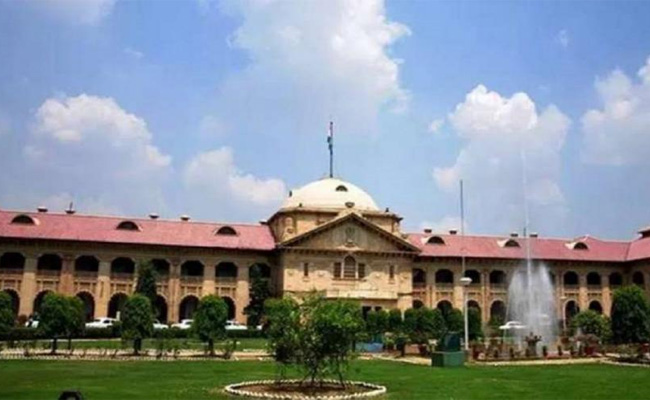
Lucknow (PTI): The Lucknow Bench of the Allahabad High Court on Friday ordered a probe by the special task force (STF) into alleged irregularities in the rejoining of a teacher at City Intermediate College in Barabanki, observing that the reinstatement appeared to be prima facie illegal.
The court also directed the recovery of the salary paid to the teacher during the disputed period.
A bench of Justice Rajeev Singh passed the order on a petition filed by the college management committee. The court expressed doubts over the roles of the District Inspector of Schools (DIOS), Barabanki, the college principal and the teacher concerned and hence, directed a detailed inquiry into the matter.
Taking note of alleged manipulation of records and misleading submissions, the court ordered the immediate transfer of the Barabanki DIOS to ensure a fair probe. It also directed the initiation of disciplinary proceedings against the then joint director of education of the Ayodhya division.
In its order, the court found that the teacher, Abhay Kumar, was initially appointed as an assistant teacher in 2018 but joined an Eklavya Model Residential School in Chhattisgarh as a lecturer in June 2024 without obtaining permission from the management. His subsequent request to retain the lien was rejected.
Despite this, he was allowed to rejoin the Barabanki College in September 2025 on the directions of the joint director of education and the DIOS, and was even paid the salary for October 2025. The court termed the rejoining "wholly illegal" and lacking any legal basis.
The bench also expressed concern over lapses in communication within the education department and directed the Uttar Pradesh chief secretary to ensure that official orders are communicated through email and WhatsApp as well, to prevent disputes.
The matter is next listed for hearing on May 28 when a compliance report is sought.