How many more pilots have to give up their lives to shake 'you' up, asks wife of Mirage crash pilot
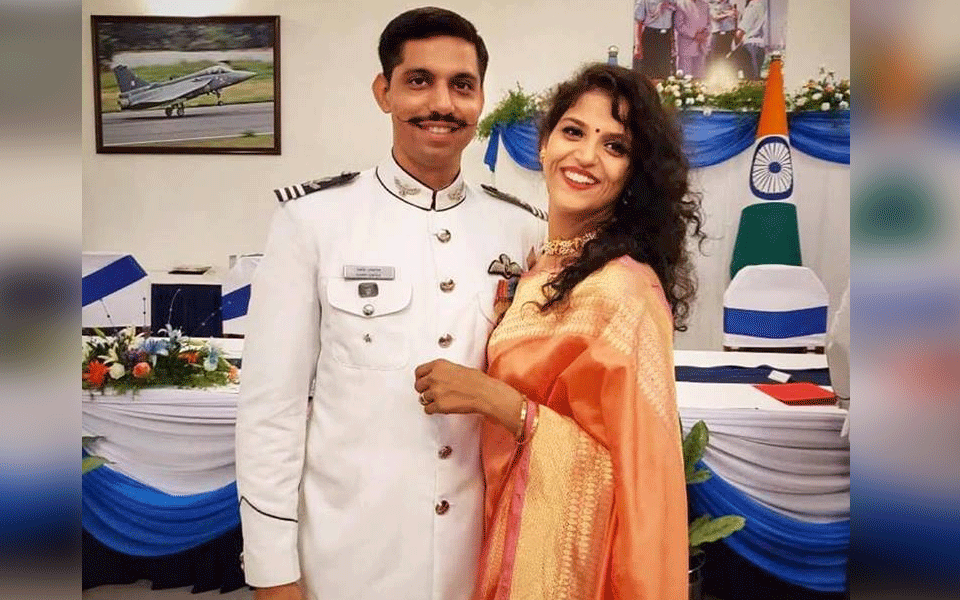
New Delhi : Garima Abrol, wife of IAF pilot Samir who died in a Mirage 2000 aircraft crash earlier this month, has sought to know how many more aviators will lose their lives for the authorities to realise there is "something really wrong" in the system.
In a moving Facebook post, Abrol said the feeling has still not sunk in that her husband is no more and that she will keep fighting for the cause that claimed Samir's life.
On February 1, Squadron Leaders Samir Abrol and Siddhartha Negi, both from Aircraft and Systems Testing Establishment, died after their fighter jet crashed in Bengaluru.
They were conducting an acceptance sortie of the Mirage-2000 trainer, which had been newly upgraded by state-run aerospace company Hindustan Aeronautics Limited.
Though the two pilots made a bid to eject, they were caught in the flames as the plane crashed with a huge explosion.
"I am Garima Abrol I am the wife of Martyr Squadron Leader Samir Abrol...whose tears are still not dry... It still hasn't sunk in that you are gone. No one has the answer to my questions. Why YOU? My husband was a proud Indian and I loved sending him off to serve the nation with a morning cup of tea and a head held high.
"Every soldier's wife's biggest fear in life is when her husband would be called to the front line and serve in an active war. I too had this fear. Many a times I woke up crying after having one such bad dream... But Samir would hold me, console me and tell me...that (it) is the ultimate purpose of his job...to be able to serve our nation when the call comes... He wanted me to be brave, as that's what he was, a brave soldier, patriot to the core," she said in a Facebook post.
"How many more of these pilots have to give up their life to shake you up and make you realise there is something really wrong in the system? How many fighters have to give up their life for you to wake up?" she said.
In another post last week, Samir's younger brother, Sushant, had said while the bureaucracy enjoy its "corrupt cheese and wine", the air warriors are given "outdated machines" to fight.
An emotional poem penned by Sushant, posted on Facebook, states it is an "unforgiving" job to be a test pilot, given the risks it posses.
Let the Truth be known. If you read VB and like VB, please be a VB Supporter and Help us deliver the Truth to one and all.
Man arrested with Rs 2.54-crore heroin in Mumbai

Mumbai (PTI): Police have arrested a man and seized over 500 grams of heroin worth Rs 2.54 crore in the illicit market from him in Mumbai, officials said on Friday.
The police's Anti-Narcotics Cell (ANC) made the drug seizure in Santacruz in the western suburbs. The operation was conducted by the Kandivali unit of the ANC on Thursday as part of a special crackdown against drug trafficking in the area, they said.
Acting on specific inputs, an ANC team conducted a raid in Santacruz (East) and intercepted a man. During a search, the team recovered 508 grams of high-grade heroin from his possession, an official said.
The seized contraband, a highly addictive, opioid drug derived from morphine, is estimated to be worth Rs 2.54 crore in the international market, he informed.
Following the seizure, a case was registered against the man under relevant sections of the Narcotic Drugs and Psychotropic Substances (NDPS) Act, 1985, and he was formally placed under arrest in the early hours of Friday.
The police are currently investigating the source of the drug and trying to identify the intended recipients of the consignment, he said.