How Sanatan Sanstha got away without implications after Gauri Lankesh's murder: Rollo Romig explains
New York Times writer Rollo Romig in conversation with Karthik Venkatesh for Vartha Bharati
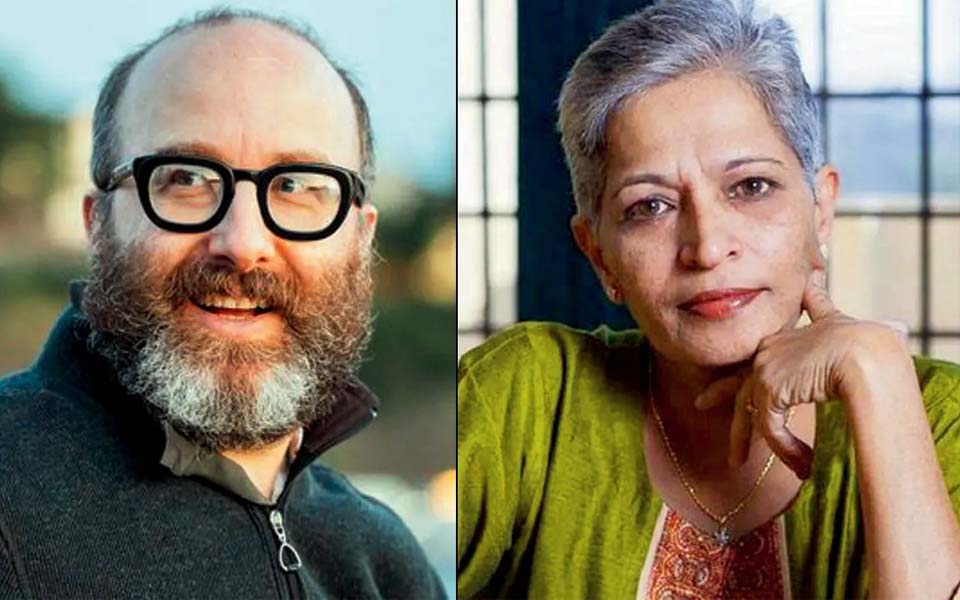
Rollo Romig, a Detroit-born journalist and essayist, has been visiting India for over a decade, with a special connection to Bangalore and other parts of South India. A regular contributor to The New York Times Magazine and other leading publications, Romig has built a reputation for his sharp reporting and deep engagement with the region. His recent book, I Am on the Hit List: A Journalist’s Murder and the Rise of Autocracy in India, investigates the 2017 assassination of Gauri Lankesh, the outspoken editor and activist, and traces the chilling investigation that followed. The book, published by Penguin Press in 2024 in the US, and by Westland in India with different sub-title, was named a finalist for the 2025 Pulitzer Prize in General Nonfiction and has been widely praised for blending true crime, biography, and political history with the story of a city and its changing times.
Romig was candid and frank in his observations and refused to be cynical about the circumstances, however discouraging they appeared. He spoke to Karthik Venkatesh for Vartha Bharati about a number of issues and concerns. Here are excerpts from that conversation:
When and how did your interest in India begin? What drew you to the Indian cultural and social scenario?
My wife, whom I met in New York City, is originally from Kerala. When we got married, I was just getting started as a freelance journalist. When I visited India on family visits, I realized that there was a lot of fascinating journalistic work I could do. What really interested me was that in American media, when it pays attention to India at all, it is almost always North India. The journalists are usually based in Delhi and they are usually focused on what is happening in Delhi and the neighbouring areas occasionally venturing further afield. I was struck by the fact that India is an extraordinarily diverse country. It is really more like a continent than a country and South India where I was spending most of my time feels like an entirely different place in almost every way from Delhi and its environs. So I made it my mission to do as many stories as I could on this/these particular place(s) in the world telling stories that I wasn’t seeing otherwise in the American media. For a decade, I did a lot of reporting from South India, mostly for the New York Times magazine.
To an average American, India is likely just one big mass of people (except perhaps the North East. But you said something astute: that South India is different. Was your attention to this difference because of your wife or was there something else that you caught on to was different?
I have my wife to thank for, for most of my perceptions of India. I couldn’t have done what I have done without her insights at every stage. But everywhere I go, I approach it with the assumption that the generalized story that we think we know of a place is wildly insufficient and dumbed down. Things are more complicated than we assume it to be when we view it from far away. I always look for the more complicated, more nuanced story wherever I go.
You have been reporting on India for more than a decade. And this past decade has been a rupture in India looking at its own historical trajectory. The majoritarian impulse is riding roughshod over everything. Even the opposition parties have adopted it, to an extent. This has paralleled a similar discourse in the USA. Where do you see all of this emerging from? Why has this caught on in the last decade or so, both in India and USA, both important democracies?
What always impressed me about India was its extraordinary diversity and pluralism. To me, that’s what makes India what it is, what makes it flourish. To see that pluralism eroded and the attempt to make it a unitary culture is alarming and sad. This is a global trend, this hyper nationalism.
My sense is that this tendency is always lurking in politics, ready for a comeback. I remember Raghu Karnad making a point in a literary festival in Brooklyn. His book was on the Second World War and he was in conversation with some others from countries Europe and USA don’t associate with the Second World War. He made the point that we think the Second World War ended in 1945, but in many parts of the world it actually did not end. It continued. I think that’s true in our politics too. We assumed that the fascists were decisively defeated. But that was a huge mistake, a huge misunderstanding. I never thought I’d see actual Nazis come back in my lifetime, like they have in the US, but they have just been waiting for their moment. Similarly, the lineage of the hyper nationalist groups in India is specifically rooted in European fascism of a hundred years ago. It is factual that the RSS modelled itself on Mussolini’s organizations at the time. And some of the leaders of the movement met with Mussolini personally. So it is not metaphorical, it is quite direct.
There is this pendulum effect in politics and one aspect of it that I actually never fully understood until I observed it firsthand both in the US and in India is that authoritarianism and autocracy have an enthusiastic constituency. I didn’t grasp that when I was younger. I assumed that countries with autocratic leaders were forced into their situation and people approved of authoritarianism because of force. Now I see that a lot of people around the world crave the strongman, who promises that he alone can solve every problem. We should have been more aware that this tendency was always there, waiting for its moment. In every place where authoritarianism has risen and democracy has declined, there have been very organized movements working towards this outcome very patiently for decades.
While authoritarianism is attractive to many, would you say that in part this is because governments in power haven’t deepened democracy enough. Talking of India, while there is democracy at the centre or in the state capital, but in the districts or in villages, the age-old feudalisms continue to run amok. There is very little democracy that has percolated down below. Could that be a reason?
Absolutely. That is such an important point. The reason why it’s been so easy to dismantle democracy in many places is that democracy was woefully incomplete, to begin with. We have been fed this idea that voting equals democracy and that as long as you are voting for your leaders, you are in a democratic country. That’s just one component among many. All of the institutions and all of civil society, these are all the building blocks of democracy. I’ve always been a little hesitant when I hear the US and India acclaimed as these perfect democracies. They never have been. They were always incomplete democracies. It’s always been a work in progress. It’s dismaying to see it moving in the other direction.
Now in the US and India, there is this atmosphere of hatred. There are things been said in public that probably wouldn’t even have been whispered fifteen or twenty years ago and that’s adding to the fire. Everything’s now snowballing. How does one keep one’s hope in this kind of situation?
Great question! It’s so dismaying to see hate normalized. I never expected it to make such a gleeful comeback—the hate-mongering, the hate speech. It’s so easy to feel discouraged and even cynical in the face of what seems to be the triumph of these hateful attitudes. It’s something I struggle with all the time. I often feel demoralized. But we have to remember that that’s the point. The trolling is intended to make people who care feel upset and demoralized and like nothing can be done in response. That makes it all the more urgent to resist the pull of cynicism. Ultimately, cynicism is the most useless position to take. It’s guaranteed to lead you towards inaction.
I do see lots of hope. It is discouraging that it is going to be such an uphill battle to rebuild the social fabric. But I see hope every time I walk around my neighbourhood and have conversations with ordinary people. Part of the solution for seeing hope is getting off the internet and interacting with people in real life. You are often surprised at how it feels from the atmosphere online, where everything feels so hyper polarized and so entrenched. When you talk to regular people, you find that things are a lot more complicated and people are a lot more open-minded than we give them credit for.
When Zohran Mamdani won the (Democratic) primary (for the New York city mayoral elections), it was fuelled by this unprecedented movement of volunteers who got out on the streets to campaign for him. It was incredible. I was among them. I spoke to my neighbours about his proposals. It was a wonderful experience, hopeful and affirming. It really put the lie to this idea that we’re all set in these two camps, two realities that cannot be breached. When you have a conversation with someone in real life, you find out it’s not true. These are the things that have given me hope.
News at the national and international level does make me feel discouraged and the solution to that is being plugged in super-locally.
In the Indian context, the documentary filmmaker, Anand Patwardhan’s film ‘Vivek’ follows the murders of writers who were killed by right-wing extremists. One of the things that makes it special is that like my book, he tells the story of rising autocracy in India. It is discouraging. In between, as he keeps tracing this story, he keeps cutting to very local movements in opposition to this. These are movements of music, of street theatre, always in public places. They are speaking to local audiences at the neighbourhood or village level and this is where hope is kept alive. Hope is not kept alive in the national political parties. It is kept alive in local movements among people who see a different vision of the future that parties have yet to imagine or embrace.
Talking specifically about your recent book, to what do you trace your interest in this particular event that shocked Bangalore in September 2017. Gauri Lankesh was not well known nationally, she was only well known locally, in part because she was the daughter of P. Lankesh. Why did you get interested in this?
I was really shocked by the murder. I had heard of her, but I hadn’t met her. The month before she was assassinated (August 2017), I spent the entire month in Bangalore. I like Bangalore and I’d been doing some journalism there. Bangalore has a wonderful literary scene. It’s got the best booksellers’ row that I am aware of … in the world! I like the incredible array of bookshops. I really feel at home. We’d been thinking of even moving to Bangalore.
So I had heard of Gauri. Among my friends in Bangalore, all of them knew her and many of them knew her well. So it came as a shock that anyone would be assassinated with a gun in Bangalore. It’s happened in India. But in Bangalore this sort of crime seemed unimaginable. It also seemed like a disturbing culmination of these trends that we felt were growing of increasing political violence, of attacks on women, of attacks on journalists… So even among many Indians who hadn’t heard of her, it was alarming for these reasons.
She was a local figure though she’d done work nationally. She had done magazine writing in English at the national level. She’d done television work for a channel based in Delhi. But she was far from a household name.
Even in Bangalore, her profile wasn’t enormous. The newspaper that bore her name, Gauri Lankesh Patrike—its circulation was in the thousands, not a very huge circulation. It didn’t compare at all to the size and influence of her father’s newspaper. Her father, P. Lankesh, was a towering literary figure in Karnataka.
There was this incredible outpouring of grief nationwide in response to her murder. But the outpouring in Bangalore was different. Thousands of people came out on the street. This surprised even her closest friends and family. Even they were surprised at the scale of the outpouring in Bangalore. There were so many different groups that seemed to have a connection to her – a variety of different kinds of people. That was a surprise to them. They didn’t actually know that she was connected to so many people. This suggested that she was an even more significant figure than even they realized.
When I worked on the book, there was of course the mystery of who killed her and why. But there was also the question of what was her significance and what made her special. I came to see she was an extraordinary person. She was extraordinary for the way she could connect to people. In her journalism and personal life, she was very argumentative. But she was also quietly doing this work behind the scenes of connecting with people and connecting people to each other. She was aligning people who wouldn’t normally work with each other. She was also encouraging and mentoring younger writers and activists. She did this quietly without any fanfare. One of her associates told me that she was the kind of person you only realize after they’re gone the role they played. She’s left this huge gap which can’t be filled.
The things she was good at are often dismissed as ‘women’s work’. It is things that are so essential for any movement, but the men in the movement underrate and undervalue it—this work of making connections, building friendships, showing sincere personal concern for the people around you. All of these things she was exceptional at.
Studying her life and her approach to life had a profound effect on me. It made me think about friendship, community and made me want to make some changes.
As you followed her story, what were some of the things that came your way? What do you think triggered those who wanted her killed?
The killers didn’t take responsibility for the murder. They disappeared just like the murderers of Dabholkar, Pansare and Kalburgi—all in the series of unsolved murders of writers. Though in the US there are manifestoes left behind after political murders, in many cases, no credit is taken and you wonder what was the message.
Nathuram Godse gave an eloquent explanation for why he committed Gandhi’s assassination. But even if he hadn’t, it would have been easy to guess. Gandhi was a historic figure with enormous influence. Gauri was not like that. She was a local figure and she had limited influence. So it was baffling why she would be targeted.
But there was this long list of possible suspects because she was so argumentative and we live in such polarized times. She had a lot of people who hated her. She had a long history of trolls. She had a history of lawsuits against her. So everyone who had criticized her, trolled her, sued her in court became a possible suspect.
Immediately her closest friends and colleagues suspected some element of the radical right wing because they had been most obvious and direct opponents. It was also the only group that seemed to be gleeful in response to her death. So that was a clue, but not evidence. There were a lot of other theories at the time. All these different possibilities were an opportunity to explain Karnataka life and society. So one of the leading theories at that time was that she had been murdered for her position on Lingayats. There was a debate about whether they should be considered Hindus or not and the Lingayats themselves were divided into two fervent camps. Gauri was involved in that argument and that argument had reached a boiling point at that time. But it turned out to have nothing to do with it. There were many other false leads.
Eventually the police investigation led to this little-known organization called the Sanatan Sanstha, whom you researched and wrote about in your book. One would think that an obviously fascist, militaristic organization was behind the murder. But here was this organization that seemed to be devoted to spiritual pursuits and reforming Hindu society. They were accused of being behind the murder. What were your first thoughts and impressions when that came to light?
A position of an organization like this in a country’s politics is really interesting. We have equivalent organizations like this in the US – these far-right fringe right wing groups that aren’t directly connected to the Republican party, but who play an important role in the ecosystem. Sanatan Sanstha is not part of the Sangh Parivar. Their overt purpose is spiritual and the face they present to the world is of an ashram where people are engaged in meditation, reflection and prayer. But they have an overt political agenda at the same time which is pretty closely aligned with the ruling party (BJP). Every year, the Sanathan Sanstha’s political wing hosts a convention in Goa centered around the establishment of a Hindu Rashtra. Right wing groups from all over the country converge in Goa for that convention. The year before he was elected Prime Minister, Narendra Modi sent a letter of congratulations to the convention along with regrets that he couldn’t attend. So I don’t think there is actually a lot of difference between what the Sanatan Sanstha believes politically and what the RSS is trying to achieve. The Sanathan Sanstha will communicate in much more inflammatory ways. This serves an important purpose too. By speaking in outrageous and inflammatory terms, these fringe groups which aren’t a part of the main organization can keep pushing the limits on what is acceptable to say and then the established organizations can conveniently embrace or distance themselves from the fringe group based on what is convenient for them at the moment.
The Sanatan Sanstha has very nimbly distanced themselves from this violence. They do it in a similar way to what the RSS themselves does. They have a bewildering set of organizations that they pretend are not all the same organization. There is a high-minded spiritual group. There is a political arm, there is even an international proselytizing arm which attracts seekers from many countries and they put on a very different face for this often-white crowd. It’s all the same organization, but it adds a layer of confusion when you call everything by different names and pretend that they are all not the same group. They did a good job of distancing themselves from this violence.
Sanatan Sanstha itself has not been implicated in Gauri’s murder or the murders of the other three writers. But the members of the conspiracies that killed all of them have been affiliated with Sanatan Sanstha in one way or another, some of them as attendees in the Sanstha’s programmes, some of them in leadership positions in the Sanatan Sanstha. In each case, they were careful to resign from their positions before they joined this conspiracy. They seem to have been in communication with some people in the Sanstha during the conspiracy. But the distancing seems to have worked and the Sanstha has not been implicated. Their influence only seems to have grown.
Violence seems to have followed the Sanstha. There have been cases of bombings involving Sanatan Sanstha members, of movie theatres and stage productions which the organization does not approve of. Every time it happens, they say this is just a wayward member of the group, a member gone astray and that it shouldn’t have happened. When this pattern kept repeating, Narendra Dabholkar, the first writer to have been murdered, asked how many of their members went astray and when is it to going to be recognized that this is a problem.
The police have arrested many people affiliated with the organization.
Eighteen men were charged for being involved in Gauri’s murder. Seventeen were arrested, one is still absconding.
There appears to be political patronage for the organization and they have helped to keep the heat off the organization.
There have been earthshaking claims about the voting process in India by Rahul Gandhi, similar in some sense in its scope to the Epstein list in the US. It indicts the ruling establishment in both places, but there has been such a hard pushback. It is clear evidence of corruption and moral degradation. But a huge group of people seem to be okay with this. They think it’s fine if it has happened. Where does that come from?
For journalists who scrupulously find facts and present them in a way that will convince people, it sounds incredibly disturbing to see how ineffectual that work is. Our journalistic institutions have been so degraded that the effect is quite limited. The very idea of a journalistic media playing a valuable role has been undermined. There is so little trust in what journalists do that the impact has become sharply reduced. There’s been such a successful cultivation of these highly ideological propaganda operations that present themselves as journalists both in India and US (both countries have learnt from each other in this). No matter what the evidence that comes out of official malfeasance, it is surprisingly easy to dismiss it with a few sharp lies. It is something I am deeply concerned about. I wish I knew the answer to how do you actually rebuild the trust in journalism.
I have become convinced that a solutions-focussed approach to journalism can go a long way in rebuilding trust. Readers want to see what’s being done to fight a problem and not just only hear about the problem. People are doing work to solve problems and it is the journalist’s job to report that with the same rigour. We should scrutinize the solutions as closely as we do the problems. I think if you build a framework of journalism in this way, we could rebuild trust.
About author: Karthik Venkatesh is a freelance writer based in Bangalore. He has written the children's books, '10 Makers of the Constitution' and '10 Indian Languages and How They Came to Be'.
Let the Truth be known. If you read VB and like VB, please be a VB Supporter and Help us deliver the Truth to one and all.
Polling begins for 152 assembly seats in 1st phase of Bengal elections
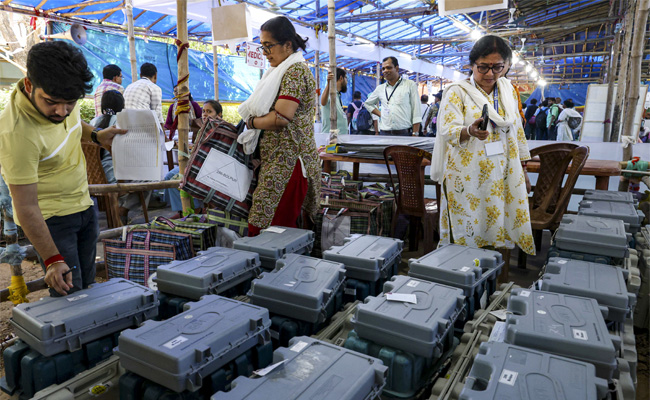
Kolkata (PTI): Voting began on Thursday in 152 constituencies in the first phase of the West Bengal assembly elections, amid unprecedented security arrangements and a high-stakes battle that could shape the direction of the entire contest.
Polling started at 7 am with voters queueing up outside booths in districts ranging from Darjeeling and Jalpaiguri in the north to Murshidabad, Nadia, Birbhum and Hooghly in the south.
The opening round covers more than half of the state's 294 assembly seats and is being seen as the BJP's best opportunity to make an early breakthrough and the ruling Trinamool Congress' most important test in its bid for a fourth consecutive term.
According to the Election Commission, over 3.60 crore electors are eligible to vote in this phase, including around 1.75 crore women and 465 third-gender voters.
A record 2,450 companies of central paramilitary forces, comprising nearly 2.5 lakh personnel, have been deployed across the state for the polls, with over 8,000 polling stations identified as highly sensitive.
The Election Commission has placed districts such as Malda, Murshidabad, Uttar Dinajpur, Cooch Behar, Birbhum and Purba Bardhaman under special surveillance.
More than 2,193 quick response teams, surveillance units and flying squads have also been deployed to prevent violence and ensure free and fair polling.
The first phase assumes political significance because it includes all 54 seats in north Bengal, the region that powered the BJP's rise in the 2019 Lok Sabha elections and helped it emerge as the principal challenger to the TMC in the 2021 assembly polls.
Of the 152 seats, the BJP had won 59 in 2021, while the TMC had secured 93.
For the saffron camp, retaining its dominance in north Bengal is crucial if it is to remain in contention in the statewide battle. For the TMC, led by Chief Minister Mamata Banerjee, preventing a BJP sweep in the north is equally important to establish momentum before the second round.
This phase is also being closely watched because it comes after the Special Intensive Revision of electoral rolls, which resulted in the deletion of around 91 lakh names from the state's voter list.
The controversy has sharply polarised the campaign, with the BJP alleging that the revision weeded out infiltrators and bogus voters, while the TMC has accused the Centre and the Election Commission of disenfranchising genuine electors, especially minorities and migrant workers.
Several high-profile candidates are in the fray in the first phase.
Key candidates in this phase include leader of the opposition Suvendu Adhikari (BJP, Nandigram), former Union minister Nisith Pramanik (BJP, Mathabhanga), state minister Udayan Guha (TMC, Dinhata), Goutam Deb (TMC, Siliguri), and Adhir Ranjan Chowdhury (Congress, Baharampur).
The second phase of polling will be held on April 29. Counting of votes will take place on May 4.