‘Hunger watch’ survey: In Gujarat, ‘21 pc had to sleep without single meal amid pandemic’
This report was first published in indianexpress.com and has been posted here without any alterations or editing. To read the original report, CLICK HERE
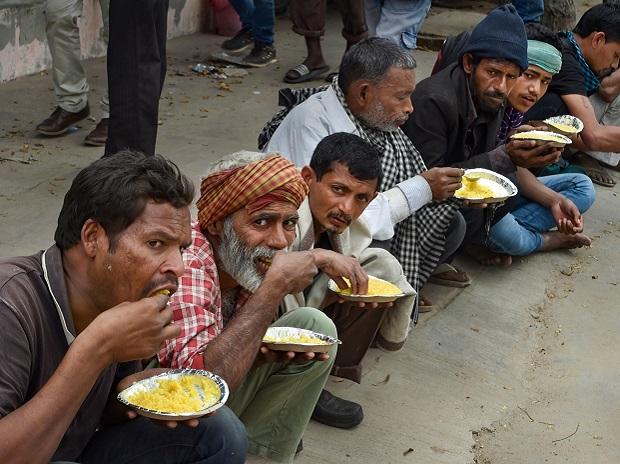
The ‘Hunger watch’ survey carried out by Anna Suraksha Adhikar Abhiyan (ASAA), Gujarat to track the hunger situation amongst vulnerable and marginalised communities amid the of Covid-19 pandemic revealed that 20.6 per cent households sometimes skipped meals due to lack of food while 21.8 per cent said they sometimes slept without a single meal.
The survey conducted in September and October to unravel the impact of the lockdown on people’s food security and nutrition across households in nine districts including Ahmedabad, Anand, Bharuch, Bhavnagar, Dahod, Morbi, Narmada, Panchmahals and Vadodara revealed that households have reduced consumption of essential food items too. The survey also found that in Gujarat, many ration cards have been made “silent”.
“The government has not given accurate information to the families, many of whom are from very deprived communities, as to why their ration cards cannot be used anymore to claim their basic entitlements. This process of making ration cards ‘silent’ has happened at the local taluka and/or district level. Additionally, in many areas, taluka level committee meetings are not being held due to Covid-19 effectively depriving families their right to food security,” the report stated.
Nearly 38 per cent respondents shared that their consumption of rice/wheat had decreased while 40.7 per cent said their consumption of pulses had come down and 57.6 per cent said their consumption of vegetables had reduced.
The responses were collected from 403 households which fall under the most backward communities in both rural and urban regions of the state where 91.1 per cent covered during the survey were from rural regions, 49.4 per cent were women. Among the respondents, 64.5 per cent worked as casual daily wage workers and 38.7 per cent were farmers.
However, 32 per cent relied on more than one activity for their livelihood, 83 households were headed by single-women and 35 per cent respondents were either homeless or slum dwellers. Among 403 households, 50.4 per cent of the respondents earned less than Rs 3,000 per month.
Sejal Dand, one of the founder members of non-profit organisation ANANDI who was one of the panelists for the virtual session on ‘Situation of hunger and food sovereignty in Gujarat-Impact of Covid-19’ said, “The survey results show that households have reduced consumption of essential food items. Out of the 135 respondents who collect forest produce like roots, tubers, meat by hunting, 15.5 per cent of them said they were restricted from accessing the forest during the lockdown.”
Among some of the recommendations put forward for the state government included a universal public distribution system that provides every individual with 10 kg grain, a total of 1.5 kg pulses and 800 gm cooking oil for at least the next six months (up to June 2021), families of the migrant community who are included under the state government’s Anna Brahm scheme to get food grains from the PDS shop to continue.
“Since livelihoods of citizens have been completely dismantled during and after the lockdown grossly affecting their food security, we demand that under the MGNREGA Act, work should be approved immediately in rural areas as well as in urban areas,” the report states.
Courtesy: indianexpress.com
Let the Truth be known. If you read VB and like VB, please be a VB Supporter and Help us deliver the Truth to one and all.
Austrian police detain suspect in case of rat poison found in baby food jars on supermarket shelves
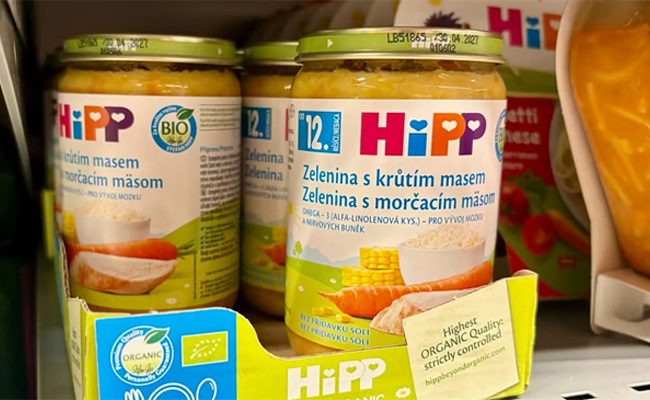
Vienna (AP): Police in eastern Austria say a 39-year-old suspect has been arrested after rat poison turned up in some HiPP baby food jars on supermarket shelves in central Europe.
HiPP, which recalled some of its baby food jars in Austria, Slovakia and the Czech Republic after the case came to light last month, said in a statement Saturday it was “greatly relieved” by the arrest, and would provide further updates as verified details come in.
The Burgenland State Criminal Police Office, under the direction of prosecutors, said a probe was launched after poison turned up in a baby food jar purchased at a supermarket in the city of Eisenstadt on April 18.
It said the suspect was being questioned, and that no further details would be immediately provided. The Burgenland public prosecutor's office has announced an investigation into suspected “intentional endangerment of the public.”
The Austrian Press Agency reported that an expert report on the toxicity of the poison was pending. A total of five tampered baby food jars were seized before they could be consumed, APA reported.
Authorities said previously they believe the tampering occurred in 190-gram (6.7-ounce) jars of baby food made with carrots and potatoes for 5-month-olds that were sold from SPAR supermarkets in Austria.
HiPP responded by recalling all of its baby food jars sold at SPAR supermarkets — which include SPAR, EUROSPAR, INTERSPAR and Maximarkt stores — in Austria as a precaution. Vendors in Slovakia and the Czech Republic also removed all of the brand's baby jars from sale.
The company said the recall was not due to any product or quality defect on its part, and said the jars left its facility in “perfect condition.”
Police said a customer at the time of the discovery had reported that a jar appeared to have been tampered with, but no one had consumed the baby food.