IAF probing whether friendly fire brought down own chopper after Balakot strike
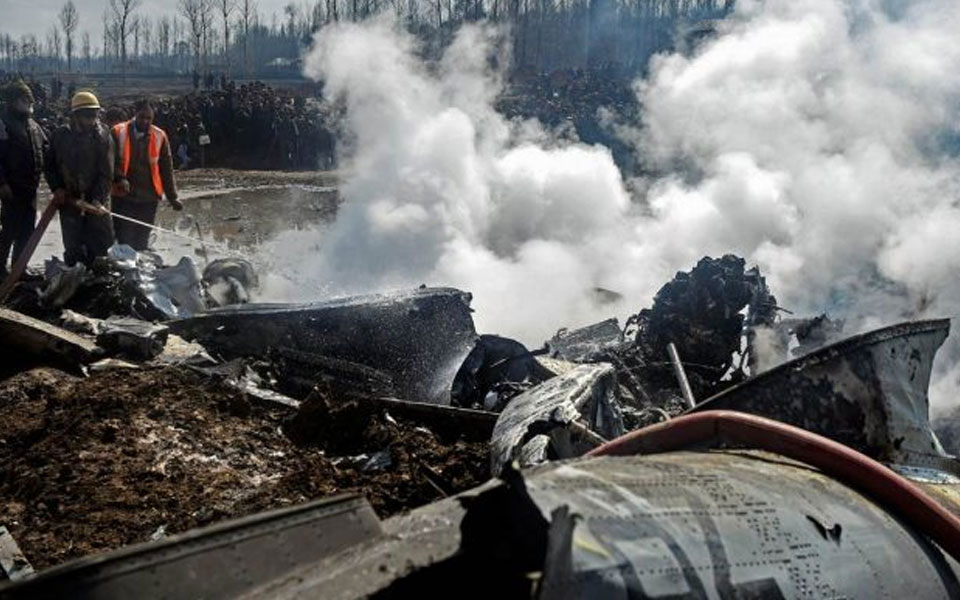
Srinagar: Among the threads being investigated in the February 27 crash of an IAF Mi-17 helicopter near Srinagar during a tense standoff with Pakistan include the possibility that it may have been "accidentally" shot down by Indian Air Defence System, officials said.
The officials, who are familiar with the investigation and spoke on condition of anonymity, believe that the Indian Air Force (IAF) helicopter may not have switched on the Identification Friend or Foe (IFF) system which identifies the flying object to radars, whether it is a an enemy or one of its own.
The IFF technology developed during World War II is an instrument within the aircraft or a helicopter which sends signals to nearby radars giving its identification signatures.
The IAF refused to comment on speculation that the helicopter, which crashed in Kashmir region killing all six personnel on board, may have been shot down by the air defence system which was on the highest alert after Indian air strikes at Balakot in Pakistan on February 26.
An IAF spokesperson would only say, "In any flying accident the Court of Inquiry looks into all possibilities before conclusively establishing the cause of an accident. In the instant case also, the ongoing Court of Inquiry is looking into every possibility that could have caused the accident. Before the court submits it's report it will be premature to comment."
The helicopter was flown by Sqdn Leader Siddharth Vashisht with other members Sqdn Ldr Ninad Mandvgane, Kumar Pandey, Sergeant Vikrant Sehrawat, Corporals Deepak Pandey and Pankaj Kumar.
It crashed at Budgam after taking off from Srinagar airport at 10:10 am, soon after Pakistani Air Force jets had attempted to violate the Indian airspace at around 9.30 am on February 27.
The Pakistani Air Force, after intruding in Rajouri sector of Jammu region on February 27, was attempting a similar misadventure in Uri sector of North Kashmir's Baramulla around the same time when the helicopter was airborne from Srinagar airfield.
The domination of IAF fighter jets made Pakistan abandon its misadventure at Uri but the air defence system is believed to have fired at the helicopter by then, killing all the personnel and a civilian on the ground, officials said.
If this line of inquiry is pursued, the investigators will also try to find out whether the pilot inadvertently did not switch on the IFF or whether the instrument malfunctioned, they said.
Let the Truth be known. If you read VB and like VB, please be a VB Supporter and Help us deliver the Truth to one and all.
EAM Jaishankar meets Jamaican PM, gifts over 10 BHISHM Cubes
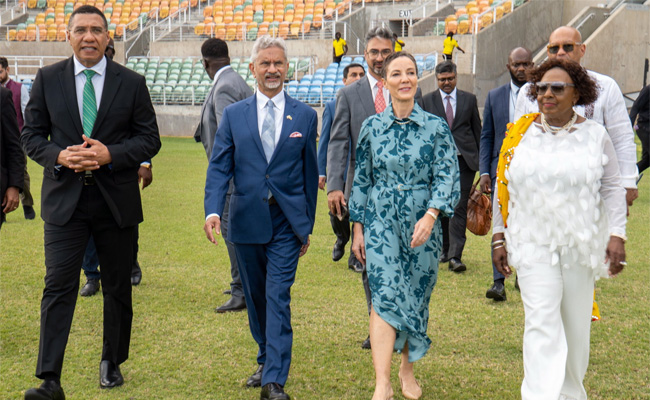
Kingston (PTI): External Affairs Minister S Jaishankar on Monday met Jamaican Prime Minister Andrew Holness and discussed ways to further deepen "political, economic and people-to-people cooperation."
Jaishankar also conveyed greetings from Prime Minister Narendra Modi to Holness.
"Pleased to call on Prime Minister @AndrewHolnessJM in Kingston. Conveyed the greetings of PM @narendramodi," Jaishankar posted on X.
"Discussed deepening our political, economic and people-to-people cooperation. Value his commitment towards further strengthening India-Jamaica relations," the post further read.
Also, the external affairs minister handed over 10 BHISHM (Bharat Health Initiative for Sahyog Hita & Maitri) Cubes as a gift to Jamaica.
"Formally handed over 10 BHISHM Cubes as a gift from India to Jamaica, in the presence of PM @AndrewHolnessJM, Health Minister @christufton and FM @kaminajsmith," Jaishankar posted on X.
"The BHISHM Cube mobile hospital system, designed for rapid deployment, will help Jamaica during disasters and emergencies. The gift of these cubes is a statement of friendship, a commitment to disaster preparedness, and an outcome of innovation," the post said.
Jaishankar arrived in Kingston on Saturday evening, marking the first leg of his nine-day tour of Jamaica, Suriname, and Trinidad and Tobago, aimed at further strengthening India's strategic and cultural ties with the Caribbean nations.
Earlier in the day, he interacted with the Indian diaspora and discussed India's ongoing transformation in infrastructure, human development and technology-driven governance and entrepreneurship with them.
He also highlighted the cricket bond between both countries as India gifted a scoreboard to Jamaica.
A scoreboard was dedicated at Sabina Park in Kingston. It is the home of the Jamaica cricket team and is the only Test cricket ground in the Caribbean island nation.
The minister expressed hope that the new scoreboard would witness many memorable innings, including those symbolising the enduring friendship between the two countries.
Cricket has long been a strong cultural bridge between India and Jamaica, which is part of the West Indies cricket team.
Jamaican players, including Chris Gayle, Courtney Walsh and Michael Holding, have played a major role in shaping the legacy of West Indies cricket in the international arena, contributing to its dominance in earlier decades and its continued global appeal.