IAS officer Dr. Nagarjun B. Gowda at the Centre of ₹51 crore mining fine row, denies allegations
Bhopal, Madhya Pradesh: A major controversy has erupted in Madhya Pradesh’s administrative circles involving IAS officer Dr. Nagarjun B. Gowda, who is accused of drastically reducing a ₹51 crore illegal mining fine to merely ₹4,032 during his tenure as Additional District Magistrate (ADM) in Harda district. The allegations have led to intense public debate, with demands for greater transparency and accountability within the bureaucracy.
The issue came to light following a complaint by RTI activist Anand Jat, who accused Dr. Gowda of favouring a private company, Path India Limited, in a case linked to alleged illegal mining activities connected to the Indore–Betul National Highway project.
The controversy: From ₹51 crore to ₹4,032
According to official records and media reports, Path India Company was working on the Indore–Betul National Highway when it allegedly excavated 3.11 lakh cubic meters of murram soil in Andherikheda village, Harda district, without obtaining the necessary permissions. The then ADM, Praveen Phulpagare, had issued a notice imposing a penalty of ₹51.67 crore against the company for unauthorized extraction.
However, following Phulpagare’s transfer, Dr. Nagarjun B. Gowda assumed charge as ADM. The case came up for review during his tenure, and in the final order, the fine amount was reduced to just ₹4,032, reportedly on the grounds that the previous estimates were unsupported by verifiable documentation.
Dr. Gowda’s decision has now become the focal point of public and media scrutiny, with critics questioning how a fine amounting to crores could be reduced to a few thousand rupees in an official proceeding.
RTI activist’s allegations: “A clear case of favouritism”
RTI activist Anand Jat, who brought the matter to light, claims that the fine reduction indicates possible favouritism or compromise between the administration and the company. He alleges that while official records claim the absence of photographic or video evidence of mining, local villagers reportedly possess visual proof of large-scale excavation.
In multiple statements, Jat has accused Dr. Gowda of “manipulating the case records” and “settling the issue through a backdoor deal.” He demanded an independent inquiry, arguing that the fine reduction has caused a significant loss to the exchequer and undermined public confidence in administrative fairness.
“Reducing a fine of ₹51 crore to ₹4,000 cannot be justified on any administrative ground. The documents clearly point to a cover-up,” Jat stated.
Dr. Nagarjun B. Gowda’s response: ‘All actions were legal and evidence-based’
Facing mounting criticism, Dr. Gowda issued a formal clarification, categorically denying all allegations of corruption or bias.
According to his statement, the previous ADM had only issued a notice, not a finalized penalty, and the final adjudication was completed during his tenure after considering all available evidence.
“The ₹51 crore amount was not a finalized fine but a proposed figure in the initial notice. The subsequent inquiry found no substantial evidence to support the claims of large-scale illegal mining. The Tehsildar’s panchnama lacked verification, and the documentation was weak. Therefore, based on the available material and due legal procedure, the fine was calculated at ₹4,032,” Dr. Gowda said.
He further clarified that no appeal or objection was filed against his decision in the following two years, which, in his view, validates the legality and procedural soundness of his order.
“The decision was made on record, following due process, and in compliance with the legal framework. I am open to any review or inquiry. There was no wrongdoing on my part,” he added.
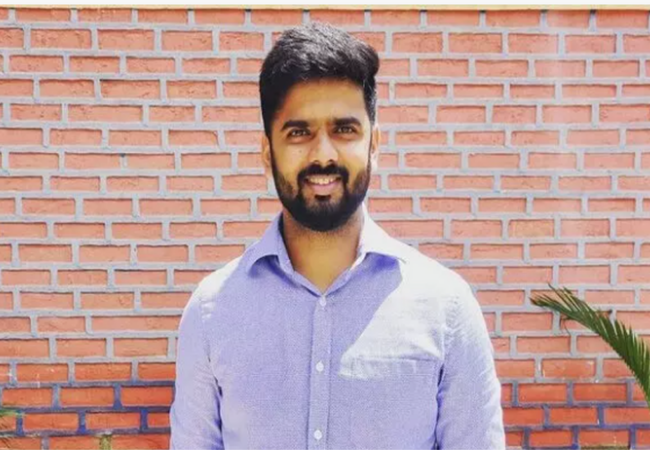
Who is IAS Dr. Nagarjun B. Gowda?
Dr. Nagarjun B. Gowda, born on May 9, 1992, in Mandya district, Karnataka, is a doctor-turned-civil servant who secured All India Rank 418 in the UPSC Civil Services Examination 2018. A medical graduate from the Mandya Institute of Medical Sciences, he worked as a resident doctor before cracking the country’s toughest exam while continuing his medical practice.
Initially allotted to the Manipur cadre, Dr. Gowda was later transferred to the Madhya Pradesh cadre upon marriage to his batchmate IAS Srushti Jayant Deshmukh, who ranked fifth among women in the same batch.
Both officers have a strong following among UPSC aspirants and are often regarded as “celebrity IAS officers” due to their online presence, motivational talks, and co-authored book on ethics.
Currently, Dr. Gowda serves as the CEO of the Khandwa District Panchayat, while his wife, Srushti Deshmukh, is the CEO of Burhanpur District Panchayat.
The revelation has sparked a wave of outrage on social media, with many users questioning how such a dramatic reduction could occur without higher administrative oversight. Memes, posts, and hashtags targeting the officer and the Madhya Pradesh administration have flooded platforms like X (formerly Twitter) and Instagram.
Despite the growing controversy, the Madhya Pradesh government has not yet announced any formal inquiry or review into the case. However, senior bureaucrats, speaking on condition of anonymity, have suggested that the matter may soon attract the attention of the State Vigilance Department or Lokayukta, given the magnitude of the alleged discrepancy.
Civil society groups and RTI activists have also written to the Chief Secretary of Madhya Pradesh, demanding that the decision be revisited to ensure transparency and prevent what they describe as “erosion of public trust in governance.”
Let the Truth be known. If you read VB and like VB, please be a VB Supporter and Help us deliver the Truth to one and all.
Injured Phil Salt returns home for scans

New Delhi (PTI): Royal Challengers Bengaluru opener Phil Salt has returned to England for scans on a finger injury sustained last month.
The injury has kept Salt out of RCB's last three matches, with compatriot Jacob Bethell stepping in at the top of the order.
The 29-year-old is reported to have "damaged a finger on his left hand" while diving to save a boundary at deep backward square leg during RCB's defeat to Delhi Capitals at the M. Chinnaswamy Stadium on April 18.
"Salt, who is centrally contracted by the ECB, has since returned home at the request of England's management and has undergone scans on his finger," ESPNCricinfo reported.
According to the report, both RCB and Salt are hopeful of a speedy recovery and the opener can return to India later this month.
Salt had enjoyed a strong start to the season, amassing 202 runs in six innings at an impressive strike rate of 168.33.
RCB are currently second on the points table behind Punjab Kings. They take on Lucknow Super Giants (LSG) on Thursday next.