If Babri Masjid was illegal why Advani is being tried: Asaduddin Owaisi
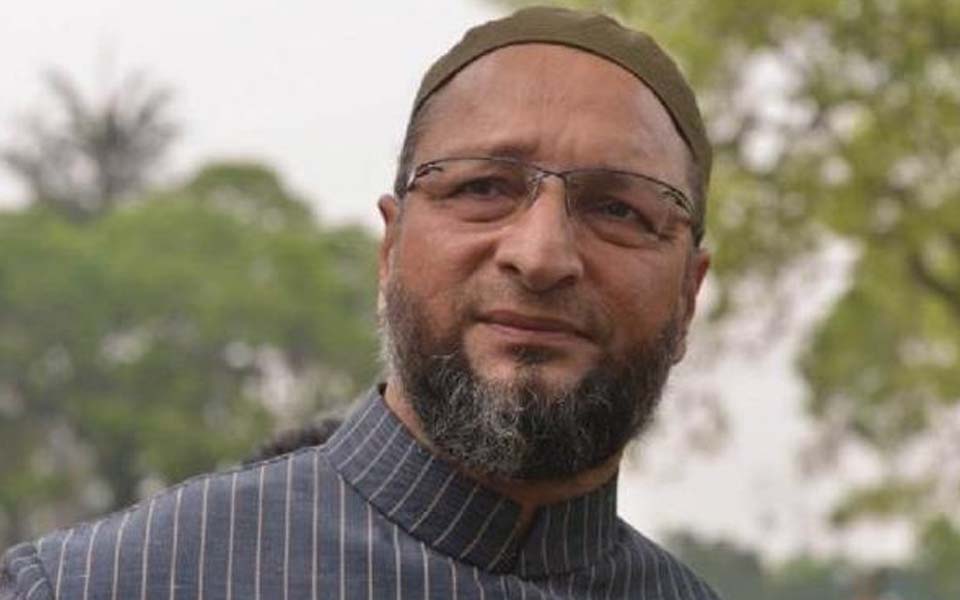
Hyderabad, Nov 10: AIMIM chief Asaduddin Owaisi has sought to know if the Babri Masjid was illegal why were L K Advani and others being tried in connection with its demolition.
Addressing a public meeting here on Saturday night, the AIMIM president said, "If Babri Masjid was legal then why was it (land) handed over to those who demolished it. If it was illegal then why the case is going on and withdraw the case against Advani. And if it is legal then give it to me." "It's a basic question... We are not satisfied with this judgement. Babri Masjid is my legal right. I am fighting for the Masjid and not the land," Owaisi said reacting to the Supreme Court's verdict on Saturday paving the way for construction of a Ram temple in Ayodhya.
On Sunday, Owaisi tweeted "Then what does a Muslim see today? That there stood a mosque, for so many years, which has been demolished.
Now the court is allowing a building to come up on that site, on an alleged finding that the land belonged to Ram Lalla."
"We are being insulted by giving (alternate) land. Don't treat us like us beggars... We are respectable citizens of India. The fight is for legal right," he said in another tweet.
"... we asked for justice, not charity. If your house is demolished and you go to an arbitrator, whether the house should be given to you or not. Should it be given to the demolisher?," he asked while reiterating that he was not satisfied with the judgement.
Claiming that even today BJP and RSS have a list of several mosques which they want to "transform," Owaisi said they (muslims) should fight for the Masjid.
He also questioned parties including, Samajwadi Party, BSP, Nationalist Congress Party on their "silence" over the apex court judgement.
Asserting that he would inform the coming generations of the Babri Masjid demolition, Owaisi urged the youngsters of the community to take part in politics and support his party.
Soon after the Ayodhya verdict was delivered on Saturday, Owaisi had said the Supreme Court judgment in the sensitive case was a "victory of faith over facts" and suggested rejection of alternative five-acre plot given for construction of a mosque.
Let the Truth be known. If you read VB and like VB, please be a VB Supporter and Help us deliver the Truth to one and all.
Nitish likely to resign as Bihar CM after last meeting of cabinet on April 14
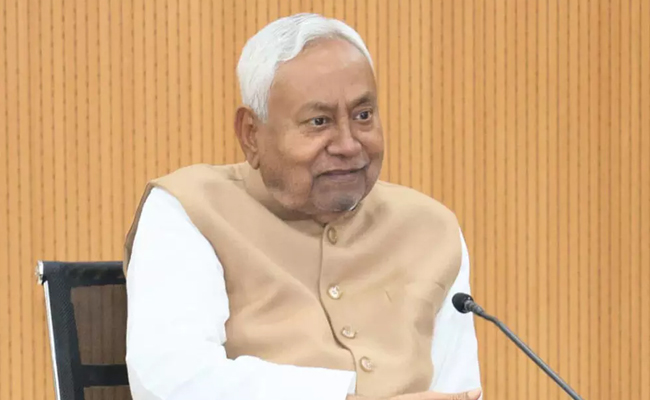
Patna (PTI): Bihar inched towards a political transition on Sunday with Chief Minister Nitish Kumar convening a meeting of his cabinet on April 14, following which the JD(U) president is likely to relinquish the post to make way for a BJP-led government.
According to a notification issued by the cabinet secretariat department, the meeting will take place at 11 am, after which the longest-serving CM of the state, who got elected to the Rajya Sabha last week, was expected to submit his resignation to Governor Syed Ata Hasnain.
Earlier, Kumar's close aide and JD(U) national working president Sanjay Kumar Jha had told reporters that the process of formation of a new government was likely to "roll out after April 13".
Meanwhile, the BJP, which has been approaching the prospect of having its first- ever chief minister in the state with considerable restraint, got down to business and named Shivraj Singh Chouhan as a "central observer", who would oversee the change of guard.
A statement issued by the BJP headquarters in Delhi said the parliamentary board has appointed Chouhan, a Union minister and a multiple-term former CM of Madhya Pradesh, as “central observer for electing the leader of legislature party in Bihar”.
Senior JD(U) leader and Minister for Parliamentary Affairs, Vijay Kumar Chaudhary, had said here earlier in the day "the new chief minister will be elected by the NDA, upon the recommendation of the BJP, which has a big role to play".
Speculations are doing the rounds that Deputy Chief Minister Samrat Choudhary, who holds the crucial Home portfolio in the outgoing government, is the frontrunner among contenders for the top job.
BJP leaders in the state, who have been making frantic visits to Delhi in the recent past, are keeping their cards close to the chest.
"Who will be the next CM is a decision to be taken by our central leadership," minister Dilip Jaiswal, who is a former state BJP president, had said a day ago, adding, "I am not at all in the race".
Other than Choudhary, who had joined the BJP less than a decade ago, those whose names are doing the rounds include Union Minister of State for Home Nityanand Rai and state ministers Lakhendra Paswan and Shreyasi Singh.
According to BJP sources, all these leaders fit the bill in different ways. Choudhary is a ‘Koeri’, and his elevation could ensure that the ‘Luv Kush’ (Kurmi Koeri) equation nurtured by Kumar during his 20-year-rule remained intact in favour of the NDA, after the JD(U) supremo's departure.
Rai is a Yadav and brings the promise of support of the largest caste group in Bihar, which has been with Lalu Prasad's RJD, the BJP's principal rival in the state, for decades.
Paswan is a Dalit and his elevation could help the BJP transcend its "pro-upper caste" image, which brings its own disadvantages in the Hindi heartland, where the Mandal agitation of the 1990s has cast a long shadow, the sources said.
Singh, in her 30s, is an upper caste Rajput, but her elevation could be projected as the party giving preference to young blood.
Moreover, the party has also been trying to present itself as a champion of gender equality, by pushing through the ‘Nari Shakti Vandan Adhiniyam’ that ensures 33 per cent reservation to women in both Houses of Parliament.
However, the BJP sources admitted that there was a strong possibility of the central leadership springing a "surprise", citing examples of many states ruled by the party, where less fancied leaders have landed the top job in the recent past.
Actor-turned-politician Shatrughan Sinha, a Trinamool Congress MP who spent nearly three decades in the BJP, had said, while commenting on the political situation in Bihar that "we have plenty of deserving people here but we must be beware of a baba who may arrive with a parchi".
The allusion was to Rajasthan, where Bhajan Lal Sharma was named the chief minister two years ago at a legislature party meeting, where Defence Minister Rajnath Singh was seen on camera taking out a piece of paper with the name of the first-term MLA written on it.