If talks can happen with China, why not with other neighbour: Farooq Abdullah in LS
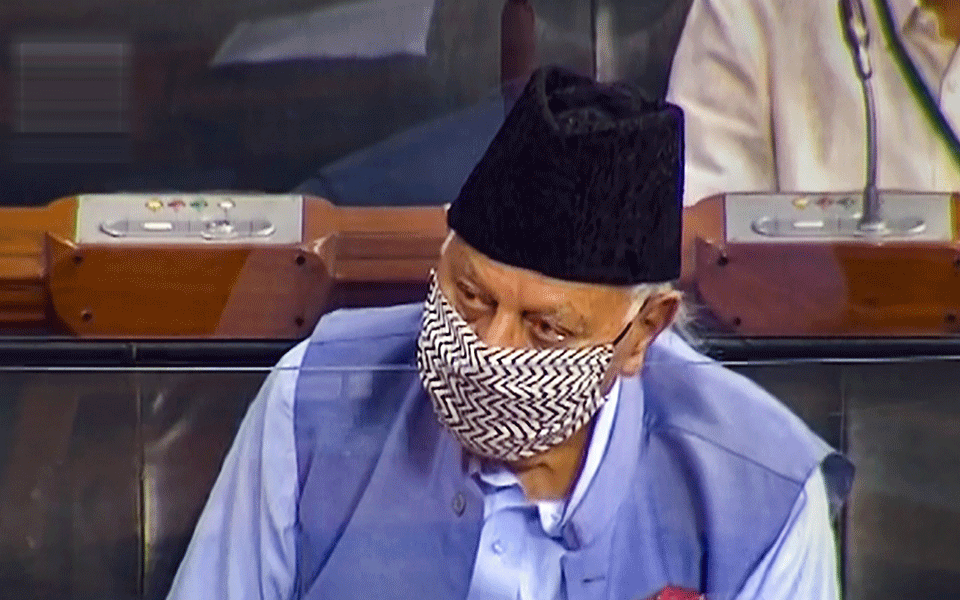
New Delhi: Speaking in Parliament for the first time since his release from detention, the National Conference president and MP Farooq Abdullah on Saturday advocated talks with Pakistan, saying if India can talk to China to defuse their border row, it can also speak to its other neighbour to deal with the situation at Jammu and Kashmir borders.
Noting that he was speaking in Lok Sabha after more than a year, Abdullah said Jammu and Kashmir has not seen any progress and spoke about authorities blocking 4G facilities in the Union Territory which, he added, goes against the interest of students and traders.
People are unemployed, engineers who formed an association to work have been "stopped" from working, he said about the union territory.
If India is developing, does not Jammu and Kashmir have the right to develop with the country as well, he asked.
Pitching for talks with Pakistan, he said, "Border skirmishes have been rising and people are dying... A way has to be found to deal with this. Except for talks... As you are talking to China to attempt that it withdraws (from Ladakh border), we should also talk to our (other) neighbour to find a way to get out of this situation."
His advocacy for talks with Pakistan during the Zero Hour drew protests from treasury benches.
The Srinagar MP also expressed his happiness at the findings of an Army inquiry into the killings of three men in Shopian in an encounter.
"I am happy that the Army has admitted that three Shopian men were killed mistakenly. I hope the government gives a hefty compensation," he said.
Officials had said on Friday the Army has found "prima facie" evidence that its troops "exceeded" powers under the Armed Forces Special Powers Act during the encounter in July and has initiated disciplinary proceedings.
He also conveyed his gratitude to parliamentarians for speaking for him when he was under detention.
Abdullah and many other leaders were put under detention by authorities last year after the Union government abrogated Article 370, which had given special powers to the erstwhile state, and split Jammu and Kashmir into two union territories. He was released in March this year.
Let the Truth be known. If you read VB and like VB, please be a VB Supporter and Help us deliver the Truth to one and all.
AIITA welcomes Karnataka’s ban on obscene songs in school events
Bhatkal: The Karnataka unit of the All India Ideal Teachers Association (AIITA) has welcomed the Karnataka government’s decision to strictly ban school children from dancing to obscene songs during educational and cultural programmes in government, aided, and private schools across the state.
AIITA Karnataka State President M. R. Manvi congratulated the government for taking what he termed an important step to preserve the sanctity of education.
“Such decisions to safeguard the dignity of school children and uphold the values of education are the need of the hour. This rule should not be limited to government schools alone but must be strictly implemented in all private educational institutions as well,” he said.
He further urged the government to address other concerns within school programmes.
“The government should not only prohibit obscene dances in the name of school anniversaries, but also ensure that plays and dialogues that incite religious hatred are avoided. Schools should be centres of harmony, not platforms for spreading hatred,” he added.
According to a recent circular issued by the Department of School Education and Literacy, obscene dances are adversely affecting the mental health and moral values of students.
In this regard, schools have been advised to use songs that promote nationalism, positive thinking, the greatness of Kannada culture, and value-based traditions instead of inappropriate content during programmes.
The circular also emphasises that students should be dressed in decent attire.
AIITA also backed the department’s warning that disciplinary action would be taken against head teachers if such guidelines are violated. The association has further demanded that district Deputy Directors of Public Instruction strictly monitor the implementation of these rules.