If workplace turns toxic, employees serve notice period before leaving: Bharadwaj replies to Chadha
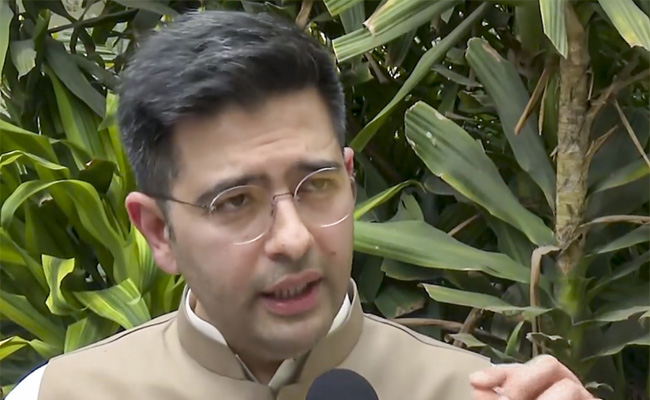
New Delhi (PTI): AAP's Delhi unit chief Saurabh Bharadwaj hit back at Rajya Sabha MP Raghav Chadha on Monday over his "toxic workplace" analogy, saying even when an employee decides to leave a company, he serves a notice period instead of conspiring to damage the organisation's image.
Bharadwaj's remarks came after Chadha, who along with six other Rajya Sabha MPs of the Aam Aadmi Party (AAP), announced his decision to merge with the ruling Bharatiya Janata Party (BJP), defended his exit by comparing the Arivind Kejriwal-led party to a toxic workplace.
In a video statement, Chadha had said if the atmosphere at the workplace becomes toxic, employees are stopped from working, their hard work is suppressed and they are silenced, then the right decision is to leave that place.
ALSO READ: Nashik court sends ‘godman’ Kharat to 3-day police custody in 7th sexual exploitation case
Responding to this, Bharadwaj said while people may leave companies, political parties are based on ideology and not merely workplace convenience.
"There is nothing to do with ideology in changing a company. But if someone agrees with the ideology of a political party, only then does he join it," he said in a video posted on X.
Bharadwaj added that even in a company, an employee who decides to leave follows professional ethics.
"If an employee leaves a company, he serves a three-month notice period so that whatever he has learnt from that company can be properly transitioned. They do not conspire to ruin the company's image," he said.
Bharadwaj alleged that instead of leaving the party respectfully, Chadha began planning to join the BJP and started acting in a way that harmed the AAP.
"When the ED's pressure increased, you planned to join the BJP and started conspiring with it," he alleged.
The AAP leader also claimed that many issues raised by Chadha in Parliament, including affordable food at airports, mobile-recharge concerns, paternity leave and gig workers' rights, were already aligned with the BJP's political agenda.
Chadha, Sandeep Pathak and Ashok Mittal announced on April 24 that they were joining the BJP, along with four other AAP MPs. The others who quit the AAP were Harbhajan Singh, Rajinder Gupta, Swati Maliwal and Vikramjit Sahney.
On Monday, the Rajya Sabha chairman approved the merger of the seven MPs with the BJP, raising the saffron party's numbers in the Upper House of Parliament to 113. The AAP is now down to three members in the Rajya Sabha.
Let the Truth be known. If you read VB and like VB, please be a VB Supporter and Help us deliver the Truth to one and all.
India, New Zealand ink free trade agreement
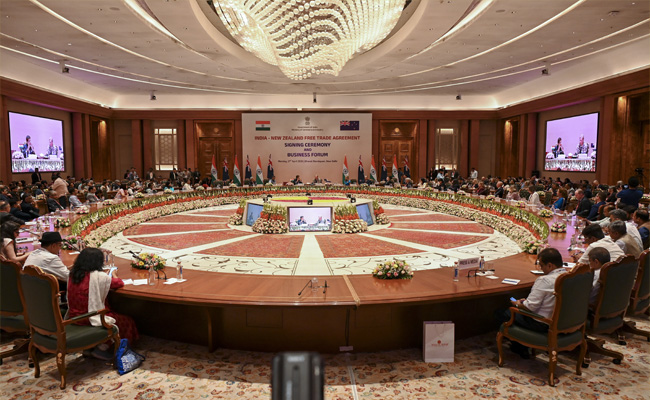
New Delhi (PTI): India and New Zealand on Monday inked a free trade agreement, aimed at boosting two-way commerce and investments.
The pact was signed by Commerce and Industry Minister Piyush Goyal and visiting New Zealand's Trade and Investment Minister Todd McClay.
The FTA provides duty-free access for 100 per cent of India's exports to New Zealand, covering all tariff lines or produce categories, and is expected to significantly boost MSMEs and employment by enhancing competitiveness in labour-intensive sectors such as textiles, apparel, leather, footwear, gems and jewellery, engineering goods, and processed foods.
Earlier, New Zealand maintained peak tariffs of up to 10 per cent on key Indian exports, including ceramics, carpets, automobiles, and auto components.
With zero-duty market access from entry into force as New Zealand's other trade partners, Indian products will be fully competitive in that country, enjoying a level playing field.
ALSO READ: Cal HC urges EC to dispose of TMC complaint over police observer's meeting with BJP nominee
Significantly, India also secured duty-free inputs for its manufacturing sector, including wooden logs, coking coal, and waste and scraps of metals, lowering production costs and enhancing the global competitiveness of the Indian industry.
On the other hand, India has offered tariff liberalisation on 70.03 per cent of tariff lines covering 95 per cent of bilateral trade value, while keeping 29.97 per cent of tariff lines excluded to protect India's sensitive sectors.
The products that are kept in exclusion are mainly -- dairy (milk, cream, whey, yoghurt, cheese etc.), animal products (other than sheep meat), agricultural products (onions, chana, peas, corn, almonds), sugar, artificial honey, animal, vegetable or microbial fats and oils, arms and ammunition, gems and jewellery, copper and articles thereof (cathodes, cartridges, rods, bars, coils), aluminium and articles thereof (ingots, billets, wire bars) among others.
On 30 per cent of tariff lines of New Zealand, India will provide duty elimination on goods such as wood, wool, sheep meat, and leather-raw hides.
Similarly, 35.60 per cent of tariff lines are subject to phased elimination over 3, 5, 7, and 10 years, including petroleum oil, malt extract, vegetable oils, selected electrical and mechanical machinery, and peptones.
New Zealand products which enjoy tariff reductions include wine, pharmaceutical drugs, polymers, aluminum, iron and steel articles, and goods that only 0.06 per cent fall under tariff rate quotas, including Manuka honey, apples, kiwi fruit, and albumins, including milk albumin.
The FTA also includes a commitment to facilitate USD 20 billion in investment into India.
A rebalancing clause is incorporated into the Agreement to provide a framework for addressing any shortfall in investment delivery, thereby ensuring robust and tangible economic outcomes.
Total bilateral trade in goods and services reached USD 2.4 billion in 2024.