If you don't want to use the term ‘India', you can't use ‘Hindu' either: Shashi Tharoor
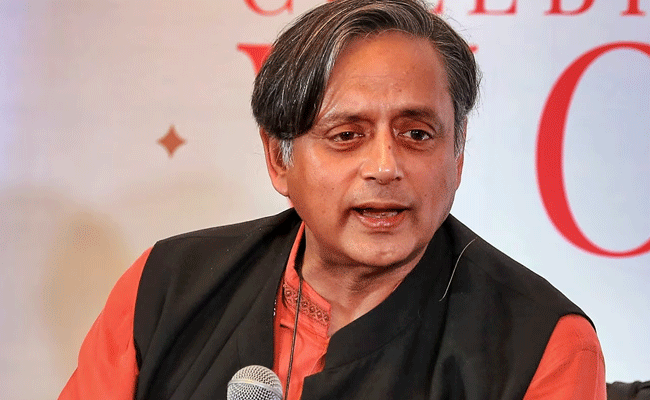
Bengaluru(PTI): Congress MP Shashi Tharoor on Friday took a swipe at those who have a problem with the term 'India' but are comfortable calling themselves 'Hindu', although both the words, India and Hindu, are derived from the same etymology, which is river Sindhu.
Dwelling on the origin of the term 'Hindu' during the launch of Nanu Yaake Hindu', the Kannada version of his book Why I am a Hindu', the Thiruvananthapuram MP said both the words were given by foreigners to describe people beyond the river Sindhu or Indus.
Tharoor's book has been translated from English to Kannada by Congress leader Prof K E Radhakrishna.
In the midst of the 'India versus Bharat' debate, Tharoor said, "It's very ironic when I hear some people in the ruling party objecting to the use of the word 'India' saying that it is not authentic and the same people shout slogans saying Garv Se Kaho Hum Hindu Hain'."
"Well, India' and Hindu' are derived from the same etymology. If you don't want to use India', you can't use Hindu' either. They both come from the same source, from the river Sindhu," he explained.
Tharoor said it is still interesting that Hindus call themselves by a label that they did not invent themselves in any of their own languages, but "adopted it cheerfully when others began to refer to them by that word".
Noting that some Hindus prefer an altogether different term, 'Sanatana Dharma', he said Hinduism is just a name that foreigners gave for what they saw as the indigenous religion of India.
Hinduism, according to the Congress MP, embraces an eclectic range of doctrines and practices, which believes in reincarnation and in the caste system.
"But none of these constitutes an obligatory credo for a Hindu. We have no compulsory dominance. And this is why I'm so comfortable with the tenets of Hinduism, much more than I would be with those of the other faiths that I know," Tharoor underlined.
The Congress MP said the great sages first came up with the original idea of the divine Brahma, which was very much similar to the Islamic idea of God -- that is a God without shape, without form, without gender.
The rishis or seers then realised that this was not good enough for ordinary people as they found them worshipping mountains, trees and rivers because they needed something to focus on. Thus was born the idea of worshipping the divine with a form, Tharoor explained.
Everybody was free to imagine the divine in whatever form or shape he or she chose, he said.
"You want to imagine God as a 10-handed woman riding a tiger, you're welcome to do that. You want to imagine God as a potbelly figure with an elephant's head, you're welcome to do that.
"If you want to imagine God as a man suffering on the cross, Hinduism has no problem with that. That's why the people of other faiths sometimes find it difficult to understand," the Congress MP said.
Tharoor said that rigid and censorious beliefs never appealed to his temperament. Hinduism is in many ways predicated on the idea that the eternal wisdom of the sages about divinity cannot be confined to a single set of belief system, he said.
"As a Hindu, therefore, I can claim adherence to a religion without an established church or a priestly papacy, a religion whose rituals and customs I'm free to reject as I do reject personally the caste system," he explained.
"There is no Hindu Pope. There is no Hindu Vatican, there is no Hindu catechism. There is not even a Hindu Sunday. You can worship your Ishta Devata (beloved deity) on different days of the week depending on what days are ascribed to him or her," Tharoor added.
He said as a Hindu he can subscribe to a creed that is free of the restrictive dogmas of holy writ, one that refuses to be shackled to the limitations of a single volume of holy revelations.
Let the Truth be known. If you read VB and like VB, please be a VB Supporter and Help us deliver the Truth to one and all.
National Synodal Assembly 2026 begins in Bengaluru with over 220 delegates
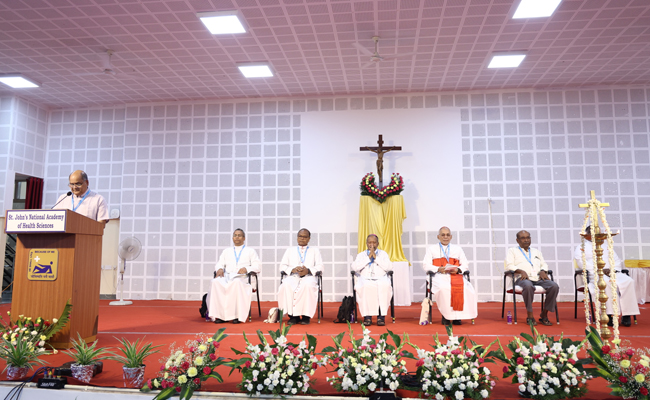
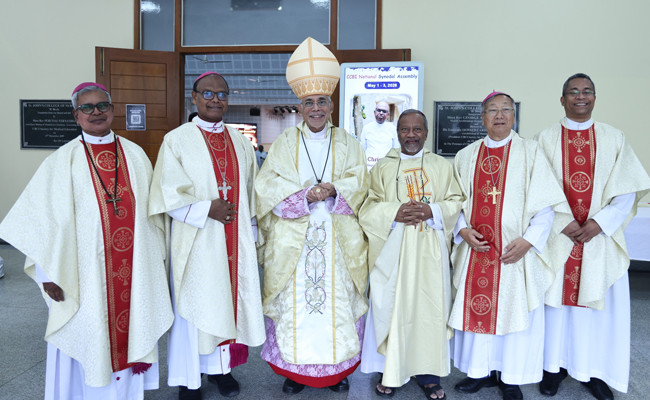
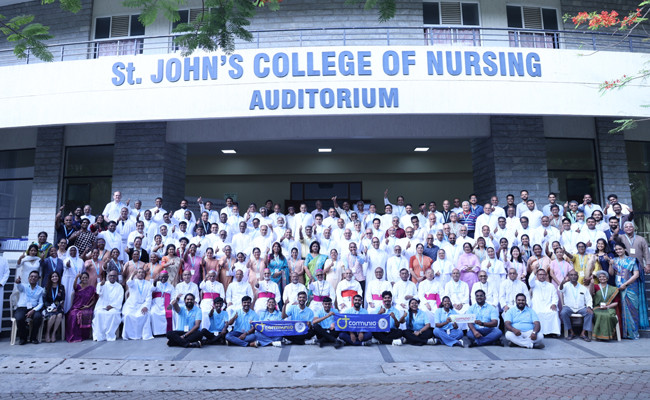
Bengaluru: The Conference of Catholic Bishops of India (CCBI) on May 1 inaugurated its National Synodal Assembly 2026 at St. John’s Medical College, bringing together more than 220 delegates from across the country under the theme Synodal Pilgrims of Hope.
The assembly is part of the global synodal process initiated in 2021 by Pope Francis, which calls for greater participation, dialogue and shared responsibility within the Church. In India, the process has involved consultations at diocesan, regional and national levels.
Participants at the assembly include two Cardinals, 25 Bishops, 65 priests, more than 20 women religious, and over 100 lay faithful, including youth and women leaders.
The gathering began with a Eucharistic celebration led by Filipe Neri Ferrão. In his homily, he described the assembly as a moment of grace and discernment and called on delegates to walk together in prayer, listening and missionary commitment.
He spoke about the importance of the Risen Christ in the mission of the Church and urged the faithful to be witnesses of the Gospel. Referring to the conversion of St Paul, he said every baptised person has a role in spreading the message of Christ. He also highlighted the example of St Joseph the Worker, stressing the dignity of labour and the call to holiness in everyday life.
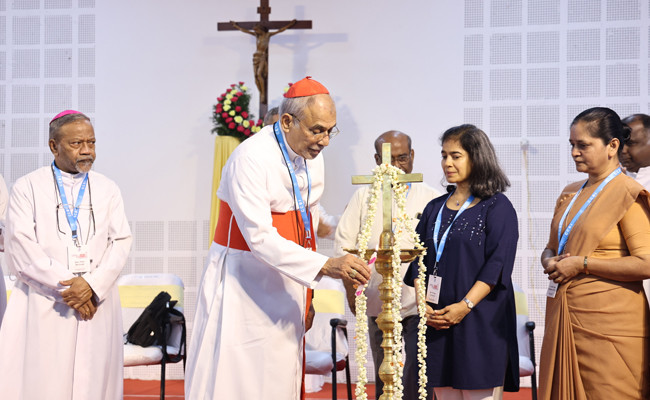
The formal inauguration included the invocation of the Holy Spirit through Veni Creator Spiritus and the lighting of the ceremonial lamp. Deputy Secretary General Fr. Stephen Alathara welcomed the delegates and described the gathering as a spiritual journey.
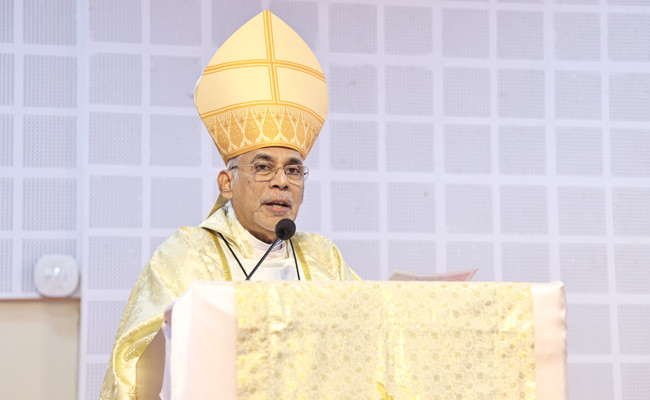
In his presidential address, Cardinal Ferrão referred to the CCBI pastoral plan titled Journeying Towards a Synodal Church: Mission 2033 and called on participants to build on the vision outlined at the 36th Plenary Assembly held in Bhubaneswar in 2025.
Delegates will reflect on four key themes identified from 16 pastoral priorities: interreligious dialogue and peacebuilding, inclusion of the excluded, poverty and integral ecology, and support for children and youth.
The discussions are being conducted through a method of spiritual conversation aimed at encouraging listening, dialogue and collective decision-making. The focus is on translating these discussions into practical actions within the Church.
The assembly also looks ahead to the Jubilee Year 2033, which will mark 2,000 years of the Redemption, and aims to strengthen the Church’s mission in the coming years.
Further consultations are scheduled for September 2026, with the process expected to conclude at the 38th Plenary Assembly of the CCBI in January 2027.
Organisers said the assembly seeks to strengthen unity within the Church and promote participation of all sections, including women and youth, in shaping its future direction.