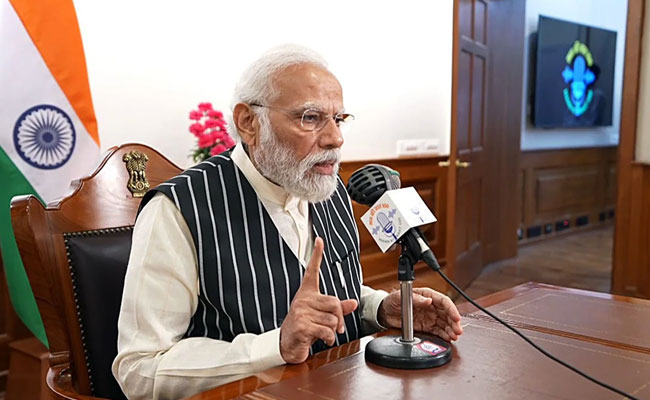
Bengaluru: A month after Prime Minister Narendra Modi claimed on social media platform 'X' that a study was conducted on the impact of his radio show 'Mann Ki Baat' by the State Bank of India (SBI) and the Indian Institute of Management Bangalore (IIMB), but the RTI response by IIMB has suggested that it has not commissioned any such study.
Narendra Modi on October 3 had posted a tweet celebrating the completion of nine years of his monthly show 'Mann Ki Baat' and also shared a link to a document titled 'Transformational Impact of Mann Ki Baat: An Analysis by SBI and IIM Bangalore', reports The News Minute. He tweeted, "Today, as #MannKiBaat completes 9 years, here is an interesting study by @TheOfficialSBI and @iimb_official which highlights some of the themes covered and their societal impact. It is amazing how we have celebrated several life journeys and collective efforts through this medium."
The study in the document shared by the PM mentioned the impact of the 105 episodes of PM Modi’s show in the last nine years, mentioning the study on various projects, such as 'Beti Bachcao Beti Padhao', the promotion of Yoga and Khadi, the Mudra Loan Application and the use of millets, having gained popularity through the radio show.
However, the RTI response by the IIM Bangalore shows the institute having no information on record related to questions such as the title and date of the study, the money spent on it and the agreement with the SBI.
Let the Truth be known. If you read VB and like VB, please be a VB Supporter and Help us deliver the Truth to one and all.
Bhatkal: Preparations are under way for the upcoming Coastal Karnataka History Summit, with the official logo of the academic event unveiled at Dawat Centre by Students Islamic Organisation of India Bhatkal Unit in Bhatkal on February 22, 2026. The summit is scheduled to be held on May 5, 2026.
The initiative is being organised by the Centre for Education and Research & Analysis (CERA) with the aim of documenting and examining the historical evolution of Coastal Karnataka, including Uttara Kannada, Udupi, Dakshina Kannada and adjoining areas of Kasaragod.
At the launch event, the organisers released the official Call for Papers, inviting scholars, researchers, academicians and students to submit original and unpublished research. Abstracts of 200 words, either in English or Kannada, must clearly mention the research question, methodology and key findings. The deadline for abstract submission is February 28, 2026. Selected participants will be informed by March 15, and full papers must be submitted by April 20.
The summit will centre around five broad themes. One section will explore the trade and economic networks of the coastal belt, including maritime routes, port towns, fisheries and commodity-based exchanges such as pepper trade. Another domain will examine social structures, caste formations and inter-community relations, along with the role of Islamic, Arab, Persian and local traditions in shaping the region’s cultural fabric.
A separate section will focus on the origin and growth of linguistic communities such as Tulu, Konkani, Beary, Moya Malayalam and Navayati. Governance and administration under different rulers — including the Alupa dynasty, Rani Abbakka, Tipu Sultan, the Nawaith Sultans of Bhatkal and developments after Independence — will also be studied. The fifth theme will highlight social reformers such as Narayana Guru, Syed Madani, Malik Deenar, Vakkom Moulavi, Sayyid Fazl Pasha and Kudmul Ranga Rao, and their contributions to education and social reform.
The logo launch programme was attended by senior journalist Dr. Haneef Shabab, JIH Bhatkal President
Bhatkal: Preparations are under way for the upcoming Coastal Karnataka History Summit, with the official logo of the academic event unveiled at Dawat Centre by Students Islamic Organisation of India Bhatkal Unit in Bhatkal on February 22, 2026. The summit is scheduled to be held on May 5, 2026.
The initiative is being organised by the Centre for Education and Research & Analysis (CERA) with the aim of documenting and examining the historical evolution of Coastal Karnataka, including Uttara Kannada, Udupi, Dakshina Kannada and adjoining areas of Kasaragod.
At the launch event, the organisers released the official Call for Papers, inviting scholars, researchers, academicians and students to submit original and unpublished research. Abstracts of 200 words, either in English or Kannada, must clearly mention the research question, methodology and key findings. The deadline for abstract submission is February 28, 2026. Selected participants will be informed by March 15, and full papers must be submitted by April 20.
The summit will centre around five broad themes. One section will explore the trade and economic networks of the coastal belt, including maritime routes, port towns, fisheries and commodity-based exchanges such as pepper trade. Another domain will examine social structures, caste formations and inter-community relations, along with the role of Islamic, Arab, Persian and local traditions in shaping the region’s cultural fabric.
A separate section will focus on the origin and growth of linguistic communities such as Tulu, Konkani, Beary, Moya Malayalam and Navayati. Governance and administration under different rulers — including the Alupa dynasty, Rani Abbakka, Tipu Sultan, the Nawaith Sultans of Bhatkal and developments after Independence — will also be studied. The fifth theme will highlight social reformers such as Narayana Guru, Syed Madani, Malik Deenar, Vakkom Moulavi, Sayyid Fazl Pasha and Kudmul Ranga Rao, and their contributions to education and social reform.
The logo launch programme was attended by senior journalist Dr. Haneef Shabab, JIH Bhatkal President Moulana Syed Zubair SM, SIO Bhatkal President Mohammed Zayan Bangali, Unit Secretary Githreef Rida Manvi and Media Secretary Mashaikh Talish.
Organisers said the summit intends to create a structured academic space for discussing the region’s layered past and bringing local histories into wider public and scholarly discourse. For submissions and queries, researchers may contact coastalkarnatakahistorysummit@gmail.com.
Moulana Syed Zubair SM, SIO Bhatkal President Mohammed Zayan Bangali, Unit Secretary Githreef Rida Manvi and Media Secretary Mashaikh Talish.
Organisers said the summit intends to create a structured academic space for discussing the region’s layered past and bringing local histories into wider public and scholarly discourse. For submissions and queries, researchers may contact