IIT-Kanpur PhD scholar ends life by hanging in hostel room

Kanpur (UP), Feb 10 (PTI): A 24-year-old PhD scholar at the Indian Institute of Technology here ended his life by hanging himself from the ceiling of his hostel room on Monday, police said.
The incident came to light in the evening when calls made to Ankit Yadav (24), a Noida resident pursuing a PhD in chemistry, by his friends went unanswered.
Sensing trouble, Yadav's hostel mates informed the IIT-Kanpur authorities, who in turn alerted the police and rushed to the room, said Additional DCP (west) Vijendra Dwivedi.
"We received information about the suicide around 5 pm after which we along with local police arrived there. By the time police reached there, the IIT-Kanpur authorities had already taken out the body after breaking open the door and shot a video of it as evidence," the police officer told PTI.
A suicide note was found in the room in which Yadav stated that he took the extreme step of his own will and blamed nobody for it.
The police said a forensic team was called to collect evidence.
The exact reasons behind the suicide will only be revealed after a preliminary probe, Dwivedi told PTI, adding the body has been sent for post-mortem and the family members have also arrived at the institute.
In a statement, the institute said, "IIT-K mourns the tragic and untimely demise of Ankit Yadav, a PhD scholar in the Department of Chemistry, here today. Yadav was a promising research scholar who joined the institute in July 2024, with an UGC Fellowship."
The reason for the drastic step is uncertain at this stage, however, IIT-K is actively cooperating with the police and forensic team in the ongoing investigation, it said, adding the institute is committed to taking all necessary steps to prevent such unfortunate incidents.
On October 10 last year, 28-year-old PhD student Pragati Kharya ended her life by hanging herself from the ceiling hook inside her hostel room. On January 18, 29-year-old PhD student Priyanka Jaiswal who was pursuing a PhD in Chemical engineering allegedly committed suicide inside her hostel room.
On January 11, 2024, an MTech second-year student Vikas Kumar Meena (31) allegedly hanged himself from the ceiling fan in his IIT-Kanpur hostel room, reportedly after he was "temporarily" barred from continuing with his course. On December 19, 2023, postdoctoral researcher Pallavi Chilka (34) hanged herself from the ceiling fan of her hostel room.
Let the Truth be known. If you read VB and like VB, please be a VB Supporter and Help us deliver the Truth to one and all.
EC can choose counting personnel, no further order needed: SC on TMC plea
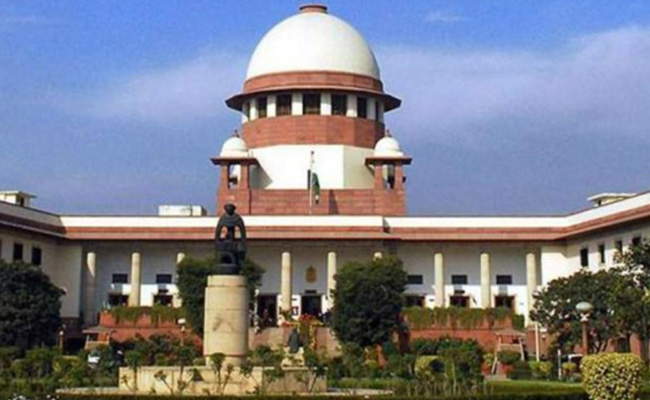
New Delhi (PTI): The Supreme Court on Saturday said no further order was necessary on the TMC's plea challenging the Calcutta High Court's dismissal of its petition against an Election Commission circular on the deployment of central government personnel for vote counting in West Bengal.
A special bench of Justices P S Narasimha and Joymalya Bagchi said the Election Commission can choose the counting personnel, and its April 13 circular, which provides for deployment of state government employees as well, cannot be said to be incorrect.
The poll body said the apprehensions of Trinamool Congress (TMC) of any wrongdoing is misplaced, as the circular very clearly states that there will be a mix of central and state government employees.
The Election Commission assured the court that the circular would be implemented in letter and spirit, and there would be state government employees also during the counting of votes on May 4.
At the outset, senior advocate Kapil Sibal, appearing for the TMC, said the circular was dated April 13, but they came to know about it on April 29.
ALSO READ: Anbumani asks PM Modi to ban sale of cigarettes for those born after 2009
He said there are four issues: One, the circular appointing Central employees was issued to DEOs on April 13, but came to their knowledge only on April 29; Two, the Election Commission says it has apprehensions of irregularity, despite having a Central nominee in the counting process; Three, the poll body already has a Central government officer at each counting table in the form of a micro observer, and four, the commission has not appointed state nominees even though the circular provides so.
Sibal submitted that the Chief Electoral Officer's communication states that there are apprehensions expressed from various quarters regarding possible irregularities in counting.
"That is like pointing a finger at the state government..." Sibal said, adding, "There must be some data. Where is (the proof of) the apprehension (raised) from each booth? They have not disclosed this. And why not tell us that they are going to have a Central government nominee?"
The bench, which held a special sitting, told Sibal that even if the Election Commission's circular had provided for the appointment of Central employees as both the counting supervisor and the counting assistant, the court could not have faulted the decision.
"The option is open for the Election Commission: whether the counting supervisor and assistant may be of the Central or the state government. When that option is open, we cannot hold that the notification is contrary to regulations. Even if the EC says that both of them can be Central government employees, we could not have faulted them. Because regulations say that either the Central government or state government officers can be appointed," Justice Bagchi told Sibal.
Sibal then submitted that the court may ask the Election Commission to follow the impugned circular in its entirety, which provides for a state government nominee.
"All we want is, in terms of the circular, the state government nominee should be there," he said.
Justice Bagchi asked if he wants compliance with the circular, then why is the TMC before the court.
Senior advocate D S Naidu, appearing for the Election Commission, submitted that the returning officer is a state government employee with overarching power to deploy personnel from any pool of government employees.
"We are saying that there will be state government employees during the counting of votes," Naidu submitted, adding that each candidate will also have their own counting agent.
"The TMC's apprehension of any wrongdoing is completely misplaced," he reiterated.
The bench then disposed of the plea, saying that no further order is necessary and reiterated that the Election Commission will follow its circular in letter and spirit.
Polling for the 294-member West Bengal Assembly was held in two phases -- April 23 and April 29. The counting of votes will be taken up on May 4.
On April 30, the Calcutta High Court dismissed the TMC's petition against the Election Commission circular, saying there was no illegality in the poll panel's decision to appoint counting supervisors and assistants from Central government and Public Sector Undertaking (PSU) employees, instead of the state government staff.
In the high court, the TMC had challenged an April 13 communication issued by the additional chief electoral officer of West Bengal that stated that at least one of the counting supervisors or assistants at each table should be a Central government or PSU employee.
The TMC's counsel had argued before the high court that the communication was issued without jurisdiction and was based on mere apprehension.
The EC's counsel had contended before the high court that the Representation of the People Act, 1951, allows delegation of the commission's functions and that the directive was valid.
The poll panel's counsel had also submitted that the communication was issued on April 13, but the petition was filed only on April 30, close to the counting date, alleging that the move was intended to stall the process.
The high court had not agreed with the TMC's allegation that its main opponent, the Bharatiya Janata Party (BJP), controls the employees of the Central government or PSUs, making them susceptible to suggestions and control by the Union government.
It had also noted that apart from the counting supervisors and assistants, micro-observers, counting agents of candidates, and other personnel would also be present in the counting hall.