I'm not a party in Dabholkar, Pansare cases, says Devendra Fadnavis
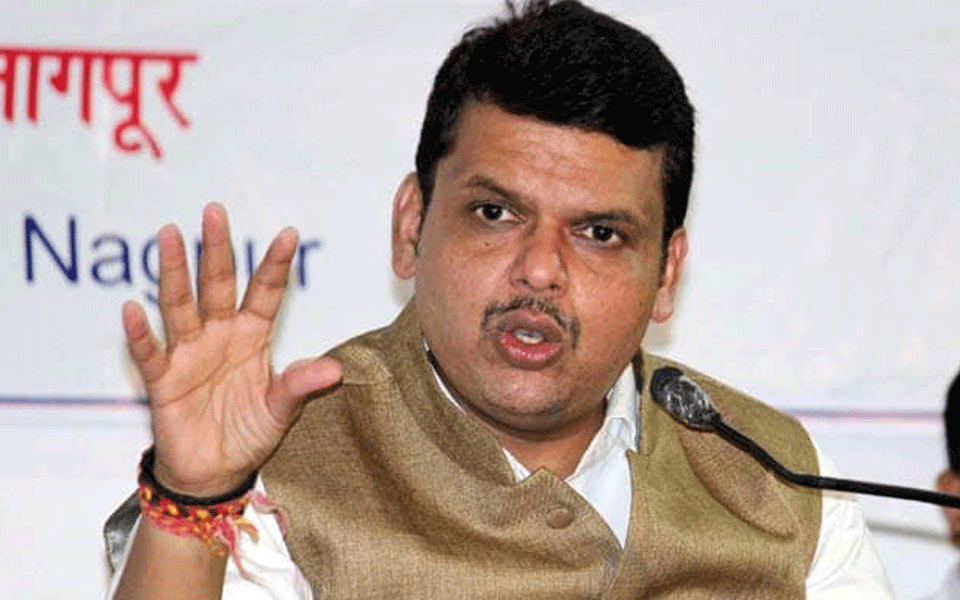
Mumbai, Jun 20: Maharashtra Chief Minister Devendra Fadnavis Thursday said that, he is not a party to the cases related to the killing of rationalists Narendra Dabholkar and Govind Pansare and asserted oral remarks by courts are not judicial orders.
Fadnavis, who also holds the home portfolio, made the statement in the Legislative Assembly in the backdrop of the Bombay High Court in March making strong observations against him in connection with the pace of investigation into the two high profiles cases.
"I am neither a respondent nor an accused in the cases. Oral remarks (by courts) are not judicial opinion or orders," the chief minister said, citing previous court orders.
Fadnavis said there is clear separation of powers of judiciary and legislature and this arrangement has to be respected.
In March-end, the HC had expressed displeasure over the pace of probe into the killing of Dabholkar (August 2013) and Pansare (February 2015), asking whether the chief minister did not have time to take stock of the cases.
The CBI is probing the Dabholkar killing case, while the state CID is probing the Pansare matter.
"What is the CM doing? He holds 11 portfolios, including home, but does not find the time to take stock of the case," the court had said.
Fadnavis was Thursday replying to the debate on Governor Vidyasagar Rao's address to the joint session of the state legislature made in February.
During his speech, the chief minister touched upon a host of issues, including the proposed water grid in drought- hit Marathwada and `Jalyukt Shivar', his government's flagship water conservation programme.
He said all tenders for a planned water grid in the parched Marathwada region will be invited before the model code for the assembly polls, likely in October, kicks in.
"The first DPR (detailed project report) and tender will be issued next month and we plan to bring maximum tenders before the election code of conduct comes into force," he said.
The state government is committed to provide tap water to every household, Fadnavis said.
Speaking about Jalyukt Shivar, he said due to the success of the scheme, intensity of drought in the state has been less.
The project, which aims to make the state drought- free, involves deepening and widening of streams, construction of cement and earthen stop dams, work on nullahs and digging of farm ponds.
"There is no scope for corruption in Jalyukt Shivar.
The nature of work is very small. If quality of work is bad, the work is redone...Jalyukt Shivar is not to create water bodies but to store water," he said.
Referring to the farm loan waiver announced two years ago, Fadnavis said debt write-off up to Rs 1.5 lakh is unconditional.
"The earlier figures of Rs 34,000 crore (the size of loan waiver) and 89 lakh farmers (the number of beneficiaries) were given by banks. Later, the banks deleted 11 lakh accounts," he said.
The chief minister said out of the 50 lakh farmer accounts, 43.32 lakh accounts have been credited with loan waiver amount.
Fadnavis said despite the prevailing drought in parts of the state, foodgrain production has increased.
"This has happened because irrigation capacity has increased. Soya bean production has increased by 16 per cent and cotton production has increased by 17 per cent," he said.
Fadnavis said the upcoming memorial to Dalit icon B R Ambedkar at Indu Mills in Dadar, Central Mumbai, will be completed by December 2020.
The Navi Mumbai International Airport construction is going on as per schedule, he added.
On the controversy over Marathi medium Class II mathematics text book brought out by state publisher Balbharati, Fadnavis said syllabus changes as per learning ability of students.
"The teaching system has not changed. It is an unnecessary controversy," he said.
The CM said if necessary a committee of educational experts will be set up to find out if the new syllabus is appropriate or not.
On Muslim reservation demand, Fadnavis said the quota provision for economically weaker sections is applicable for the minority community as well.
"The 10 per cent economically weaker section quota is applicable for backward classes among minorities as well," he said.
Fadnavis said there will never be any bias against minorities and maintained development is one of the focus areas of his government.
As many as 1.5 lakh government posts will be filled in two years, he said.
Let the Truth be known. If you read VB and like VB, please be a VB Supporter and Help us deliver the Truth to one and all.
US Embassy advises Americans to reconsider Hajj travel

Riyadh: The United States Embassy in Saudi Arabia has advised American citizens to reconsider travel to the country, including participation in the annual Hajj pilgrimage, amid the ongoing regional conflict.
In a travel advisory, the embassy urged US nationals to exercise caution and review their plans in light of the current security situation.
It specifically advised Americans to reconsider “participation in Hajj this year” to the holy city of Mecca.