IMA president says suit against him for Ayurveda remarks 'design to harass allopathic doctors'

New Delhi, Aug 5: Indian Medical Association (IMA) president J A Jayalal has called the civil suit filed against him for alleged derogatory remarks against Ayurveda an elaborate design to harass the allopathic doctors.
He said the plea, which sought a public apology for hurting the sentiments of Ayurvedic believers, prevents him from exercising the fundamental right to freedom of speech and expression guaranteed under the Constitution.
The plaint is part of an elaborate design on the part of the certain section of people to seek to harass allopathic doctors and restrain them from exercising their fundamental rights, Jayalal, along with IMA and its general secretary Jayesh Lele, stated in a 212-page reply to the suit.
The medical association in its July 30 reply has also called the allegations bald, unsubstantiated, and not maintainable in law, adding that the application deserves to be rejected by the court with a cost.
Jayalal, IMA, Lele, the National Medical Association, and the Bureau of Indian Standards are the defendants in the case.
Civil Judge Deeksha Rao of Tis Hazari court has directed the rest of the defendants to submit their reply to the suit by September 29.
The suit, filed by one Rajender Singh Rajput, has sought a public apology and a direction from the court to desist Jayalal and others from making derogatory statements against Ayurveda treatment and hurting the sentiments of its believers.
The plea cited Jayalal saying in an interview that the Indian government is trying to replace modern medicine with Ayurveda because of their cultural value and traditional belief in Hindutva .
This is an indirect way for the government to introduce the language of Sanskrit and the language of Hindutva into the minds of the people. The church takes care of people, not the government, he said, as per the plea.
Furthermore, Rajput said that Jayalal is abusing powers by trying to infuriate the religious sentiments of the citizens of India by maliciously bringing Christianity in all the statements circulated through print and electronic media.
The suit, filed through advocate Bharat Malhotra, also alleged that IMA is promoting commercial products of private companies in exchange for crores of rupees, a claim refuted by the medical association and its topmost officials in their reply.
Let the Truth be known. If you read VB and like VB, please be a VB Supporter and Help us deliver the Truth to one and all.
Trump says EU has until July 4 to approve last year's trade deal or it will face higher tariffs
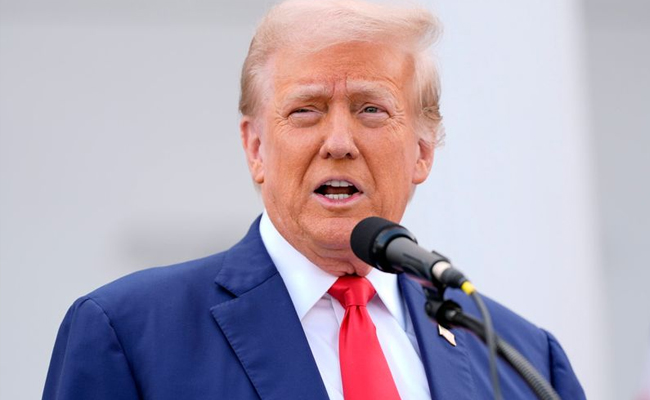
Washington (AP): President Donald Trump has said in a social media post that goods from the European Union would face higher tariff rates if the 27-member bloc fails to approve last year's trade framework by July 4.
The announcement on Thursday appeared to be a deadline extension after the president said last Friday that EU autos would face a higher 25 per cent tariff starting this week. Trump made the updated announcement after what he described as a "great call" with European Commission President Ursula von der Leyen.
Still, the US president was displeased that the European Parliament had yet to finalize the trade arrangement reached last year, which was further complicated in February by the US Supreme Court ruling that Trump lacked the legal authority to declare an economic emergency to impose the initial tariffs used to pressure the EU into talks.
"A promise was made that the EU would deliver their side of the Deal and, as per Agreement, cut their Tariffs to ZERO!" Trump posted. "I agreed to give her until our Country's 250th Birthday or, unfortunately, their Tariffs would immediately jump to much higher levels."
It was unclear from the post whether Trump was implying that the tariff rates would jump on all EU goods or the increase would only apply to autos.
His latest statement indicates he might be backing away from his earlier threat on EU autos by giving the European Parliament several more weeks to approve the agreement.
Under the original terms of the framework, the US would charge a 15 per cent tax on most goods imported from the EU.
But since the Supreme Court ruling, the administration has levied a 10 per cent tariff while investigating trade imbalances and national security issues, aiming to put in new tariffs to make up for lost revenues.