Impatient to take India to new heights: Modi
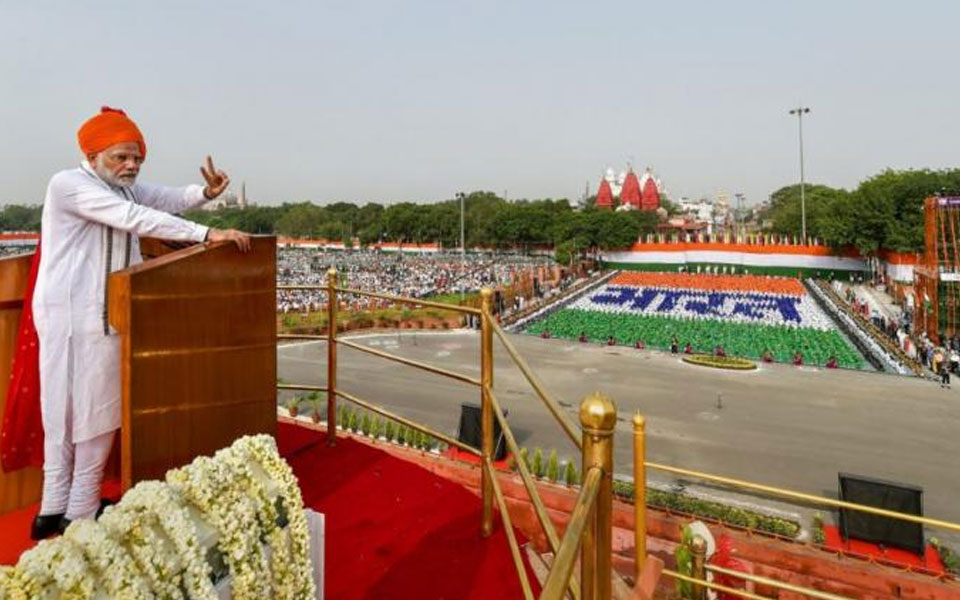
New Delhi, Aug 15: Prime Minister Narendra Modi on Wednesday said the country was on a new trajectory of growth due to initiatives in the last four years of his government and asserted that he was impatient to take the country ahead of many others in the world.
Addressing the nation from the ramparts of the Red Fort on the 72nd Independence Day, he took a dig at the previous UPA rule, saying if his government had continued with the same pace of development, the country would have taken decades to reach where it was today.
"Yes, I am impatient because many of the countries have moved forward. We have to move forward too. Malnutrition is a big problem in the country's development. I am anxious to eradicate it.
"I am impatient to provide health cover to every poor person so that they can fight diseases. I am anxious to provide quality life to all citizens. I am eager because we have to lead knowledge-based fourth industrial revolution. I am eager because I want that the country uses its resources and potential," he said.
Promising sanitation, housing, electricity, water, LPG, skills, health insurance and connectivity for all, Modi said towards the end of the speech that he wanted to create a new India for a better future.
"We have to make a new sunrise and take the country ahead of the skies and create a new India. We want to move ahead with the dream of reaching the crescendo of development. We want to progress more. There is no question of stopping or getting tired on the way," he said.
The Prime Minister said India was earlier seen among the fragile five nations but now it had turned itself into a "land of reform, perform and transform".
"We are all set for record economic growth. India's voice is being heard effectively at the world stage. We are integral part of forums whose doors were earlier closed for us," he said.
"The demand for higher MSP (minimum support price for farmers) was pending for years. From farmers to political parties to agriculture experts, everybody was asking about it but nothing happened. The decision was taken by our government to provide the MSP of 1.5 times of production cost."
He said the armed forces veterans were demanding one rank, one pension but no one listened to them before the Bharatiya Janata Party came to power.
He talked about the Goods and Services Tax (GST), saying it had given new confidence to small and big traders who "wholeheartedly embraced" the new tax regime despite "initial problems".
"Who did not want the passage of the GST? Yet, it was pending for years. Last year it became a reality. The OROP demand was pending for decades. The people of India, our brave Army personnel had faith in us and we were able to take a decision on OROP."
Drawing a parallel between the pace of works during UPA and the NDA governments, he said: "If we had continued at the same pace at which toilets were being built in 2013, the pace at which electrification was happening, LPG gas cylinders were being distributed and optical fibres were being laid in 2013, then it would have taken us decades to complete them.
"The country is now feeling the change. As a result, we are making highways with a double speed, houses are being made in villages with four times more pace, there is record production, we are manufacturing record mobiles. Today we are buying more aeroplanes.
"It is the same land, same sky, sea, government offices and the country. But in the last four years, India has moved with a new zeal and therefore today India is constructing twice the highways and producing record crops."
Let the Truth be known. If you read VB and like VB, please be a VB Supporter and Help us deliver the Truth to one and all.
TN polls: TVK pushes DMK behind with leads in 83 seats, AIADMK ahead in 54
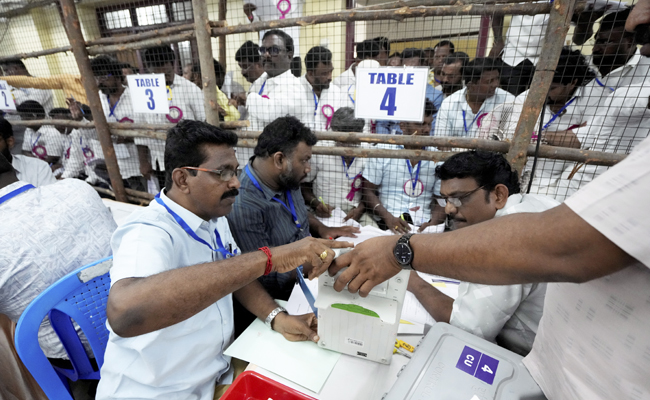
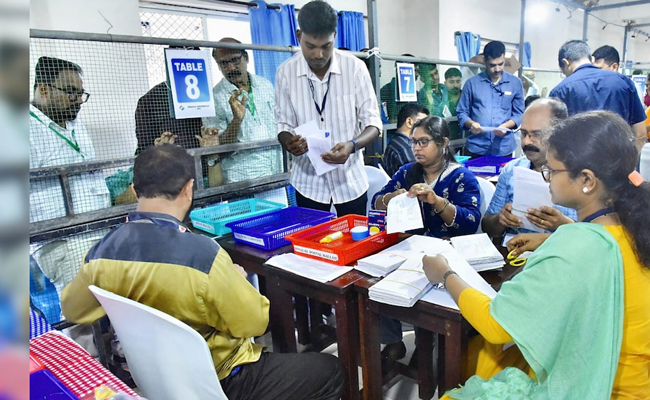
Chennai (PTI): New entrant TVK, led by actor-politician Vijay, was leading in as many as 83 constituencies on Monday when counting of votes polled in the April 23 Assembly polls was on across Tamil Nadu. The AIADMK was leading in 58 seats while the ruling DMK was ahead in 34, EC data showed.
About two hours after the postal ballots were counted and EVMs opened for multi-round counting, Vijay's Tamilaga Vettri Kazhagam surged ahead of its Dravidian rivals-- the DMK and the AIADMK, with the ruling party struggling to catch up.
If the trends maintain, Vijay could as well ensure the biggest electoral upset, something in lines with the "1967,1977" wins he had referred to in his campaign speeches.
While the Dravidian stalwart CN Annadurai brought the first non-Congress government in Tamil Nadu post-independence in 1967, the charismatic MG Ramachandran (MGR) installed the maiden AIADMK government 10 years later, unseating then DMK government under M Karunanidhi. TVK was leading in most Chennai segments, all considered DMK strongholds and currently represented by the party in the 234-member House.
A poor show by DMK could belie most exit polls giving an edge to it, riding on the number of populist measures Chief Minister M K Stalin had implemented in his five year "Dravidian model," inclusive governance.
According to EC and TV reports, 15 cabinet ministers, including Stalin were trailing. His son and deputy CM Udhayanidhi was also behind in his incumbent Chepauk-Tirvuvallikeni seat, according to a number of reports.
Stalin was trailing behind TVK's VS Babu by 1234 votes in Kolathur segment. Vijay was ahead in Tiruchirappalli East by over 3,000 votes at the end of two rounds of counting, according to EC data.
BJP is trailing in 26 constituencies and it is ahead in Thali segment alone. TVK is ahead in constituencies including Ponneri, Tiruvallur, Poonamalle, and Avadi.
AIADMK is leading in segments including Katpadi, and Guidyattam and party chief Edappadi K Palaniswami is ahead in Edappadi segment by 7003 votes.
DMK was leading in segments including Vellore, Anaikattu and Rishivandiyam.