Imperative to amplify justice needs of under-represented: CJI
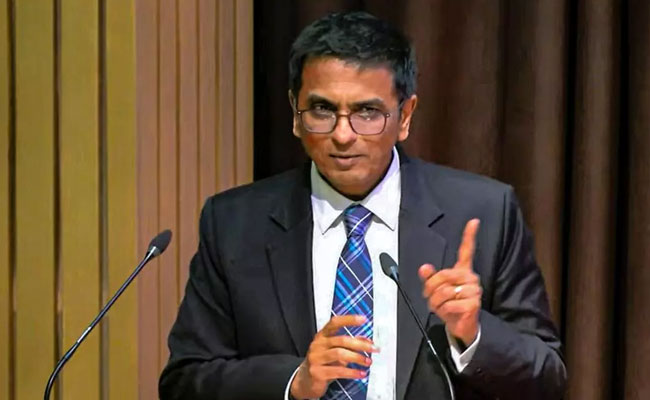
New Delhi (PTI): Access to justice cannot be secured only by crafting pro-people jurisprudence in judgements but requires active progress on the administrative side of the court such as improving infrastructure and enhancing legal aid services, Chief Justice of India DY Chandrachud said on Monday.
Speaking at the first Regional Conference on Access to Legal Aid organised by National Legal Services Authority (NALSA) here, Chandrachud said the challenge for judges is not to do justice in the facts of the individual case but to institutionalise the processes and look beyond the immediate as well.
"Access to justice is not a right that can be secured only by crafting pro-people jurisprudence in our judgements rather it requires active progress on the administrative side of the court as well," Chandrachud said.
The CJI said the discourse about human rights and access to justice has historically been monopolised by voices from the Global North (industrialised nations) which makes such dialogues unsuitable.
He said it is imperative to amplify the justice needs of the under-represented populations in our country.
Chandrachud said the concept of justice has historically been construed as applicable solely within the confines of a sovereign state.
"Given the intricate web of transnational relations in the present age, our concepts of justice have also changed. In transnational relationships, all nations are not treated equally. However, some nations share a sense of solidarity and belonging. It is here that constructed categories such as Global South become important points of collaboration, dialogue and deliberation.
"This term is not geographical but based on political, geopolitical, and economic commonalities between certain nations. Several nations in the Global South, including India, have historically been at the receiving end of imperialism or colonial rule. This history resulted in a relationship of unequal power with such nations being forced into the periphery of the economy. It is for this reason that before academics used the term Global South, terms such as developing, the underdeveloped or third world gained wide currency," he said.
The CJI said there has been a universal shift in wealth from the Mediterranean to the Asia Pacific.
"By 2030 it is projected that three of the four largest economies will be from the Global South. The GDP in terms of purchasing power of the Global South-dominated BRICS nations surpasses that of the Global North G7 Club and the reason why we have achieved success is their willingness to recognise the unique needs and collaborate with each other. This conference serves as a starting point for the nations to expand beyond the mere economic and trade alliances and make cooperation between our legal systems a key priority," he said.
This commitment to collaboration between nations of the Global South drives us not only to come together but also serves as a reminder that our institutions play an important role in promoting and upholding the rule of law.
"The complexities of law and process, inequality between citizens and powerful adversaries, judicial delays and the belief that the system works against marginalised communities are among the various barriers that stand in the way of justice," he said.
Chandrachud said during his tenure as CJI, he has initiated several initiatives for access to justice and the most potent important weapon in access to justice is technology.
"We are using it to bring the courtroom closer to people. Online streaming of proceedings has taken the court to the hearts and homes of people. It is about creating courtrooms where we make everyone feel welcome, including people from diverse backgrounds beyond caste, gender etc," he said.
Vice President Jagdeep Dhankhar, Union Law Minister Arjun Ram Meghwal, G20 Sherpa Amitabh Kant, Supreme Court judges SK Kaul and Sanjiv Khanna and Attorney General R Venkataramani also spoke on the occasion.
Let the Truth be known. If you read VB and like VB, please be a VB Supporter and Help us deliver the Truth to one and all.
Karnataka School Edu Dept prohibits children from being made to dance to obscene songs
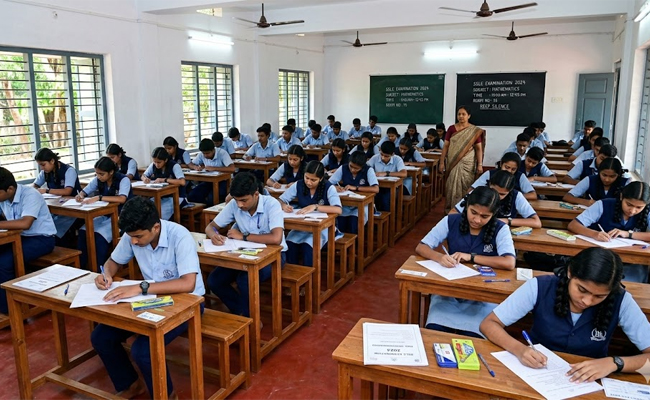
Bengaluru (PTI): The Karnataka School Education Department has issued a circular strictly prohibiting children from being made to dance to obscene songs in educational and cultural programmes.
It stated that such dances would negatively impact students' mental health and moral values. It will create indiscipline and harm the sanctity of education.
"All the Deputy Directors (Administration) of the state's School Education Department have been asked to take strict measures to prevent children or students from dancing to obscene songs in all government, aided and unaided schools in the state," the office of the commissioner of the School Education Department said in a recent circular.
"If it is found that children are being made to dance to obscene songs, appropriate action will be taken against the headmaster or management of such school," it added.
The department also listed certain measures in this regard, which include: strictly prohibiting children from being made to dance to obscene songs during educational and cultural programmes; selecting songs that are inspiring, positive, instilling national pride in children and reflecting the greatness, dignity, values, culture, and morality of the state.
Stating that the school headmaster and management are responsible for selecting songs and dances for cultural programmes, it said, they should also ensure that students wear decent clothes in dance or cultural programmes.