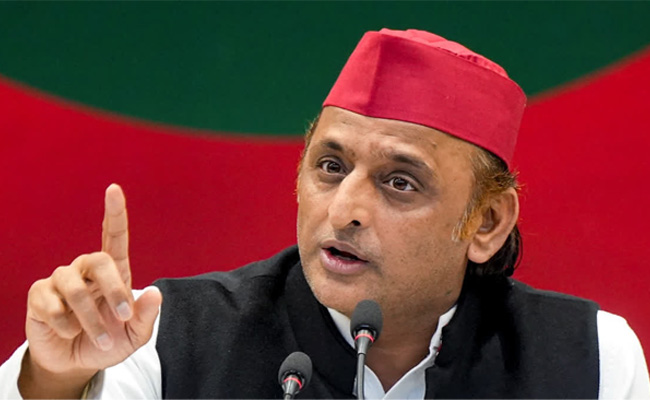
Important announcements regarding seat sharing, tickets on Sunday: Bihar BJP chief Dilip Jaiswal
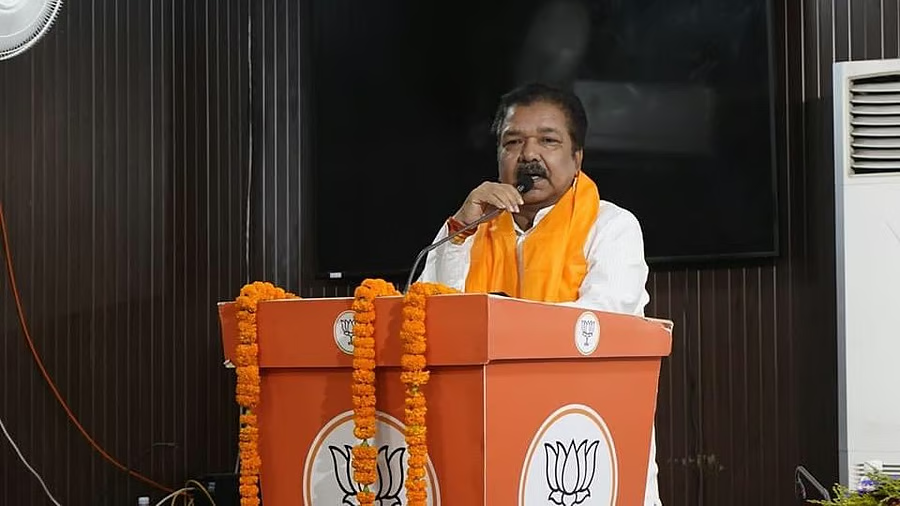
Patna (PTI): Bihar BJP chief Dilip Jaiswal on Saturday said that the central leadership of the party will make important announcements regarding seat sharing with NDA constituents and tickets for the upcoming assembly polls on Sunday.
Addressing a press conference here, the senior BJP leader dismissed speculations about rumblings of discontent among NDA constituents in the state.
"Everything is fine in the NDA... seat-sharing arrangements and the list of candidates will soon be decided by the party's central leadership, which will make important announcements related to seat sharing and tickets at 11 am on Sunday," Jaiswal said in a press conference here.
Earlier in the day, NDA constituent Rashtriya Lok Morcha (RLM) chief Upendra Kushwaha also dismissed the speculations about discontent and said that talks for seat sharing have not yet concluded.
The former Union minister, in an X post, said, "Don't pay attention to rumours floating around. The talks are not yet concluded. Wait...! I don't know how the news is being circulated in the media. If someone is planting news, it's deceit, it's betrayal."
Union minister Jitan Ram Manjhi had earlier said that he was "requesting and not making a claim" that his Hindustani Awam Morcha (HAM) be given a respectable number of seats, otherwise the party might not contest the election.
Another Union minister, Chirag Paswan's Lok Janshakti Party (Ram Vilas), which had earlier settled for around 20-22 seats, is now reportedly asking for at least 25 more.
Assembly elections in the state will be held on November 6 and 11, while votes will be counted on November 14.
"It will be a humiliation for me and my party if we are not given at least 15 seats in the coming assembly polls. If we get 15, we can easily win at least 8-9 seats and will become a recognised party," Manjhi had said.
Even after 10 years of establishment, HAM remains an unrecognised party.
"I have been helping the NDA for a long time. So, I am requesting the NDA leaders and not making a claim. My party would prefer not to contest the polls, if we don't get a respectable number of seats.
“But I must make it clear that even if we don't contest polls, our party will keep working for the NDA partners in the coming polls," Manjhi said.
According to sources in the NDA, the bigger allies JD(U) and the BJP are likely to contest 102 and 101 seats, respectively.
LJP (Ram Vilas), which had earlier settled for around 20-22 seats, is now asking for at least 25 more. Senior leaders in the LJP (RV) are of the opinion that the party should get at least 45 seats, said a party leader on the condition of anonymity.
Let the Truth be known. If you read VB and like VB, please be a VB Supporter and Help us deliver the Truth to one and all.
Accused gunman at correspondents' dinner was believed to be targeting top officials, Blanche says
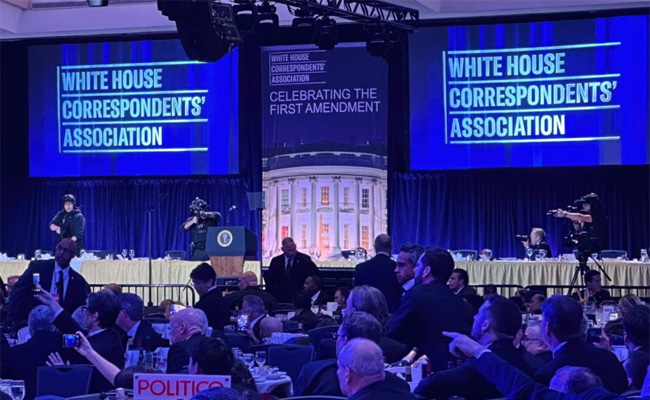
Washington (AP): The accused gunman who tried to storm the ballroom at the White House Correspondents' Association dinner with guns and knives travelled across the country before the event and is believed to have been targeting members of the Trump administration, acting Attorney General Todd Blanche said Sunday.
Blanche also said officials believe the suspect traveled by train from California to Chicago and then on to Washington, where in recent days he checked in as a guest to the hotel where one of Washington's glitziest events was being held Saturday night.
Investigators have not publicly named the suspect, but two law enforcement officials familiar with the matter have identified him to The Associated Press as 31-year-old Cole Tomas Allen of Torrance, California.
Law enforcement officials who have examined the gunman's electronic devices and his writings preliminarily believe he intended to target administration members in attendance at the dinner. He attempted to charge into the cavernous ballroom at the Washington Hilton but was tackled to the ground in a chaotic scene that resulted in shots being fired, President Donald Trump being hurried off the stage and guests ducking for cover beneath their tables.
“It does appear that he did in fact set out to target folks who work in the administration, likely including the president,” Blanche told NBC's “Meet the Press.”
The suspect is believed to have purchased the firearms he carried within the last couple of years, Blanche said. He is not being cooperative and is expected to face multiple charges on Monday.
Video posted by Trump showed the suspect running past security barricades as Secret Service agents ran toward him. One officer was shot in a bullet-resistant vest but was recovering, officials said. The gunman was taken into custody and was not injured, but was being evaluated at a hospital, police said.
“He failed,” Blanche said on CBS's “Face the Nation.” “Law enforcement did their jobs.”
Social media posts that appear to match the suspect show he is a highly educated tutor and amateur video game developer.
A May 2025 profile photo of Allen appears to match the appearance of the man in a photo of the alleged attacker being taken into custody that was posted Saturday night by Trump. The photo, posted to the social networking site LinkedIn, shows him in a cap and gown after graduating with a master's degree in computer science from California State University, Dominguez Hills.
Allen earned a bachelor's degree in 2017 in mechanical engineering from the California Institute of Technology in Pasadena. He listed his involvement there in a Christian student fellowship and a campus group that battled with Nerf guns.
The shooting at the security barricades happened minutes after the event got underway.
The Secret Service and other authorities swarmed the room as guests ducked under tables by the hundreds. Gasps echoed through the ballroom as guests realized something was happening. Hundreds of journalists immediately got on phones to call in information.
“Out of the way, sir!” someone yelled. Others yelled to duck. From one corner, a “God Bless America” chant began as the president was escorted offstage. Outside the hotel, members of the National Guard and other authorities flooded the area as helicopters circled overhead.
After an initial attempt to resume the event, it was scrapped for the night and will be rescheduled.

_vb_69.jpeg)