In New Modi govt, 51 ministers are crorepatis, 22 face criminal cases: ADR
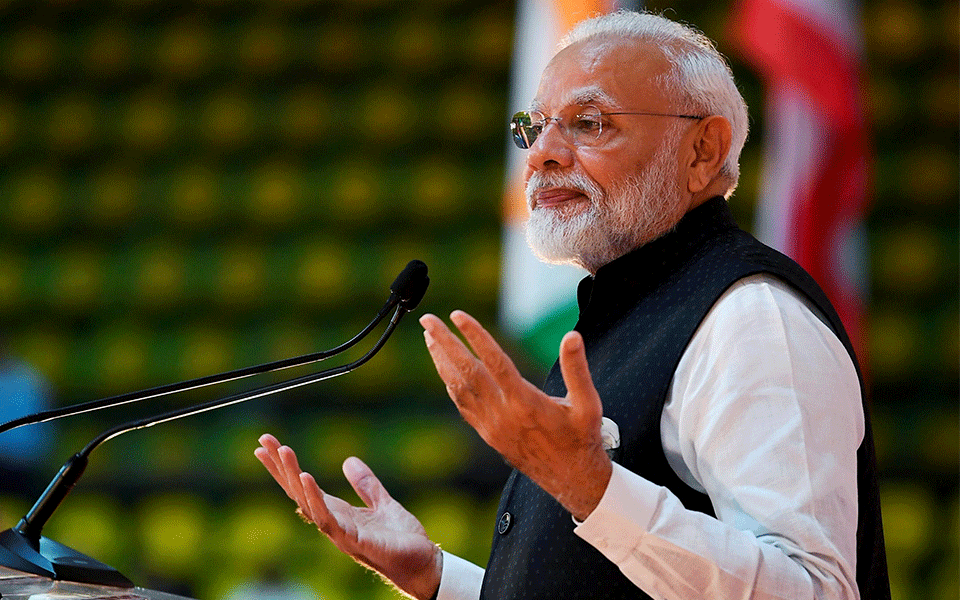
New Delhi, May 31: Of the 56 ministers who took oath on Thursday and are part of either the Lok Sabha or the Rajya Sabha, 51 are crorepatis and 22 have declared criminal cases against themselves, according to election watchdog Association for Democratic Reforms (ADR).
It said eight ministers have declared their educational qualification to be between 10th and 12th standard, while 47 are graduates. One minister holds a diploma.
The ADR released the findings after analysing affidavits of 56 of the 58 ministers, including Prime Minister Narendra Modi, from the 17th Lok Sabha and the current Rajya Sabha.
The details of Lok Janshakti Party chief Ram Vilas Paswan, who is the minister of consumer affairs, food and public distribution, and External Affairs Minister Subrahmanyam Jaishankar were not analysed as they are not members of Parliament currently.
Of the 56 ministers analysed, 22 (39 per cent) have declared criminal cases against themselves, while 16 (29 per cent) have declared serious criminal cases, including those related to attempt to murder, communal disharmony, electoral violations etc., the ADR said.
When compared with data from the 16th Lok Sabha, the number of ministers with criminal cases has risen by eight percentage points, while the count of those with serious criminal cases has increased by 12 percentage points, it said.
Six ministers have declared cases related to promoting enmity between different groups on grounds of religion, race, place of birth, residence, language, etc. Three ministers, including firebrand BJP leaders Giriraj Singh and Ashwini Kumar Chaubey, have declared cases of poll code violation against themselves.
The ADR said 51 (91 per cent) of the ministers are crorepatis. On an average, each minister has assets worth Rs 14.72 crore.
Four ministers, including Home Minister Amit Shah, Railway Minister Piyush Goyal and Shiromani Akali Dal's Harsimrat Kaur Badal, have declared assets worth more than Rs 40 crore.
Only five ministers, including first-timers Kailash Chaudhary and Rameswar Teli, have declared assets worth less than Rs 1 crore.
These also include Pratap Chandra Sarangi from Odisha's Balasore who is famous for his austere lifestyle. He has declared assets worth around Rs 13 lakh, according to the ADR.
Eleven ministers are aged between 41 and 50, while 45 have declared their age to be between 51 and 70 years.
Let the Truth be known. If you read VB and like VB, please be a VB Supporter and Help us deliver the Truth to one and all.
Trump says EU has until July 4 to approve last year's trade deal or it will face higher tariffs
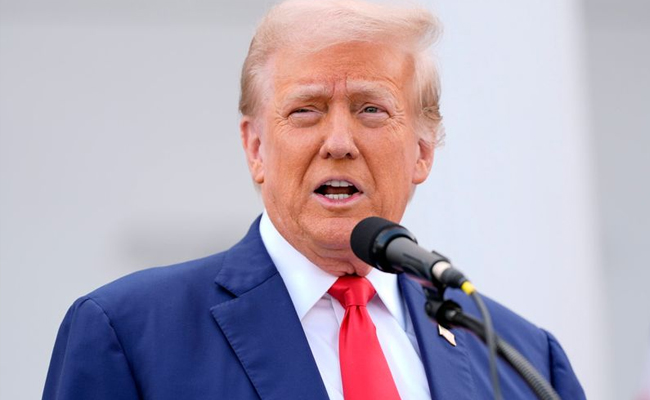
Washington (AP): President Donald Trump has said in a social media post that goods from the European Union would face higher tariff rates if the 27-member bloc fails to approve last year's trade framework by July 4.
The announcement on Thursday appeared to be a deadline extension after the president said last Friday that EU autos would face a higher 25 per cent tariff starting this week. Trump made the updated announcement after what he described as a "great call" with European Commission President Ursula von der Leyen.
Still, the US president was displeased that the European Parliament had yet to finalize the trade arrangement reached last year, which was further complicated in February by the US Supreme Court ruling that Trump lacked the legal authority to declare an economic emergency to impose the initial tariffs used to pressure the EU into talks.
"A promise was made that the EU would deliver their side of the Deal and, as per Agreement, cut their Tariffs to ZERO!" Trump posted. "I agreed to give her until our Country's 250th Birthday or, unfortunately, their Tariffs would immediately jump to much higher levels."
It was unclear from the post whether Trump was implying that the tariff rates would jump on all EU goods or the increase would only apply to autos.
His latest statement indicates he might be backing away from his earlier threat on EU autos by giving the European Parliament several more weeks to approve the agreement.
Under the original terms of the framework, the US would charge a 15 per cent tax on most goods imported from the EU.
But since the Supreme Court ruling, the administration has levied a 10 per cent tariff while investigating trade imbalances and national security issues, aiming to put in new tariffs to make up for lost revenues.