India announces plans to amend nuclear liability laws ahead of Modi's expected visit to US

New Delhi, Feb 1 (PTI): India on Saturday announced plans to amend its nuclear liability law and set up a nuclear energy mission, a move that came ahead of Prime Minister Narendra Modi's likely visit to the US.
New Delhi made public its decision to amend the nuclear liability law little over two weeks after Washington lifted restrictions on three Indian nuclear entities to open up new avenues for India-US collaboration in the civil-nuclear field.
Certain clauses in India's Civil Liability for Nuclear Damage Act, 2010 have emerged as hurdles in moving forward in implementation of the historic civil nuclear deal that was firmed up between the two strategic partners around 16 years ago.
Modi is expected to visit Washington this month to hold wide-ranging talks with US President Donald Trump with a focus on further shore up bilateral cooperation in a range of areas including trade, energy and defence.
India's decision to set up a 'Nuclear Energy Mission' with an outlay of Rs 20,000 crore and plans to amend the nuclear liability laws were announced by Finance Minister Nirmala Sitharaman while presenting the Union budget for 2025-26 in Parliament.
"Development of at least 100 GW (Gigawatt) of nuclear energy by 2047 is essential for our energy transition efforts," she said.
"For an active partnership with the private sector towards this goal, amendments to the Atomic Energy Act and the Civil Liability for Nuclear Damage Act will be taken up," she added.
The Atomic Energy Act of 1962 prohibits investments by the private sector in nuclear power plants. The proposed amendment is expected to remove this provision.
The finance minister said a 'Nuclear Energy Mission' for research and development of Small Modular Reactors (SMR) with an outlay of Rs 20,000 crore will be set up.
"At least five indigenously developed SMRs will be operationalised by 2033," she said.
Modi described the decision to promote the private sector in the nuclear energy sector as "historic".
"This will ensure a major contribution of civil nuclear energy in the development of the country in the coming times," he said in his reaction to the Union budget.
Modi said that civil nuclear energy will ensure a significant contribution to the country's development in the future.
The US last month removed restrictions on Bhabha Atomic Research Centre (BARC), Indira Gandhi Atomic Research Centre (IGCAR) and the Indian Rare Earths (IRE).
The decision came after then NSA Jake Sullivan announced that Washington was finalising steps to "remove" hurdles for civil nuclear partnership between Indian and American firms.
India and the US unveiled an ambitious plan to co-operate in civil nuclear energy in July 2005 following then Prime Minister Manmohan Singh's meeting with American President George W Bush.
The historic civil nuclear agreement was finally sealed around three years later following a series of negotiations.
It was expected to pave the way for allowing the US to share civilian nuclear technology with India.
However, the planned cooperation did not move forward for a variety of reasons including the strict liability laws in India.
US nuclear reactor makers such as General Electric and Westinghouse had shown keen interest in setting up nuclear reactors in India.
In the last few years, India has been in talks with a number of countries including the US and France on cooperation in the small modular reactors (SMRs).
India may pitch for cooperation in the SMR sector with the Trump administration.
US-based Holtec International is known to be one of the leading exporters of SMRs globally and the Department of Atomic Energy is learnt to be interested in having some collaboration with the American firm.
Let the Truth be known. If you read VB and like VB, please be a VB Supporter and Help us deliver the Truth to one and all.
Trump says EU has until July 4 to approve last year's trade deal or it will face higher tariffs
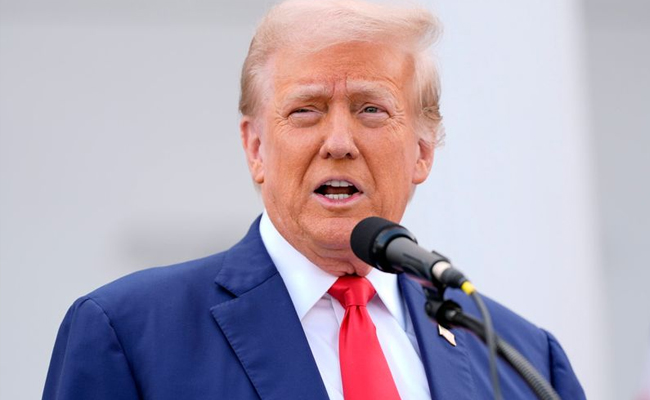
Washington (AP): President Donald Trump has said in a social media post that goods from the European Union would face higher tariff rates if the 27-member bloc fails to approve last year's trade framework by July 4.
The announcement on Thursday appeared to be a deadline extension after the president said last Friday that EU autos would face a higher 25 per cent tariff starting this week. Trump made the updated announcement after what he described as a "great call" with European Commission President Ursula von der Leyen.
Still, the US president was displeased that the European Parliament had yet to finalize the trade arrangement reached last year, which was further complicated in February by the US Supreme Court ruling that Trump lacked the legal authority to declare an economic emergency to impose the initial tariffs used to pressure the EU into talks.
"A promise was made that the EU would deliver their side of the Deal and, as per Agreement, cut their Tariffs to ZERO!" Trump posted. "I agreed to give her until our Country's 250th Birthday or, unfortunately, their Tariffs would immediately jump to much higher levels."
It was unclear from the post whether Trump was implying that the tariff rates would jump on all EU goods or the increase would only apply to autos.
His latest statement indicates he might be backing away from his earlier threat on EU autos by giving the European Parliament several more weeks to approve the agreement.
Under the original terms of the framework, the US would charge a 15 per cent tax on most goods imported from the EU.
But since the Supreme Court ruling, the administration has levied a 10 per cent tariff while investigating trade imbalances and national security issues, aiming to put in new tariffs to make up for lost revenues.