India, Bangladesh ink seven pacts on bilateral issues; Hasina raises NRC issue with PM
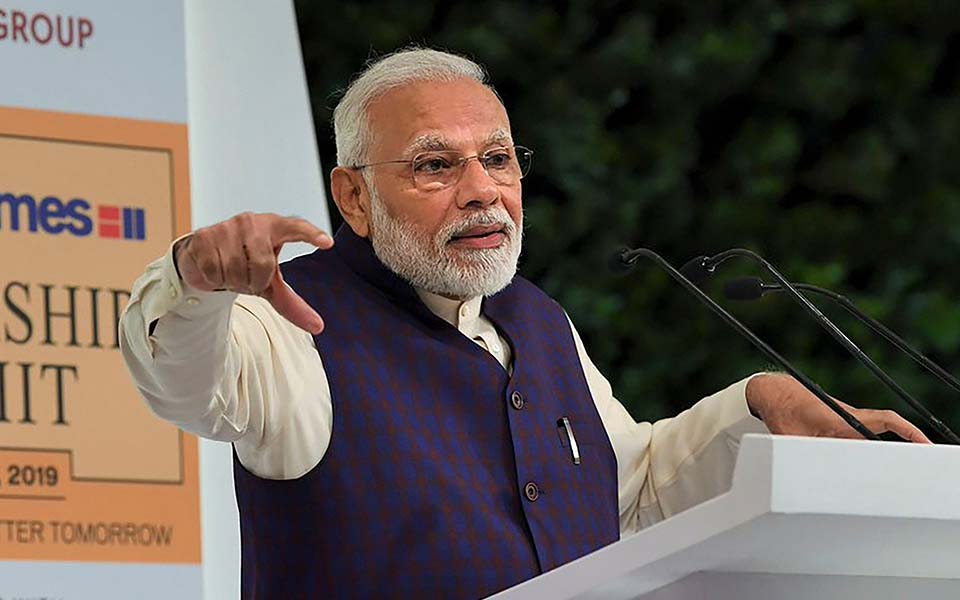
New Delhi, Oct 5: India and Bangladesh on Saturday signed seven pacts including one for setting up of a joint coastal surveillance systems as Prime Minister Narendra Modi and his Bangladeshi counterpart Sheikh Hasina held "productive and comprehensive" talks to further broadbase bilateral ties.
In the discussions, Hasina also raised her concerns over roll out of National Register of Citizens (NRC) in Assam, an exercise carried out to identify genuine Indian citizens living in Assam and weed out illegal Bangladeshis.
Government sources said the Indian side conveyed to Hasina that publication of the NRC was a court-monitored process and the final scenario on the issue is yet to emerge.
The issue of Rohingya refugees also figured in the talks and the two prime ministers agreed on the need to expedite safe, speedy and sustainable repatriation of the displaced persons to their homes in the Rakhine state of Myanmar, officials said.
A joint statement said Modi appreciated the zero-tolerance policy of the Bangladesh government against terrorism and commended Hasina for her resolute efforts to ensure peace, security and stability in the region.
Both leaders reiterated their strong commitment to eliminate terrorism in all its forms and manifestations, and stressed that there can be no justification whatsoever for any act of terror.
After the talks, Modi and Hasina, through video link, launched a project to import LPG from Bangladesh for distribution in the Northeastern states, inaugurated a Vivekananda Bhaban at Ramakrishna Mission in Dhaka and unveiled a skill development institute at Khulna.
"India accords priority to its ties with Bangladesh. The increasing cooperation between India and Bangladesh is a shining example of neighbourly relations for the entire world," Modi said in a brief media statement.
In presence of Hasina, he said Saturday's talks will further energise bilateral ties.
The joint statement said Hasina highlighted that the people of Bangladesh are awaiting early signing of the Teesta water sharing agreement which was agreed upon by both the governments in 2011.
Modi conveyed to Hasina that his government is working with all stakeholders in India for conclusion of the agreement at the earliest.
The seven MoUs signed will provide deepening cooperation in areas of water resources, youth affairs, culture, education and coastal surveillance.
Government sources called the MoU on cooperation in coastal surveillance radar system as significant for regional maritime security. India is expected to set up nearly two dozen coastal surveillance radar stations under the pact.
Another MoU will facilitate use of Chattogram and Mongla ports for movement of goods to and from India. A separate MoU will provide for withdrawal of 1.82 cusec of water from Feni river of Bangladesh for drinking purpose of the people of Sabroom town of Tripura.
The joint statement said the two prime ministers held productive and comprehensive talks and agreed to fully utilise opportunities for advancing mutually beneficial ties in both conventional and non-conventional areas, besides noting that the "irreversible partnership" enhances the legacy that started with the great war of liberation of Bangladesh.
In the talks, both leaders emphasised the importance of effective border management for ensuring a tranquil, stable and crime free border.
"Towards this goal, the leaders directed their respective border forces to complete border fencing at all pending sectors at the international border between both the countries at the earliest," the joint statement said.
"Both leaders also agreed that the loss of civilian lives at the border is a matter of concern and directed the border forces concerned to enhance coordinated measures to work toward bringing such border incidents down to zero," it said.
Modi and Hasina also agreed to expedite commissioning of the joint study on the prospects of entering into a bilateral Comprehensive Economic Partnership Agreement (CEPA) between India and Bangladesh.
Both leaders directed their officials to expedite the establishment of framework of cooperation in the area of trade remedial measures for cooperation and capacity building in this area, said the joint statement.
Let the Truth be known. If you read VB and like VB, please be a VB Supporter and Help us deliver the Truth to one and all.
Man arrested with Rs 2.54-crore heroin in Mumbai

Mumbai (PTI): Police have arrested a man and seized over 500 grams of heroin worth Rs 2.54 crore in the illicit market from him in Mumbai, officials said on Friday.
The police's Anti-Narcotics Cell (ANC) made the drug seizure in Santacruz in the western suburbs. The operation was conducted by the Kandivali unit of the ANC on Thursday as part of a special crackdown against drug trafficking in the area, they said.
Acting on specific inputs, an ANC team conducted a raid in Santacruz (East) and intercepted a man. During a search, the team recovered 508 grams of high-grade heroin from his possession, an official said.
The seized contraband, a highly addictive, opioid drug derived from morphine, is estimated to be worth Rs 2.54 crore in the international market, he informed.
Following the seizure, a case was registered against the man under relevant sections of the Narcotic Drugs and Psychotropic Substances (NDPS) Act, 1985, and he was formally placed under arrest in the early hours of Friday.
The police are currently investigating the source of the drug and trying to identify the intended recipients of the consignment, he said.