INDIA bloc meeting on December 17: RJD president Lalu Prasad Yadav
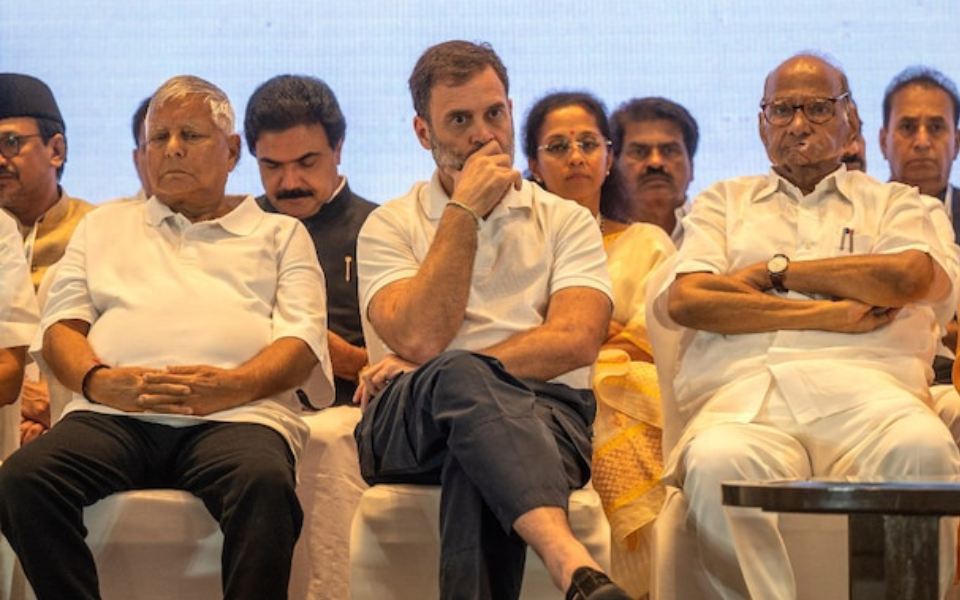
Patna, Dec 5: RJD president Lalu Prasad on Tuesday said that top leaders of the INDIA bloc will be meeting on December 17 to chalk out the strategy for the 2024 Lok Sabha polls.
Prasad was posed with queries by journalists, in Buxar district of Bihar, about the meeting that was scheduled on Wednesday but was deferred due to the inability of several top leaders to attend.
"The meeting has now been rescheduled to December 17," said Prasad, a staunch ally of the Congress and also known to be close to the Nehru-Gandhi family.
Speculations have been rife that Prasad's ally Nitish Kumar, the CM of Bihar, was reluctant to attend the meeting on Wednesday. At a recent public meeting, Kumar had lashed out at the Congress for neglecting INDIA bloc during the recent assembly elections in Rajasthan, Madhya Pradesh and Chhattisgarh.
After the Congress' defeat in the crucial polls, many leaders of Kumar's JD(U) have gone on record saying that Congress made a mistake by failing to take on board regional parties and trying to fight the BJP on its own.
Besides, another key INDIA leader Mamata Banerjee, the West Bengal Chief Minister who heads the Trinamool Congress, has also said that she would not be able to visit Delhi on December 6 as she had engagements elsewhere.
Senior Congress leader Gurdip Singh Sappal has, meanwhile, announced on X that "a coordination meeting of Parliamentary Party leaders of India Alliance will be at 6 pm on December 6th, 2023 at the residence of Congress President Sh. Mallikarjun Kharge. Thereafter meeting of Party Presidents/ Heads of the India Alliance will be scheduled in third week of December at a date convenient to all".
When Prasad was asked about the Congress' recent poll debacle, he said, "I don't think the party has grown weak. But it may need to work on its leadership in states like Madhya Pradesh."
Let the Truth be known. If you read VB and like VB, please be a VB Supporter and Help us deliver the Truth to one and all.
4 held for sexually assaulting woman, girl on moving bus after social media alert in UP's Agra

Agra (UP) (PTI): Four people were arrested, after a prompt response by police following a social media alert, for allegedly sexually assaulting a woman and a girl inside a moving bus here, officials said on Tuesday.
According to an official police statement, at 12:27 am on April 27, information was received on the social media platform X about an incident of sexual assault on a bus travelling from Kanpur to Ahmedabad, which was approaching Namner crossing in Agra.
Acting under the direction of Police Commissioner Deepak Kumar, the Agra Police social media team immediately alerted the Rakabganj police station within minutes and coordinated with the victims to confirm the incident and obtain the exact location, it stated.
Police teams launched intensive checking at Namner crossing and intercepted the bus as it reached the spot. The four accused involved in the incident were apprehended on the spot, and legal action was initiated against them, the statement said.
The police said the swift response and coordination between the social media team and field units ensured timely action, bringing relief to the victims and other passengers, who expressed gratitude towards the police, it added.