INDIA bloc parties hold online meeting ahead of Monsoon session
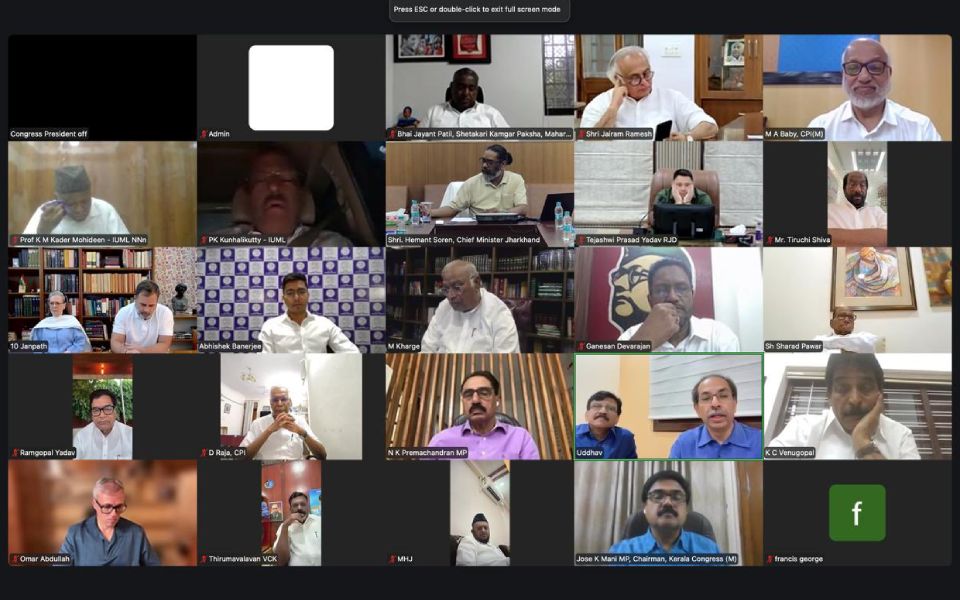
New Delhi, Jul 19 (PTI): INDIA bloc parties on Saturday held deliberations at an online meeting to reach a consensus on issues that they would raise to corner the government during Parliament's Monsoon session beginning July 21 and convey a message of unity.
Twenty-four political parties, including the Congress, TMC, DMK, RJD, SP, NCP-SP, Shiv Sena (UBT), JMM, CPI-M, CPI, CPI-ML, Forward Bloc, IUML and Kerala Congress, participated in the discussions.
The meeting came ahead of the Monsoon session, which begins on Monday. The opposition grouping met after a long gap as they jointly deliberated on the country's political situation.
"Leaders of 24 political parties belonging to the INDIA group have just begun their online pre-Parliament meeting," AICC general secretary Jairam Ramesh said in a post on X after the meeting began.
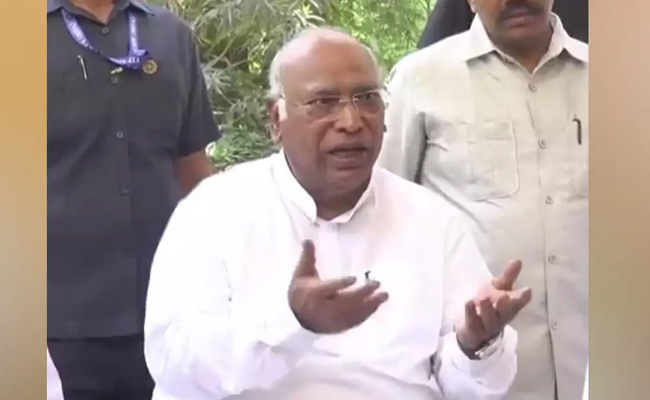
The meeting was attended by Congress president Mallikarjun Kharge, Congress parliamentary party chief Sonia Gandhi, former party chief Rahul Gandhi, Jammu and Kashmir chief minister Omar Abdullah, Jharkhand chief minister Hemant Soren, NCP (SP)'s Sharad Pawar, Uddhav Thackeray (SS-UBT), Abhishek Banerjee (TMC), Tejashwi Yadav (RJD), Ram Gopal Yadav (SP), Tiruchi Siva (DMK) M A Baby of CPI-M, D Raja (CPI), CPI(ML) general secretary Dipankar Bhattacharya, among others.
The leaders deliberated on a host of key issues, including the Election Commission's special intensive revision of the electoral rolls in Bihar, the demand for a discussion on the Pahalgam attack, and Operation Sindoor.
The opposition parties are raising strong objections to the special intensive revision of electoral rolls in Bihar and are demanding that it be scrapped now, as assembly elections are slated in the next few weeks there. They have also been demanding answers on the Pahalgam attack and Operation Sindoor and the losses that the country has suffered during it.
US President Donald Trump's claims of bringing about a halt in hostilities between India and Pakistan, and the push to impeach Justice Yashwant Varma, who is embroiled in a row following the discovery of burnt wads of currency at his residence after a fire incident, are also likely to feature in the discussions.
During the Parliament session, the top Congress leadership has resolved to raise issues such as the demand for the restoration of full statehood to Jammu and Kashmir and rising atrocities against women in the country.
The opposition party has also decided to raise farmers' problems, the issues of rising unemployment, safety and security of the country and the Ahmedabad air crash during the session.
Sonia Gandhi had convened a meeting of the party's parliamentary strategy group at her 10, Janpath residence here on Tuesday evening.
Leaders of 24 political parties belonging to the INDIA group have just begun their online pre-Parliament meeting. pic.twitter.com/j5HspeWktu
— Jairam Ramesh (@Jairam_Ramesh) July 19, 2025
Let the Truth be known. If you read VB and like VB, please be a VB Supporter and Help us deliver the Truth to one and all.
Ladakh a living land of dharma for centuries: Amit Shah
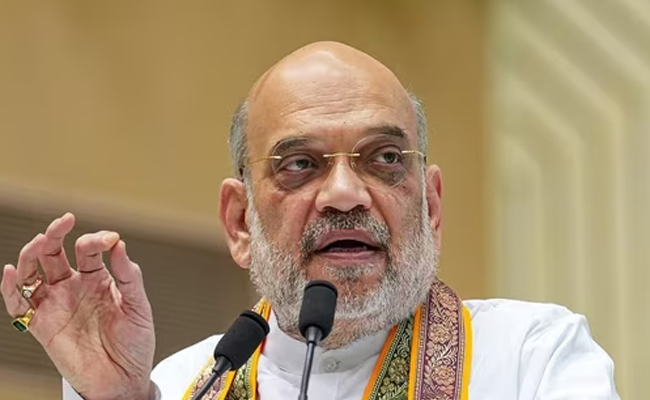
Leh/Jammu (PTI): Union Home Minister Amit Shah on Friday described the return of sacred relics of Lord Buddha to Ladakh after 75 years as a "historic reunion" and said that the Union Territory has remained a "living land of dharma", preserving and nurturing Buddhist knowledge for centuries.
Stressing the relevance of Buddha's teachings in modern times, Shah said the message of peace, compassion and the middle path was even more important today than it was 2,500 years ago.
"Ladakh has been a living land of dharma for centuries. When the Dalai Lama comes here, he says this land is not merely a geographical land but a living laboratory of Buddhist culture and compassion," Shah said, speaking after the inauguration of the sacred holy relics exposition of Tathagata Buddha and the 2569th Buddha Purnima celebrations at Jivetsal in Leh during his two-day visit to Ladakh.
Calling Ladakh a land of compassion, he said this land has preserved and nurtured knowledge. "Whenever Buddhism faced crises, this land worked to protect the teachings of Buddha. And when peace returned, it helped to expand and carry forward that preserved wisdom," he added.
"Unless one internalises knowledge and makes it a part of oneself, liberation is not possible. Knowledge is incomplete without spiritual practice, while spiritual practice without knowledge is blind. Therefore, the union of spiritual practice and knowledge is the right path. Even after all this, if there is no moral discipline, one cannot lead a truly wise life. The basis of a life of wisdom is moral discipline," he said.
Shah said it was through Ladakh and adjoining routes that the teachings of Tathagata Buddha, which originated in India, spread to China and several other countries.
"The message that emerged from the land of Ladakh has become a guiding force for many people around the world to take their lives forward. The presence of these sacred relics in Ladakh reminds us that India's civilisation has, for thousands of years, given the message of peace and coexistence," he said.
He said that in a diverse region like Ladakh and Kargil, this message becomes even more relevant. "This heritage still tells us today that amidst conflict and unrest, only the path of peace and compassion can provide solutions."
He said the return of the relics on Buddha Purnima had enhanced the significance of the festival for the people of Ladakh.
"These sacred relics have come to Ladakh after 75 years. It is as if Buddha himself is present here today," Shah said, adding that followers of Buddhism and people of other faiths in Ladakh and Kargil would draw spiritual energy from the relics.
Highlighting Ladakh's role in the spread of Buddhism, Shah said Kashmir was once an ancient centre of Buddhist studies, Mahayana philosophy and Buddhist art, from where Ladakh first came into close contact with Buddhism.
He said Emperor Ashoka's envoys laid the foundation of Buddhist influence in Ladakh through Kashmir and Gandhara, while Mahayana Buddhism expanded in the region during the Kushan period between the first and third centuries CE.
The Silk Route linking Kashmir, Leh, Yarkand, Khotan and Tibet became a channel not only for trade but also for ideas, monks, manuscripts and artistic traditions, Shah said.
He added that later, Tibetan influence between the seventh and tenth centuries further enriched Ladakh through Mahayana and Vajrayana traditions.
Stressing the relevance of Buddha's teachings in modern times, Shah said the message of peace, compassion and the middle path was even more important today than it was 2,500 years ago.
"Amid conflict and unrest, only the path of peace and compassion can provide solutions," he said.
Shah also appealed to the Ladakh administration to ensure complete arrangements so that followers of all faiths, especially Buddhists, could visit and pay obeisance to the relics.
#WATCH लेह, लद्दाख: केंद्रीय गृह मंत्री अमित शाह ने कहा, "जब दलाई लामा यहां आते हैं तो वे कहते हैं कि यह भूमि केवल भौगोलिक भूमि नहीं है। यह भूमि बौद्ध संस्कृति और करुणा की जीवंत प्रयोगशाला है। इस भूमि पर ज्ञान का संरक्षण हुआ है... भारत की सभ्यता हजारों वर्षों से शांति का संदेश… https://t.co/2nwG0w2CE6 pic.twitter.com/W13itRBqeX
— ANI_HindiNews (@AHindinews) May 1, 2026