India-China affirm disengagement progress, discuss bilateral relations
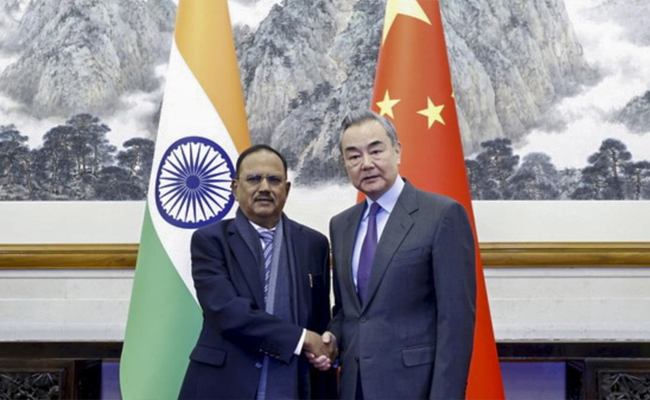
New Delhi: National Security Advisor Ajit Doval and Chinese Foreign Minister Wang Yi met in Beijing on Wednesday, marking the first boundary talks between the Special Representatives (SR) since 2019. Both sides “positively affirmed” the progress of their disengagement agreement along the Line of Actual Control (LAC) and emphasized learning from the four-year military standoff to maintain peace and stability at the border.
The talks also focused on restoring bilateral ties disrupted by tensions at the LAC. Discussions included reopening cross-border exchanges such as the Kailash Mansarovar pilgrimage, data sharing on trans-border rivers, and border trade. A statement from China’s Ministry of Foreign Affairs highlighted a “six-point consensus” reached during the dialogue, aimed at preserving border peace and fostering improved relations. While India’s Ministry of External Affairs (MEA) did not mention the six-point framework, it reiterated a shared commitment to resolving boundary issues based on earlier political guidelines.
The SR meeting, resumed after a five-year hiatus, comes on the heels of the October 2024 disengagement agreement in eastern Ladakh. This agreement, covering areas like Depsang and Demchok, allowed for patrolling and grazing, paving the way for further discussions on troop de-escalation and de-induction along the border.
The talks did not touch on the resumption of direct flights or journalist exchanges, previously discussed during External Affairs Minister S. Jaishankar's meeting with Wang Yi in Rio de Janeiro. However, Doval’s meeting with Chinese Vice President Han Zheng underscored the need to restore exchanges in economic, cultural, and trade sectors.
During the meeting, both sides acknowledged the importance of peace at the LAC for broader bilateral relations. Doval extended an invitation to Wang Yi to visit New Delhi for the next round of SR talks, reinforcing India’s commitment to strengthening strategic communication with China.
Let the Truth be known. If you read VB and like VB, please be a VB Supporter and Help us deliver the Truth to one and all.
Rajnath to top commanders: Outmaneuver adversaries with strategic surprise
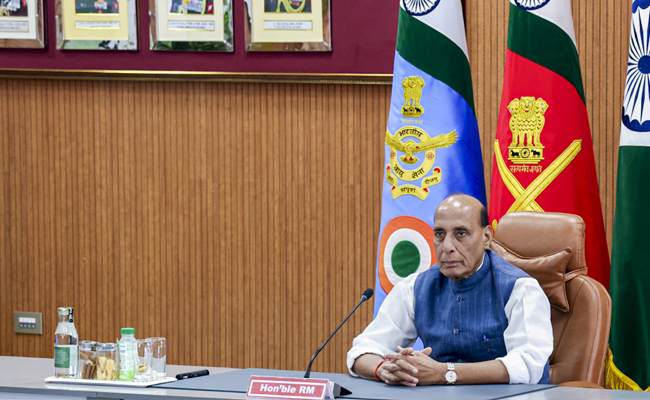
Jaipur/New Delhi (PTI): Defence Minister Rajnath Singh on Friday directed the top military commanders of the three services to integrate an "element of surprise" into modern warfare to outmaneuver India's adversaries and bolster strategic posture.
In his address at the joint commanders conference in Jaipur, Singh also described the Operation Sindoor as a testament to the "swift, precise, and joint response" of the Indian armed forces to safeguard national interests and called upon the military to remain ready to deal with any security challenges.
In their two-day deliberations, the commanders carried out a comprehensive review of the combat preparedness of the military in the wake of the evolving regional security situation.
Operation Sindoor was a demonstration of India's growing capabilities and a symbol of the nation's collective resolve and new military ethos, Singh said, a day after the first anniversary of Operation Sindoor.
He also unveiled a 'Joint Doctrine for Integrated Communication Architecture' that is aimed at strengthening doctrinal clarity, interoperability and integrated communications across the armed forces in future multidomain operations.
The joint commanders' conference, themed 'Military Capability in New Domains', brought together the top leadership of the defence ministry and the three services to deliberate on emerging security challenges and future readiness.
Comprehensive deliberations were held on future warfare, multidomain operations, technological transformation and joint capability development.
The conference witnessed extensive discussions on cognitive warfare, cyber resilience against evolving quantum and AI-enabled threats, military capability development in emerging domains, indigenous innovation and AI-enabled warfighting concepts.
It was attended by Chief of Defence Staff Gen Anil Chauhan, Chief of the Naval Staff Admiral Dinesh Kumar Tripathi, Chief of the Army Staff Gen Upendra Dwivedi, Chief of the Air Staff Air Chief Marshal AP Singh and Defence Secretary Rajesh Kumar Singh among others.
In his remarks, Singh asked the commanders to remain "future-ready" by learning from the operation as well as the current global security landscape.
He underscored the need to strengthen capabilities in artificial intelligence, autonomous systems, data analytics and secure communication networks to stay prepared in the rapidly evolving geopolitical security scenario. He emphasised that future conflicts will increasingly be shaped by hybrid threats, information dominance and operations conducted simultaneously across cyber, space, electromagnetic and cognitive domains, according to an official readout.
Highlighting the transformative impact of emerging technologies, Singh stressed on the importance of ensuring integrated national preparedness across all spectrums of conflict, it said.
Singh's remarks at the conference came a day after the first anniversary of Operation Sindoor.
The defence minister appreciated the progress achieved in enhancing jointness, integration and technological adoption across the three services, the readout noted.
Singh said that jointness constitutes a pivotal dimension within the transformative changes sweeping across the global defence sector.
"Future wars will not be won solely through weaponry, but through innovative thinking and enhanced synergy," he said.
The defence minister exhorted the commanders to cultivate the "element of surprise" to remain unpredictable to the nation's adversaries and secure a strategic edge in any given situation.
He, however, urged them to remain vigilant of the element of surprise of the enemy and always stay two steps ahead.
Singh also reiterated the Narendra Modi government's commitment to enhancing the capabilities of the defence forces through state-of-the-art weapons and platforms. He added that special focus is being laid on research in niche domains.
During the conference, he released a documentary film on Operation Sindoor.
The film reaffirms the nation's and defence forces' commitment to operational preparedness and decisive national response capabilities.
Demonstrations of advanced systems and platforms developed for intelligence fusion, operational planning and information management were also showcased during the conference reflecting growing integration of cutting-edge technologies into joint operational structures, according to the defence ministry.
The discussions will contribute significantly towards shaping India's future military transformation and integrated operational preparedness, it said.