India declares 2025 as defence reforms year; lists simpler procurement, theaterisation as priorities
New Delhi (PTI): India on Wednesday declared 2025 as the year of defence reforms and that the aim will be to facilitate rolling out integrated theatre commands to bolster synergy among the three services and transform the military into a technologically-advanced combat-ready force.
The broader aim of the reforms planned by the defence ministry would be to make the defence acquisition procedures simpler and time-sensitive, ensure deeper collaboration among key stakeholders, break silos, eliminate inefficiencies and optimise utilisation of resources.
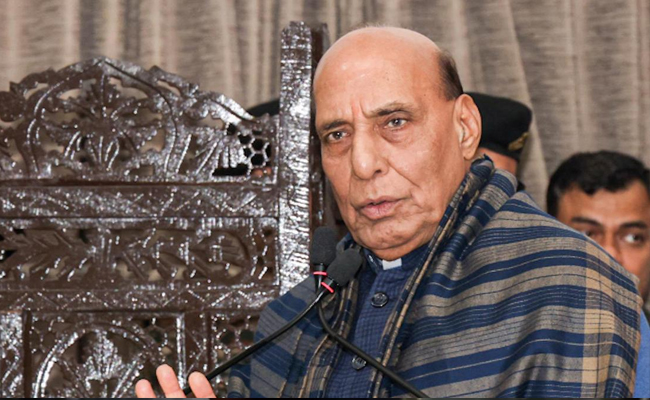
Defence Minister Rajnath Singh said the reforms would lay the foundation for "unprecedented" advancements in defence preparedness and ensure India's security and sovereignty amid challenges of the 21st century.
The defence ministry's aim on theatre commands assumes significance as it virtually indicated the plan to unveil the reform measure in 2025.
Under the theaterisation model, the government seeks to integrate the capabilities of the Army, Air Force and Navy and optimally utilise their resources for wars and operations.
As per the theaterisation plan, each of the theatre commands will have units of the Army, the Navy and the Air Force and all of them will work as a single entity looking after security challenges in a specified geographical territory.
At present, the Army, Navy and the Air Force have separate commands.
The decision on observing 2025 as year of reforms and the broad objectives under it were finalised at a high-level meeting chaired by Singh.
The ministry said the focus in 2025 will also be on new domains such as cyber and space, emerging technologies like artificial intelligence, machine learning, hypersonic and robotics.
"'Year of reforms' will be a momentous step in modernisation journey of the armed forces," Singh said.
In order to give impetus to the ongoing and future reforms, it was unanimously decided to observe 2025 as the 'year of reforms', the ministry said.
The reforms would aim at transforming the armed forces into a technologically-advanced combat-ready force capable of multi-domain integrated operations, it said in a statement.
The Singh-led meeting held that the reforms should aim to further bolster jointness and integration initiatives and facilitate establishment of the integrated theatre commands, according to the ministry.
It was agreed that associated tactics, techniques and procedures required to win future wars should also be developed.
The meeting also called for developing a shared understanding of operational requirements and joint operational capabilities through inter-service cooperation and training.
It also emphasised on the need to make acquisition procedures simpler and time-sensitive to facilitate swifter and robust capability development.
The aim of the defence reforms also include rolling out steps to facilitate technology transfer and knowledge sharing between the defence sector and civil industries and promoting public-private partnerships by improving ease of doing business.
The meeting also underlined the need for focusing on collaboration across various stakeholders in the defence ecosystem and breaking silos.
It said the ministry should work towards positioning India as a credible exporter of defence products, fostering R&D and partnerships between Indian industries and foreign original equipment manufacturers.
It also pitched for instilling a sense of pride in Indian culture and ideas, fostering confidence in achieving global standards through indigenous capabilities, while imbibing best practices from modern militaries that suit the nation's conditions.
Let the Truth be known. If you read VB and like VB, please be a VB Supporter and Help us deliver the Truth to one and all.
KMES Institutions shine in SSLC result, continue four-decade legacy of education in rural Karkala
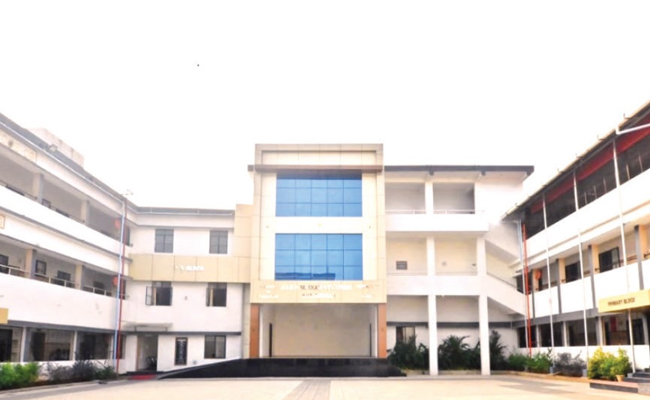
Karkala: KMES Institutions of Education at Kukkundooru in Karkala taluk has recorded outstanding results in the 2025-26 SSLC and PUC examinations, continuing a four-decade educational journey that began with just 22 kindergarten students and no building of its own.
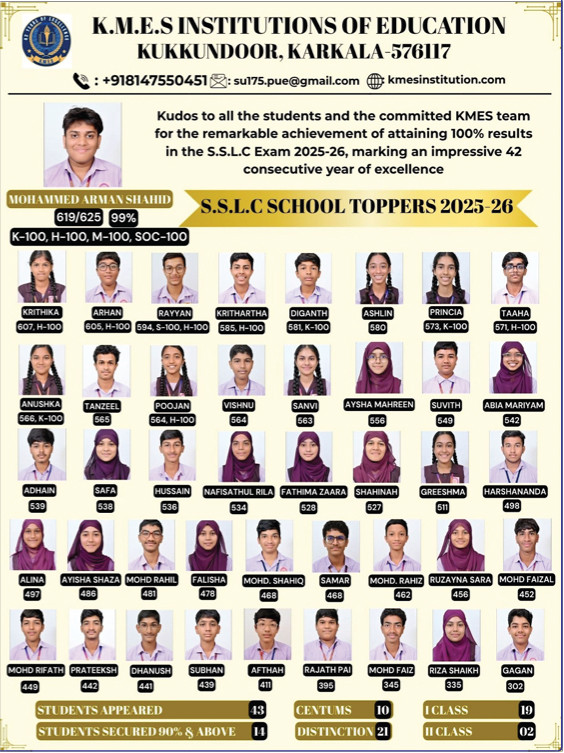
The institution secured a 100 per cent result in the SSLC examinations, with all 43 students passing the examination this year.
Muhammad Arman Shahid emerged as the school topper by scoring 619 marks out of 625, securing 99 per cent and also ranking sixth at the state level. He scored full marks in Kannada, Hindi, Mathematics and Social Science.
Krithika V. Nayak secured the second position in the school with 607 marks and 97.12 per cent, while Arhan stood third with 605 marks and 96.8 per cent.
Out of the 43 students, 21 passed with distinction, 19 secured first class, two students obtained second class and one student passed in third class. Fourteen students scored above 90 per cent.
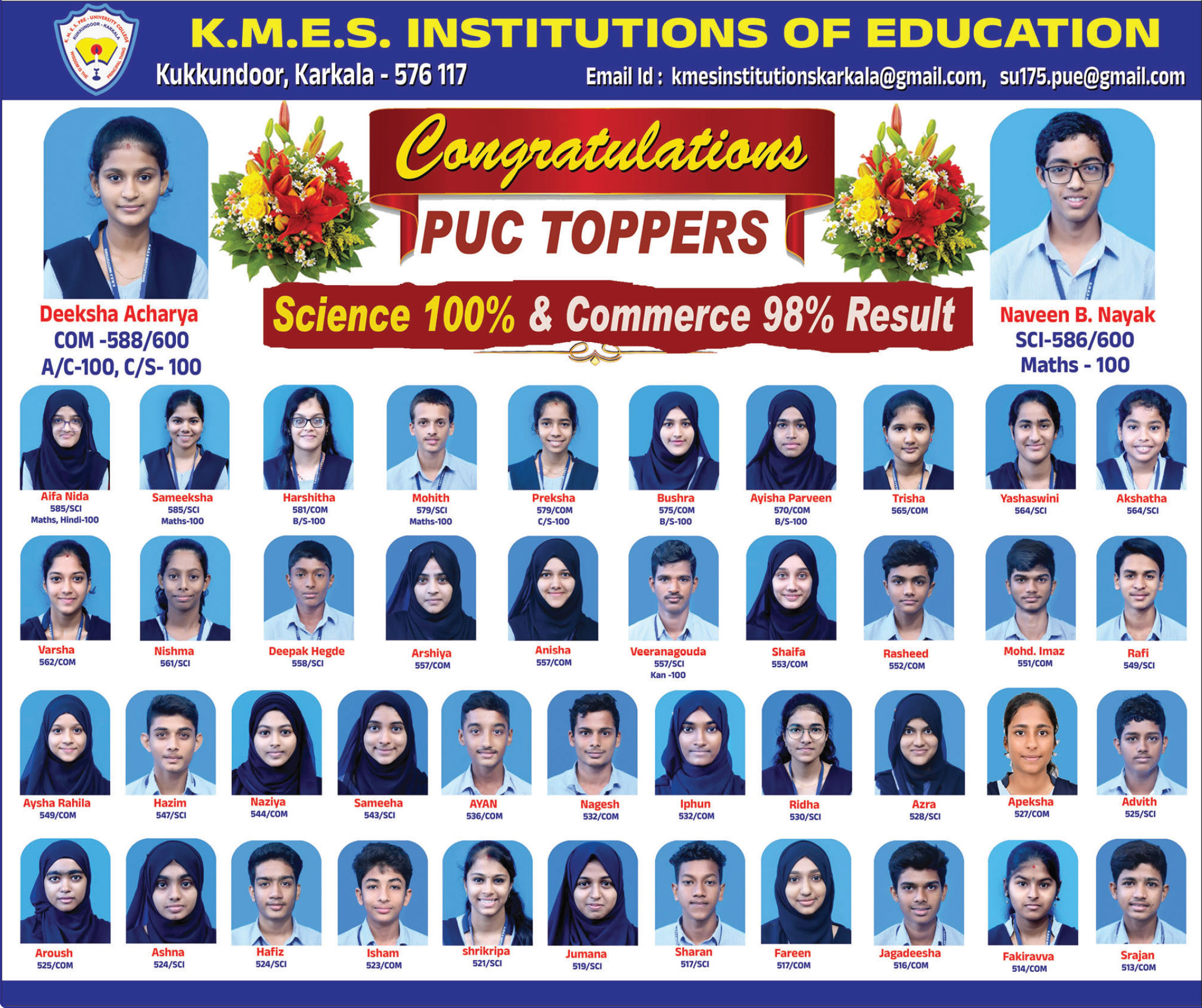
The institution also performed strongly in the PUC examinations. The Science stream recorded a 100 per cent result, with all 44 students passing, while Commerce secured a 98 per cent pass percentage.
Twelve students scored full marks in different subjects, including Mathematics.
In Commerce, Deeksha Acharya topped the college with 588 marks, while Harshitha H. Kini secured the second position with 581 marks.
In Science, Naveen B. Nayak emerged as topper with 586 marks, followed closely by Sameeksha Moily and Aifa Nidha, who both secured 585 marks.
Speaking about the achievement, High School head teacher Shrimati Patkar said the institution has always focused on supporting academically weak students through affordable education and free special classes.
“Our ambition is to provide quality education even to students who struggle in studies. The fees are very low, and free coaching classes are conducted. I have worked here for 28 years and have always found the atmosphere supportive of education,” she said.
Primary School head teacher Lolita Zeena D’Silva appreciated the dedication of the teaching staff and said the school encourages students not only to achieve high marks but also to become role models.
PU College Principal Balakrishna Rao said the institution focuses on value-based education and overall personality development.
“The aim is to help students succeed not only academically but also in cultural activities, sports and leadership. We encourage qualities such as patience, tolerance and discipline,” he said.
Rao also credited the institution’s growth to the support of founders K.S. Mohammed Masood and K.S. Nissar Ahmed, along with President K.S. Imtiaz Ahmed.
Speaking on the occasion, Imtiaz Ahmed said the institution was built on the dream of making quality education accessible to financially backward families in rural areas.
He said the guidance and encouragement of his elder brothers, Mohammed Masood and Nissar Ahmed, along with the contribution of teachers, students and parents, helped transform the institution into a model educational centre.
The KMES Institutions trace their roots back to 1984, when they were founded by senior social activists Haji P.M. Khan, K.S. Nazeer Ahmed and Haji A.S. Rashid Haider.
The institution initially functioned from the Government Urdu School premises as it did not have a building of its own. Classes began with only 22 students in lower kindergarten and two teachers.
Later, under the leadership of K.S. Mohammed Masood and with continuous financial and moral support from non-resident businessman K.S. Nissar Ahmed, the institution gradually expanded.
In 1993, the school shifted to its own building and began conducting classes from LKG to Class 5.
As student admissions increased, Nissar Ahmed personally funded the construction of three additional classrooms to address infrastructure shortages.
The institution’s new school building was completed in 1997, while the PU College building was constructed in 2001.
From humble beginnings in a borrowed building to producing state-level rank holders and consistent academic results, the KMES Institutions have grown into one of the prominent educational centres in the Karkala region.